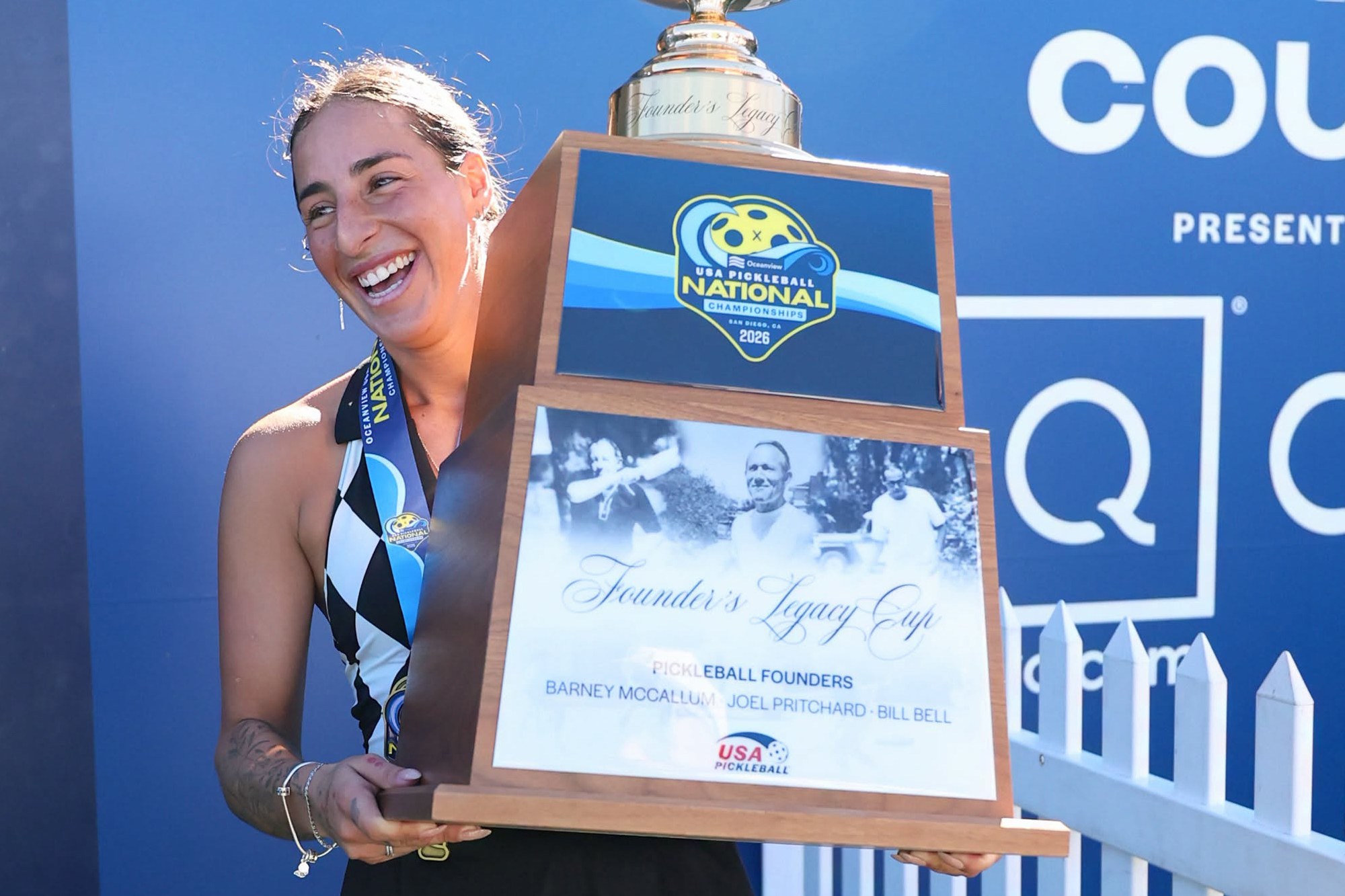
Seone Mendez won gold in Pro Women’s Singles. Photo Credit: USA Pickleball
USA Pickleball: Where Champions Are Made
Nearly 2,500 athletes converged on San Diego for nine days of competition, extraordinary performances and the opportunity to earn one of pickleball’s most meaningful titles
By Adriana Falco
November 11, 2026 • 14 min read
The Meaning of a National Championship
On November 8, the final day of the 2026 Oceanview USA Pickleball National Championships, professional athletes stepped onto the championship court at Barnes Tennis Center in San Diego with national titles and a share of a $225,000 prize purse at stake. For the finalists, months of preparation and a demanding week of competition had come down to the matches that would determine who left California as a national champion.
Yet the significance of Nationals extended far beyond the professional spotlight.
Over nine days, nearly 2,500 athletes competed across 54 courts, representing 46 states and 12 countries. Among them were seasoned professionals, ambitious juniors, collegiate competitors, wheelchair athletes and amateurs whose journeys to San Diego had begun months earlier at qualifying tournaments throughout the country.
The youngest competitor was eight years old. The oldest was 86.
For some, a national championship represented an important professional achievement. For others, earning a place in the tournament was itself the culmination of years of dedication. Their circumstances differed, but the ambition was shared: to compete against the best players in their respective divisions and pursue a title that could only be earned on the court.
While financial rewards have become an increasingly visible part of professional pickleball, the opportunity to call oneself a USA Pickleball National Champion carries a distinction that extends across generations, abilities and competitive levels.
It is a title rooted in the sport’s history, supported by a qualification structure and recognized throughout the competitive pickleball community.
For nine days in San Diego, that pursuit brought together athletes whose paths to the championship were as varied as the sport itself.
Earning the Right to Compete
The USA Pickleball National Championships have occupied a distinctive place in the sport’s competitive history for nearly two decades. Long before professional pickleball attracted substantial investment, major sponsorships and national broadcast attention, Nationals established a championship tradition centered on competitive achievement.
The 2026 event continued that legacy while demonstrating how much the sport has evolved.
USA Pickleball’s amateur championship is distinguished by its qualification requirements. Rather than relying solely on open registration, the organization provides established pathways through its Golden Ticket tournaments and Tiered Point System, connecting sanctioned competition throughout the season with the opportunity to participate at Nationals.
Gold medalists at Golden Ticket events receive priority registration access, while players can also accumulate qualifying points through performances at USA Pickleball-sanctioned tournaments. The system recognizes results across different levels of competition, with higher-tier events carrying greater weight.
For athletes pursuing Nationals, the process transforms individual tournaments into steps toward a larger objective. A regional event becomes more than a weekend competition. A difficult draw provides an opportunity to earn valuable points, while a medal may bring a player closer to qualifying for the national stage.
The structure reinforces the importance of preparation and consistency. These pathways encourage athletes to compete throughout the season, rewarding competitive achievement while creating opportunities for players across age and skill divisions to pursue a national championship.
USA Pickleball CEO Mike Nealy emphasized the significance of that standard when the organization announced the championship’s return to Barnes Tennis Center.
“This event represents the very best of our sport, athletes who have earned their way to the highest stage, competing with integrity, intensity, and respect,” Nealy said.
The qualification process gives Nationals a meaning that cannot be measured solely by the final results. For many amateurs, the opportunity to compete represents a personal milestone, regardless of whether they ultimately reach the podium.
Rob Boswell, a competitor in the 60-plus championship qualifying field, expressed that perspective during an interview with FOX 5/KUSI.
“This might be one of my few chances of qualifying and winning a National Championship,” Boswell said.
His observation underscored the importance of an opportunity that may not come along often. For some athletes, Nationals is an annual goal. For others, it may represent a rare chance to compete for a national title after years of commitment to the sport.
The achievement begins with qualification. What follows is the opportunity to prove oneself against others who have earned the same distinction.
San Diego’s Championship Stage
The return to Barnes Tennis Center for a second consecutive year reflected USA Pickleball’s growing relationship with San Diego and the facility’s ability to accommodate a major national championship.
The 2025 event had already demonstrated the potential of that partnership. USA Pickleball reported more than 10,000 in total attendance, over 2,500 competitors and more than 3,900 matches, with an estimated economic impact of $3 million for the region.
A significant part of the championship’s investment has been the transformation of Barnes Tennis Center into a premier pickleball destination. For the 2026 event, USA Pickleball converted 11 tennis courts into 30 pickleball courts, investing nearly $150,000 in the temporary conversion and subsequent restoration of the facility. The effort reflects the organization’s commitment to providing a championship-caliber environment and maintaining the highest standards for competitive play.
For 2026, the event again brought thousands of athletes, family members, officials and spectators to Southern California, reinforcing San Diego’s growing presence within the national pickleball community.
The venue offered more than competition space. The championship experience extended into a Fan Village featuring sponsor activations, equipment demonstrations, merchandise and interactive activities. Spectators could explore new products, test their skills and engage with the businesses and organizations supporting the sport.
Professional championship matches also reached viewers through streaming coverage on platforms including QVC+ and HSN+, extending the event’s visibility beyond those attending in person.
The expanding presentation reflected pickleball’s development into a sport capable of supporting major national events with substantial commercial participation.
Oceanview Life and Annuity became the championship’s title sponsor in 2026, marking a new partnership for USA Pickleball’s premier event.
“This partnership marks an exciting new chapter for our National Championships and the continued rise of pickleball nationwide,” Nealy said when the sponsorship was announced in May.
The relationship demonstrated the growing interest among national businesses in reaching pickleball’s broad demographic, which includes athletes and recreational players across multiple generations.
For USA Pickleball, the challenge is to balance that expanding commercial interest with the competitive traditions that have given Nationals its identity. The 2026 championship illustrated how those priorities can coexist, combining professional prize money, national sponsorships and broadcast coverage with championship opportunities for amateurs across age and skill divisions.
The scale had grown, but the central purpose remained the same: bringing qualified competitors together to determine national champions.
And while the professional finals would eventually command the spotlight, the opening days belonged to the generations and divisions that reveal the full breadth of competitive pickleball.
The Generations Shaping Pickleball
The opening weekend of Nationals offered a compelling view of the sport’s changing competitive landscape.
Junior boys’ and girls’ doubles began on October 31, followed by junior singles and mixed doubles on November 1. For young athletes, competing at Nationals provided an opportunity to experience the pressure and expectations of a national championship at an early stage in their development.
The youngest competitor was just eight years old, a remarkable reminder of how quickly pickleball is reaching new generations.
USA Pickleball CEO Mike Nealy highlighted the tournament’s extraordinary age range during an interview with FOX 5/KUSI.
“We have an 8-year-old competing and an 86-year-old,” Nealy said. “There’s no age limit and we’re finding it go younger and younger, it’s growing like crazy.”
The presence of young competitors reflected a significant shift in the sport’s identity. Pickleball has long been associated with older recreational players, but junior development programs, organized tournaments and dedicated coaching opportunities are introducing the game to athletes who may grow up considering it their primary competitive sport.
For these players, Nationals introduces them to higher levels of competition, unfamiliar opponents and the demands of performing in a championship environment. The experience can become an important part of their athletic development, regardless of the outcome.
The 2026 tournament also marked an important milestone for collegiate pickleball.
For the first time, the APP Selkirk U.S. Collegiate Series Championships launched its season alongside Nationals, bringing college athletes into one of the sport’s most established competitive settings.
The addition reflected the increasing organization and visibility of collegiate pickleball, a rapidly developing segment of the sport. By bringing collegiate competition alongside Nationals, the championship provided an opportunity to connect emerging athletes with the broader competitive pickleball community and showcase the sport’s growing presence on college campuses.
Collegiate participation creates a bridge between junior development and adult competition while helping establish pickleball as an organized athletic pursuit during the college years. It also connects emerging talent with a national championship tradition that predates much of the sport’s recent growth.
At the opposite end of the age spectrum, older athletes continued to demonstrate the sport’s remarkable longevity.
Competition extended into age divisions for players in their 80s, with singles, doubles and mixed doubles offering opportunities for national titles. CBS 8 reported during the event that nearly half of the competitors were at least 60 years old.
Experience, anticipation and strategic decision-making can be especially valuable in age-group competition. Players who have spent years developing their games understand how to construct points, recognize patterns and use court positioning to create opportunities.
For some, pickleball represents a continuation of a lifelong commitment to athletics. Others may have discovered the sport later in life and found an unexpected competitive outlet. Nationals gives both groups an opportunity to pursue meaningful goals against their peers.
The championship also provided a national stage for wheelchair and hybrid competition.
Wheelchair co-ed doubles opened on October 31, followed by wheelchair singles and hybrid doubles during the early days of the event. These divisions highlighted the athletic skill, tactical awareness and competitive determination required in adaptive pickleball.
Their inclusion reinforced USA Pickleball’s commitment to expanding competitive opportunities for athletes of all abilities, ensuring wheelchair and adaptive athletes have a meaningful platform to compete for national titles alongside the sport’s broader competitive community.
The breadth of competition was one of Nationals’ defining characteristics. Juniors, collegiate athletes, wheelchair players, amateurs, older competitors and professionals pursued titles within the same championship environment, each facing the demands of their respective divisions.
Together, they demonstrated a sport capable of supporting meaningful competition across an extraordinary range of ages and abilities.
As those divisions progressed through the week, the professional draws moved toward their own decisive moments, bringing another dimension of the championship into focus.
Championship Sunday: The Pros Deliver

By the final weekend, the professional divisions had narrowed to the contenders competing for national titles and a share of the $225,000 prize purse.
The championship matches produced several notable performances, including comeback victories, dominant singles results and a two-gold-medal achievement that made Richard Livornese Jr. one of the weekend’s standout competitors.
In men’s doubles, Livornese partnered with Jack Munro against Jayden Broderick and Zack Card.
The championship began with a setback for Munro and Livornese, who lost the opening game 8–11. The pair responded with an 11–6 victory in the second game before closing out the match 11–5, securing the national title.
The three-game result demonstrated the importance of adjusting under pressure, particularly against opponents capable of taking control early in a championship match.
Livornese’s success continued in mixed doubles, where he partnered with Katerina Stewart.
Their opponents were Munro and Roos Van Reek, creating an intriguing championship matchup in which Livornese faced the same player with whom he had just won men’s doubles gold.
Livornese and Stewart captured the title, 11–5, 12–10, completing a double-gold performance for Livornese.

For Munro, the weekend produced two medals, gold in men’s doubles and silver in mixed doubles. For Livornese, it represented an exceptional achievement across two disciplines.
The women’s doubles championship featured another comeback. Vivian Glozman and Roos Van Reek faced Katerina Stewart and Bobbi Oshiro, dropping the opening game 9–11. Glozman and Van Reek then took control of the match, winning consecutive games 11–5, 11–5 to secure the national title.

The result gave Van Reek a gold medal to accompany her mixed doubles silver, while Stewart finished the championship with mixed doubles gold and women’s doubles silver.
The overlapping results illustrated the depth and versatility required of players competing across multiple professional events, where partners in one discipline can become opponents in another.
In men’s singles, Ronan Camron claimed the national championship with an 11–8, 11–5 victory over Andre Millet.
Camron had already demonstrated his ability to recover from adversity in the semifinals, where he lost the opening game against Ryler DeHeart before winning the next two to advance.
His championship victory completed a successful progression through a demanding singles draw, where players must rely on individual court coverage, endurance, shot selection and the ability to adjust without a partner.
The women’s singles final produced one of the most decisive results of Championship Sunday.
Seone Mendez defeated Bobbi Oshiro, 11–0, 11–4, delivering a commanding performance to claim the national title.

Mendez had faced a considerably different challenge in the semifinals, recovering from an opening-game loss against Stewart to secure her place in the final. Her ability to navigate that difficult match before producing such a decisive championship result highlighted the changing demands of tournament competition.
The five primary professional championships showcased different paths to victory. Some champions recovered from early deficits, while others delivered dominant performances when the title was on the line.
Livornese’s double gold provided one of the weekend’s defining achievements, while the singles victories of Camron and Mendez added important accomplishments to their competitive careers.
For the professional athletes, the medals represented more than another tournament result. They were national championships earned against competitive fields, with performances that would become part of the sport’s 2026 record.
Yet even as the professional finals determined the weekend’s most visible winners, the amateur competition remained central to what made Nationals distinctive.
Beyond the Spotlight
Across the age and skill divisions, players competed for medals that carried no comparable professional prize money but represented achievements of considerable personal significance.
Their experiences reflected the unpredictable nature of competitive pickleball.
Maryland resident Lisa Munzer, who competed at the championship, described the challenges of tournament play during an interview with FOX 5/KUSI.
“I play every single day,” Munzer said. “There were a couple of teams we probably should have beaten, but that’s the nature of pickleball. You just never know what you’re going to get.”
Her comments captured the uncertainty that makes competition compelling.
Preparation and experience can improve a player’s chances, but neither guarantees a result. A difficult opponent, a shift in momentum or a handful of errors can determine whether a team advances or sees its championship hopes end.
At Nationals, those moments carry additional significance because reaching the tournament has often required months of effort.
For amateur athletes, the journey may include sanctioned tournaments, training sessions, travel, financial commitments and the challenge of balancing competition with professional and family responsibilities.
A national championship becomes a goal pursued alongside the demands of everyday life. The resulting achievements deserve recognition, even when they do not generate the same attention as professional victories.
A junior competing in a first national championship may gain experience that influences an entire athletic career. An older player may earn a medal after years of working to improve. A wheelchair athlete may achieve a significant competitive milestone, while a collegiate competitor may discover new ambitions on the national stage.
Some athletes leave with gold medals. Others return home having advanced farther than expected or having competed against opponents they once considered beyond their abilities.
For USA Pickleball, maintaining meaningful amateur competition alongside professional events is an important part of the championship’s identity. The professional landscape may continue to change, but the amateur community remains a substantial part of the sport’s foundation.
Nationals connects those two worlds, giving players at different competitive levels a place within the same national championship tradition.
Preserving that connection becomes increasingly important as pickleball’s participation, commercial opportunities and competitive structures continue to evolve.
Preserving a Championship Tradition
The 2026 Nationals illustrated the opportunities and responsibilities that accompany pickleball’s continued growth.
As participation expands, the sport requires increasingly sophisticated competition structures, consistent standards and facilities capable of accommodating large national events.
USA Pickleball’s qualification pathways, sanctioned tournament system and championship organization provide a framework through which athletes can pursue recognized competitive achievements.
As the National Governing Body for pickleball in the United States, USA Pickleball plays a central role in establishing the standards, competitive structures and development pathways that support the sport’s continued growth. The National Championships represent an important expression of that responsibility, bringing together athletes competing under a consistent framework designed to promote fairness, integrity and competitive excellence.
That commitment to competitive integrity was further demonstrated through USA Pickleball’s expanded on-site paddle testing program at the 2026 National Championships. By bringing equipment compliance verification directly to amateur competition, the organization reinforced its commitment to maintaining consistent standards, protecting fair play and ensuring athletes compete on a level playing field.
The use of DUPR as USA Pickleball’s official rating system also reflects the growing importance of standardized competitive measurement and consistent competition structures.
These developments may receive less public attention than professional championship matches, but they help establish the structure necessary for a sport seeking long-term competitive credibility.
The championship’s nearly two-decade history provides continuity at a time when professional tours, commercial partnerships and participation patterns continue to evolve.
Nationals brings those elements together while preserving a central principle: a national title should represent an achievement earned through competition.
For USA Pickleball, the championship serves as both a celebration of athletic excellence and a reflection of its responsibility to support the sport’s continued development.
Its significance is found not only in the winners it crowns, but also in the competitive opportunities it creates for athletes across the country.
The 2026 event offered a particularly compelling example of that mission, bringing together competitors separated by generations but connected through their pursuit of national recognition.
Where Champions Are Made
When the final matches concluded on November 8, the 2026 Oceanview USA Pickleball National Championships had crowned another generation of national champions.
The professional winners left San Diego with prestigious titles and their share of the prize purse. Amateur champions returned home with medals representing months, and sometimes years, of preparation. Junior, collegiate, wheelchair and senior competitors had demonstrated the remarkable range of athletic talent within the sport.
For those who finished short of the podium, the championship provided experience, perspective and new goals.
The results will remain part of pickleball’s competitive history, but the larger significance of Nationals is found in the opportunities it creates.
Few sports bring together eight-year-olds and 86-year-olds within the same national championship. Fewer still provide such a broad range of competitive divisions, allowing athletes with vastly different backgrounds and abilities to pursue recognized national titles.
Professional athletes delivered performances worthy of the spotlight, but the thousands of amateurs who earned their places at Barnes Tennis Center were equally important to the event’s identity.
Their participation reflected a sport whose appeal extends across generations and whose future depends on maintaining meaningful pathways for athletes at every level.
For USA Pickleball, the championship represented another chapter in a tradition that has grown alongside the sport itself.
For the competitors, the experience was more personal.
Each had arrived in San Diego with a goal. Some achieved it. Others discovered how much further they wanted to go.
The medals identified the winners, but the championship revealed something larger: the commitment required to earn the opportunity to compete for a national title.
At USA Pickleball Nationals, champions are crowned on the court. The journey that makes them champions begins long before they arrive. ●

About Adriana Falco
Adriana Falco is the Founder and Editor-in-Chief of The Pickleball Weekly, a global digital magazine reaching readers in over 125 countries across six continents. A pickleball player since 2012, she combines more than 25 years of executive leadership with a passion for storytelling that captures every facet of the sport. With a career from international technology companies to major news organizations, Adriana covers the people, businesses, innovations, and global trends shaping pickleball’s future, with a mission to connect and inspire the worldwide pickleball community through credible journalism and compelling stories. She is also the author and creator of the Pickleball Pip children’s book series.

Read the full magazine issue! Click below, then tap Full Screen for the best reading experience.