The Ball Does Not Lie
How Pickleball Practices the Player
By Lingbing Zhang • September 23, 2026 • 8 min read
AS A PICKLEBALL coach, I see it every week. Most people pick up a paddle for obvious reasons. It is fun. It is social. It is easy to begin and difficult to master. The court is small, the game moves quickly, and a Saturday morning can feel like a workout without feeling like punishment.
All of that is true. But after years of standing on the courts, watching the same patterns repeat themselves, I know it is also incomplete.
Stay with pickleball long enough, and you begin to realize that what the game is really practicing is not the ball.
It is the person holding the paddle.
The ball is only the messenger. Every rally is a short, honest conversation with yourself.
The Court as a Mirror
Pickleball compresses life into a small rectangle.
There is not much room to hide. I tell my students this constantly: you cannot always outrun a poor decision or cover a bad habit with athleticism. The game happens close to you, quickly and repeatedly. Your partner sees you. Your opponents see you.
More importantly, you see yourself.
I have watched the same third-shot drop get missed two times in a row, and then watched what happens next. Do you tighten up? Do you blame the wind, the paddle, or the partner who “should have been there”? Do you become afraid to try the shot again?
Or can you accept the mistake, quiet your mind, and play the next ball?
That moment is the real practice. Coaching the stroke is the easy part. Coaching that moment is the work.
The ball does not care about your age, profession, status, or how good you believe you are. From where I stand, it simply reports what happens when skill meets a little pressure, fatigue, uncertainty, and pride.
In that sense, the ball does not lie.

What the Game Asks of You
Patience.
The drop, the reset, the dink rally: none is especially glamorous. They reward the player who can wait.
Many players arrive on court already in a hurry. They want to finish the point, hit the winner, look competent, prove that they belong. Pickleball has a remarkably efficient way of punishing that impulse. I have seen it waste more points than a weak serve ever will.
Again and again, the game teaches a simple lesson I repeat often: the right opportunity cannot always be forced.
Sometimes patience is not passive. It is the discipline to wait until the right moment to act.
Presence.
The ball is coming.
If your mind is still arguing with the last unforced error, you may miss this one too. I see it in the eyes before I see it in the paddle: a player still living one point behind. Pickleball continually pulls you back to the point in front of you.
Over hundreds and thousands of rallies, returning becomes a habit. Players begin to notice sooner when the mind has wandered backward into regret or forward into anxiety.
And they learn to come back. That, more than any new shot, is what I am trying to teach.
Humility.
Few things expose the ego as efficiently as a game that looks easy until you try to become good at it. I have coached people who were excellent at almost everything else in their lives and then watched them pop up an easy dink, miss a serve or let a passing shot sneak by at the kitchen.
You will lose to someone you quietly assumed you should beat.
The question is not whether these things happen. They will. The question is what happens to you afterward. That is the part I watch most closely.
Can you laugh? Can you learn? Can you appreciate the other player’s skill? Can you remain curious when your pride would rather produce an excuse?
Pickleball reminds us, as I remind my students, that confidence is useful, but confidence without humility is fragile.
Partnership.
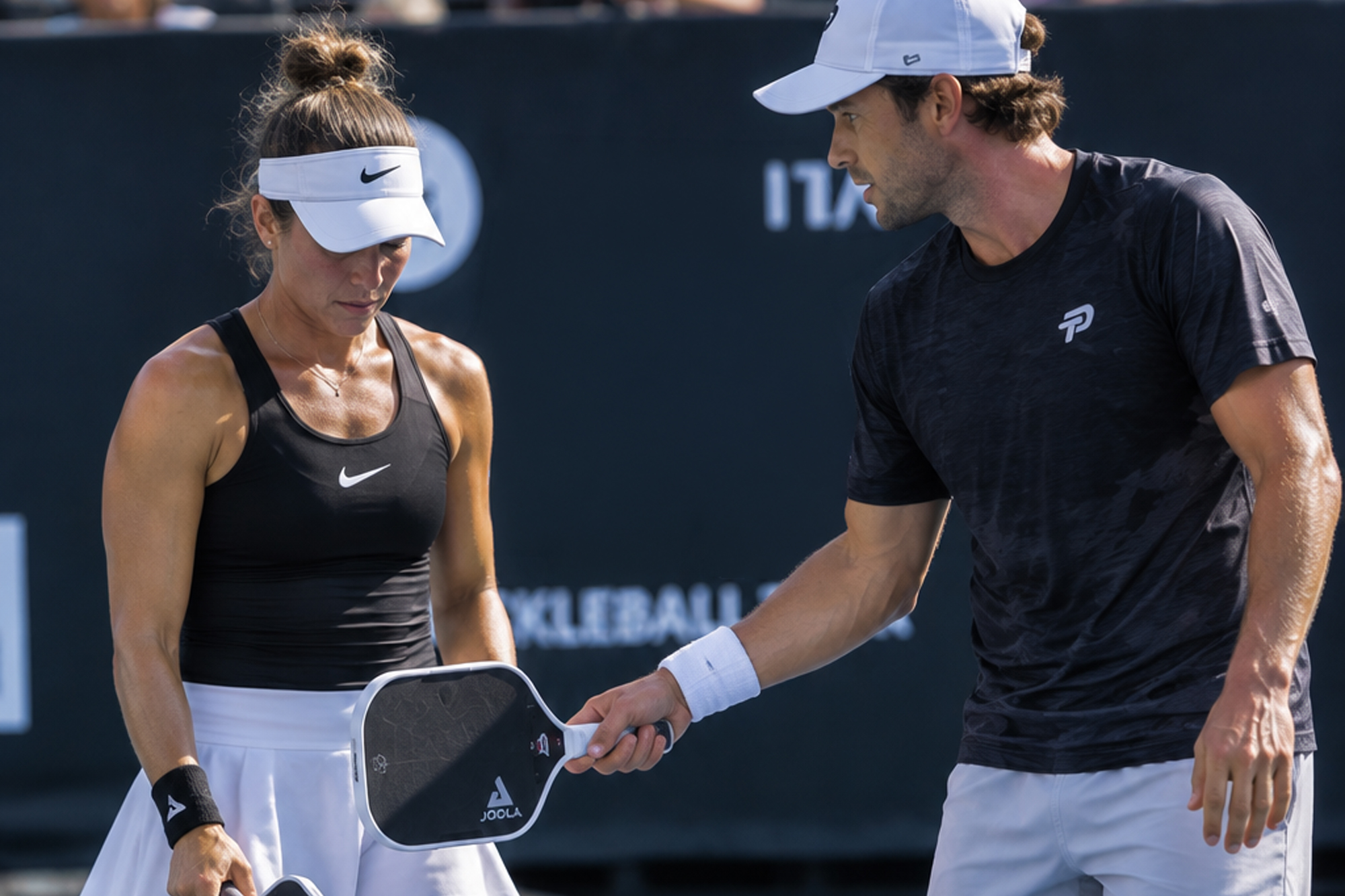
For most players, doubles is at the heart of pickleball. And doubles reveals something important that no drill quite captures: how you behave when your success depends partly on another person.
What happens when your partner misses an easy ball at 9–9?
Do you encourage them? Go silent? Roll your eyes? Try to take every ball yourself?
I have seen all of it. The court makes our relational habits visible. Trust, generosity, communication, impatience, control: they all eventually appear between the points.
And then something wonderful happens.
The next point begins, giving us another chance to be a better partner. That reset is one of the quiet gifts of the game, and one I try never to waste in a lesson.
Resilience.
Points end. Games end. Winning streaks end. Losing streaks end.
You walk to the other side and begin again.
Pickleball leaves little room for an extended performance of frustration because another ball is already coming. I have coached players who wanted three minutes to process a bad point. The game does not give it to us. The next serve does not care how unfair the previous point felt.
That rhythm becomes a quiet education in letting go.
Finding Out Who You Are
People often say that sport builds character.
From the coach’s chair, I think sport does something before that. It reveals character.
Then, if we are willing to pay attention, it gives us a place to change it.
On a pickleball court, I watch players discover how they speak to themselves after a mistake. I watch whether they can genuinely appreciate an opponent’s beautiful shot. I watch how quickly they recover from embarrassment, whether they play primarily to connect or to dominate, and what kind of competitor they become when the score gets tight.
These are not abstract philosophical questions.
They appear in the body, the voice, the expression on a face, and the half-second before a player decides what to do next.
And those half-seconds accumulate.
You are not merely learning to place a plastic ball three inches above a net.
You are rehearsing a way of being. That is what I am actually coaching, even when we pretend we are only working on the drop.
Perhaps that is why players sometimes sound surprised when they describe what pickleball has come to mean to them. They started because they wanted exercise, competition, or friendship.
They stayed because somewhere along the way, something inside them became clearer.
Practicing the Human Being
Talking about becoming “a better human being” can sound grand.
Pickleball makes the idea wonderfully ordinary. That is one reason I love coaching it.
Becoming better might simply mean becoming harder to upset and easier to play with.
It might mean becoming more honest about your own limitations and more generous toward someone else’s.
It might mean learning to compete intensely without becoming hostile, to care deeply without making the result a judgment of your worth, and to lose without needing an excuse.
It might mean leaving the court slightly different from the person who walked onto it.
Not perfected. Just a little more aware.
The ball is still only a ball. The paddle is still only a paddle. There is no magic in the equipment. I have never seen a paddle fix a player’s relationship with pressure.
The transformation, if there is one, comes through repetition: facing yourself under pressure, in public, with consequences small enough to be safe but real enough to matter.
Practice long enough, and something subtle begins to happen. I have seen it enough times to trust it.
You think you are practicing your drop shot. But you are also practicing patience.
You think you are practicing your reset. But you are practicing how to recover.
You think you are learning to play with a partner. But you are practicing trust, generosity, and restraint.
You think you are learning how to compete. But perhaps you are learning how to meet difficulty without losing yourself.
The ball does not lie. It keeps returning, asking the same quiet question I eventually ask every player:
Who are you going to be on this point?
And then it gives you another chance to answer. That may be the real beauty of pickleball. We come to practice the game.
And, without quite realizing it, the game practices us.
Lingbing Zhang
Lingbing Zhang is a PCI Certified Coach and avid pickleball player based in the San Francisco Bay Area. He developed the Jigsaw Pickleball Training Theory, a practical system that helps players improve by breaking the game into interconnected, easy-to-master skills. Through coaching, competition, and community involvement, he is passionate about helping players of all levels build confidence and elevate their game.

Read the full magazine issue! Click below, then click on the X in the lower bar to enjoy a full screen view!