
The Rainermaker: Riding the Waves to Team USA
By Adriana Falco • August 26, 2026 • 16 min read
From local courts to the world stage
A ROGUE WAVE nearly took racquet sports away from Steve Rose. Instead, it eventually gave him pickleball.
Rose was in his early 50s when a hurricane brought him to a jetty in Boca Raton, Florida. A wave swept across the structure, knocked him off his feet and shattered his ankle so badly that the rounded portion of the bone broke away from the longer section. Two surgeries followed. The ankle never fully returned to normal, and the running required for the racquetball, squash and tennis he had played for decades suddenly became much more difficult.
About a year into rehabilitation, Rose noticed a newspaper listing for something called pickleball at a YMCA in Delray Beach. Four courts had been set up inside a gymnasium. He showed up and was handed one of the early paddles common to the time. Rose soon realized he had found a sport that allowed him to use much of what he had learned through a lifetime of racquet competition without asking his damaged ankle to do quite as much.
That was around 2016.
A decade later, Rose is preparing for his third year as the overall coordinator of Team USA for the Pickleball World Cup, after two years as also the Team USA Senior Captain.
He has helped assemble the five national teams across Kids, Junior, Pro, Senior and Master divisions for the 2026 USA Team and is the key organizer behind recruiting players and coaches, raising sponsorship funds, and building the support system surrounding the American delegation.
And after years spent putting other people onto World Cup rosters, Rose is finally on one himself.
Rose, who also competes with the Palm Beach Royals Masters team, will represent the United States in the Master division in Da Nang.
The path from a shattered ankle in Boca Raton to a Team USA jersey in Da Nang was anything but planned. But looking back, nearly every piece of Rose’s life seems to have prepared him for it.
A Competitor Before Pickleball
Rose was born at Fort Hood, Texas, while his father was serving in the Army. His father later worked for Scott Paper Company, and the family moved frequently, from Texas to Philadelphia, Chicago and Mobile, Alabama, before the Rose family eventually landed in Fort Lauderdale, Florida when Rose was at age 12.
Growing up, sports were always part of the picture. There were baseball and football, a ping-pong table in the garage, some tennis and eventually racquetball, which became serious once Rose reached middle school. By his early 20s, he had climbed as high as seventh in Florida at the A level and competed at Florida State University, where fraternity competitions put him into everything from badminton and ping-pong to foul shooting and racquetball.
He kept playing racquetball through his 20s and 30s before adding squash in his 40s and 50s. Surfing remained another constant, a water sport he had first picked up as a 12-year-old boy after moving to South Florida.
Even now, traces of those earlier sports remain visible in his pickleball game. Rose jokes that he can quickly identify a racquetball player by their wrist action and tennis players by their swing mechanics.
Competition was never something he had to learn when pickleball arrived. He simply found a new place to put it.
“That’s how I have become kind of a rainmaker for pickleball. Anytime I saw anybody with potential at other courts, I’d say, ‘Hey, come to Pompano.’” — Steve Rose
Building a Better Game
Rose quickly discovered that finding pickleball was one thing. Finding the level of play that he wanted was another.
The YMCA games were enjoyable, but many of the players were considerably older, and weekday morning sessions did not fit his work schedule as custom tailor. Rose moved his play to Caloosa Park in Boynton Beach and began finding stronger games. Then he started forming his own groups.
He invited former squash and racquetball friends to outdoor public courts in Pompano Beach. As his game improved, he began paying attention to promising players elsewhere and inviting them into regular Tuesday and Thursday sessions.
Rose calls himself a “rainmaker.”
“Anytime I saw anybody with potential at other courts, I’d say, ‘Hey, come to Pompano,’” he recalled. “Everybody that’s halfway decent is looking for better games. I was the host of the better game.”
Some of the names that passed through those games would eventually become among the most recognizable in professional pickleball. Leigh Waters and a young Anna Leigh Waters played there. So did Anna Bright and members of the Johnson family.
Eventually, those players found their own circles and their own paths through a sport that was exploding around them. Rose kept doing what came naturally: finding people, bringing them together and creating an environment in which good players wanted to participate.
Only later did he realize that the same skill would become central to building a national team.
“That’s why I think that I have a unique skill set to pull this thing off,” Rose said. “This is not an easy thing to do.”

A Surf Trip Changes Everything
One of Rose’s most important pickleball relationships began with a question about surfing.
He drove for a couple hours to Naples to play recreationally with Steve Kennedy, Kyle Yates and Simone Jardim. Rose did not know Yates well, and someone suggested he ask whether Yates surfed as a conversation starter.
Yates did not, but he wanted to learn. So, Rose invited him to Nicaragua to surf.
The invitation turned into a friendship that soon expanded beyond surfing. Rose and Yates began taking destination surfing trips together and eventually became involved in pickleball getaways in Costa Rica, where mornings could begin with a 5 a.m. surf session and continue with three hours of pickleball instruction before the afternoon opened for exploring.
Through Yates came another important connection: Hercilio Cabieses.
Yates had traveled to Peru to help Cabieses with the early stages of what would become the Pickleball World Cup. Rose heard about the event while the two were together in Costa Rica and asked what was happening in Peru.
Yates asked whether he wanted to bring a team. Rose’s answer was appropriately on brand.
“Sure,” he said. “It’s got waves.”
He ended up bringing two teams.
“It’s a different game, and you really have to have good singles players, because you either go home or you go on.” — Steve Rose
From Two Teams to Five
For the 2024 World Cup in Lima, Rose assembled a Senior Pro team and a Pro team. The Senior Pro squad won gold. The Pro team finished fourth. Rose came home with something else.
“I got a job,” he joked. “I don’t get paid for it, but I got a job.”
This is in addition to his longtime career with the Tom James Company.
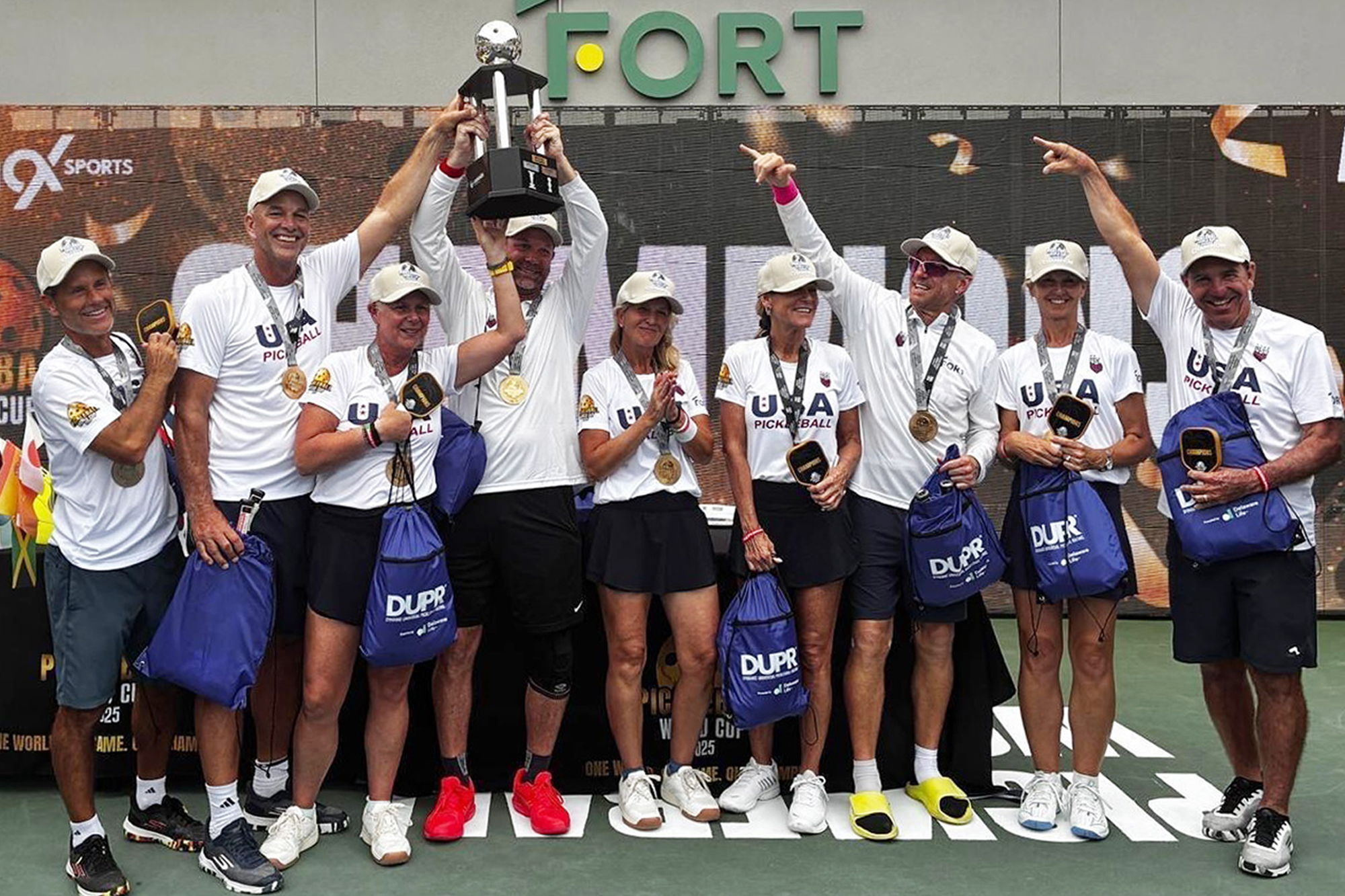
When the World Cup moved to The FORT in Fort Lauderdale in 2025, that job grew. A Junior division was added, giving Rose three U.S. teams to coordinate. He served as overall Team USA coordinator and coached the Senior Pro team, while Kyle Yates coached the Pro squad and Robert Cassidy led the juniors.
The sweep was hardly automatic. Rose remembers the Pro team surviving what he called an “unbelievable” dogfight against Venezuela before ultimately taking gold. By the end of the tournament, the United States had won all three divisions.
Building those earlier teams required more than finding talented players. For the first three years of the World Cup, players were subject to a 5.49 DUPR ceiling, ruling out pro players and turning roster construction into its own strategic exercise. Rose jokes that he became a “DUPR management guy,” constantly searching for players talented enough to compete internationally but still eligible under the cap. Many of his selections landed in the 5.2 to 5.4 range.
This year, that DUPR cap has been removed, opening the Pro division to a significantly deeper pool of talent and changing the recruiting equation for Team USA, although PPA and MLP players remain ineligible until 2027.
The World Cup organizers have also restructured and expanded the competition from three divisions to five. In 2025, the national team competition featured Pro, Senior 50+ and U16. For 2026, the divisions are Kids (under 14), Junior (under 18), Pro, Senior (50+) and Master (60+).
Rose remains the overall coordinator for Team USA, but his role has changed in one important respect. This time, he is also competing in the Masters division.
The complete U.S. delegation includes a Pro roster coached by Kyle Yates and captained by Jack Munro, a Junior squad coached by Robert Cassidy, a Kids team coached by Leah Tauber, a Senior team captained by John Hedberg and a Master team coached by Richard Cho. Rose will compete on that Master roster alongside players including David Spearman, Carol Ann Emanuel, Jean Halahan, Taiche Rudee and FD Wilder, with James Steven Dawson serving as captain.
For someone who spent the previous two World Cups worrying about everybody else’s lineup, earning his own place on one carries a different meaning.

Building Team USA
The Pro roster is largely Yates’ domain. When a player wins at the highest levels, Rose said, there is little need for an elaborate tryout process. Yates knows what he needs and recruits accordingly.
Rose also trusts Yates to manage something every deep roster eventually creates: playing time. During the 2025 World Cup, Yates used early round matches to get more players onto the court, then tightened the rotation as the competition intensified. Rose calls that judgment one of Yates’ strengths. When elimination is on the line, he said, “you can’t make mistakes.”
For the other divisions, Rose draws on the same kind of networking that once built those Pompano Beach games, relying on relationships with players and coaches, tournament scouting, direct outreach and recommendations to identify talent from across the country.
He also held an evaluation event in Boca Raton that helped identify additional players, including Kids team members Dylan Galarza and Kyle Trinidad. Other roster spots came through direct recruiting and conversations with players and families.
Rose compares the process to college recruiting.
“You’re trying to recruit people for your team,” he said.
With younger players, there is another layer.
“The parents need to have trust.”
That means evaluating more than a forehand or DUPR rating. Families are committing to international travel, significant expense and a team environment in which not every athlete will play every match.
Rose has learned that assembling a talented roster is only the beginning.
“I bring organization, I bring communication, and I think I bring a sense of class.” — Steve Rose
More Than a Lineup
The World Cup format makes roster construction particularly strategic, and the Pro division adds another layer. Pro matches begin with singles before moving into gender doubles and mixed doubles. In the other divisions, the regular match format is doubles, with singles entering the equation only if a DreamBreaker is needed.
A DreamBreaker is the deciding tiebreaker when the two teams have each won two matches. Each country team sends out two men and two women to play, rotating players every four points. The DreamBreaker is played to 21, turning individual singles ability into a critical part of what is otherwise a team competition.
That is why Rose pays attention to more than doubles chemistry when assembling a roster. A team can perform well throughout the doubles matches and still find its World Cup run resting on four players’ ability.
He has seen enough World Cup DreamBreakers to know exactly how much that matters.
“You either go home or you go on,” Rose said.
That reality influences how Team USA is assembled from the beginning. A roster filled entirely with strong doubles players can become vulnerable when a match reaches its deciding singles component. Rose wants athletes capable of closing a match alone as well as combinations that work in doubles.
He believes experience has become one of the United States’ advantages.
“It’s been very intentional,” Rose said of roster construction. His experience putting teams and lineups together, he added, has shown him that decision-making and team spirit can be every bit as important as individual ability.
The Americans will need all of it in Vietnam.
Rose expects the host country to be strong, while Australia and Italy have proven difficult in previous competitions. He is also watching the rapidly developing Asian teams, many of which are entering international pickleball with talented athletes from established racquet-sport backgrounds.
Team USA arrives highly seeded across the divisions, but Rose knows firsthand what happens when assumptions meet international competition. In 2025, Australia defeated the U.S. Senior Pro team in its opening match, forcing the Americans to fight through pool play before eventually recovering and winning gold.
Nothing, he says, is a guarantee.

The Family Within the Team
Sometimes Rose’s recruiting produces combinations even he could not have planned. The Dawson family is one example.
Steve Dawson is on the Master roster. His wife, Pickleball Hall of Famer Jennifer Dawson, will compete for the Senior team while their son, Callan Dawson, is part of the Pro squad. Together, they put three members of one of pickleball’s most accomplished families on three different Team USA rosters.
Steve and Jennifer have won numerous major championships and have competed together extensively in Senior Pro mixed doubles. Callan, known as the “Lob Doctor,” has established his own professional career with an unconventional style and exceptional defensive game.
Rose described bringing all three into the delegation as something of a recruiting “coup.” Jennifer had been uncertain about making the trip to Asia, but when Callan joined the Pro roster, the pieces began falling into place.
It is a small example of what Rose has spent years doing at a much larger scale: recognizing connections, finding the right combination and turning separate individuals into something that feels like a team.
Setting the Standard
Rose does not describe his greatest contribution to Team USA as coaching technique or tactical knowledge.
“I bring organization, I bring communication, and I think I bring a sense of class,” he said.
The organization is considerable. There are registrations, passports, uniforms, sponsorships, transportation, lodging and communication across multiple teams filled with players scattered around the country.
The title “Team USA” does not mean an all-expenses-paid trip. Rose says players are largely responsible for their own costs, leaving him to pursue sponsors and other support to help offset the expense of sending five teams halfway around the world.
Rose has built a support group around him rather than trying to handle every responsibility himself. Brenda Hill assists with administration and registrations. Emily Hill manages financial matters. Arisse Fernandez handles social media. Richard Cho assists with uniforms and serves as a sounding board. In Da Nang, Rose even located a local travel professional through Facebook who helped arrange hotels, airport transportation and other logistics.
But the culture matters just as much.
Rose manages separate team communication groups and has a simple rule: bring concerns to him privately and keep the public group positive and encouraging.
The same standard applies once competition begins.
Players will sit. Children who traveled halfway around the world may not get the minutes their parents expected. Deep rosters mean difficult coaching decisions, and difficult decisions can create unhappy benches.
Rose has seen what happens when players disengage. He does not want Team USA looking like that.
He wants the bench to resemble college volleyball or Major League Pickleball, with players standing, cheering and invested in the teammates who are competing, regardless of whether their own name was called.
For Rose, representing the United States means more than wearing the shirt. It means looking and behaving like a team.
The Rainmaker Goes to Vietnam
There is a certain symmetry to how all of this comes together. Rose never set out to make pickleball such a significant part of his life. He found the sport because an ocean wave had taken away the racquet sports he knew and Rose needed a different competitive sport his ankle could still tolerate.
Then he started inviting people.
One player became another. Tuesday and Thursday games became a network. The network produced friendships. One friendship with Kyle Yates led to surf trips, destination pickleball and eventually a conversation about bringing a team to Peru.
Two teams became three. Three became five.
The guy who once stood on the edge of other courts looking for someone who might improve his Pompano game is now helping identify athletes worthy of representing the United States on the other side of the world.
And after years of putting those athletes into position, Rose will finally stand beside them as one.
There is one more piece of the story that feels almost inevitable.
When Rose chose where he would stay in Da Nang, he found a hotel across the street from a surf break. He plans to rent a board and get into the water while he is there.
The ocean once knocked him out of the racquet-sport life he knew. Now it will be waiting across the street when he arrives in Vietnam wearing Team USA colors, preparing to play in a World Cup he helped build from the ground up.
For Steve Rose, it is simply the latest thread woven into an unlikely journey as a pickleball rainmaker.

“I used to sit behind the diamond at high school baseball games with a little cassette recorder and do my own play-by-play, just dreaming that one day that would actually be my job.” — Carl Foster
About Adriana Falco
Adriana Falco is the Founder and Editor-in-Chief of The Pickleball Weekly, a global digital magazine reaching readers in over 100 countries across six continents. A pickleball player since 2012, she combines more than 30 years of executive leadership with a passion for storytelling that captures every facet of the sport. With a career from international technology companies to major news organizations, Falco covers the people, businesses, innovations, and global trends shaping pickleball’s future, with a mission to connect and inspire the worldwide pickleball community through credible journalism and compelling stories.

Read the full magazine issue! Click below, then click on the X in the lower bar to enjoy a full screen view!
