Beyond the Court: Robert Doyle on Faith, Resilience, and the Adaptive Edge
By The Pickleball Weekly Editorial Team • Mar 25, 2026 • 11 min read
How the growing world of wheelchair pickleball is redefining purpose through play
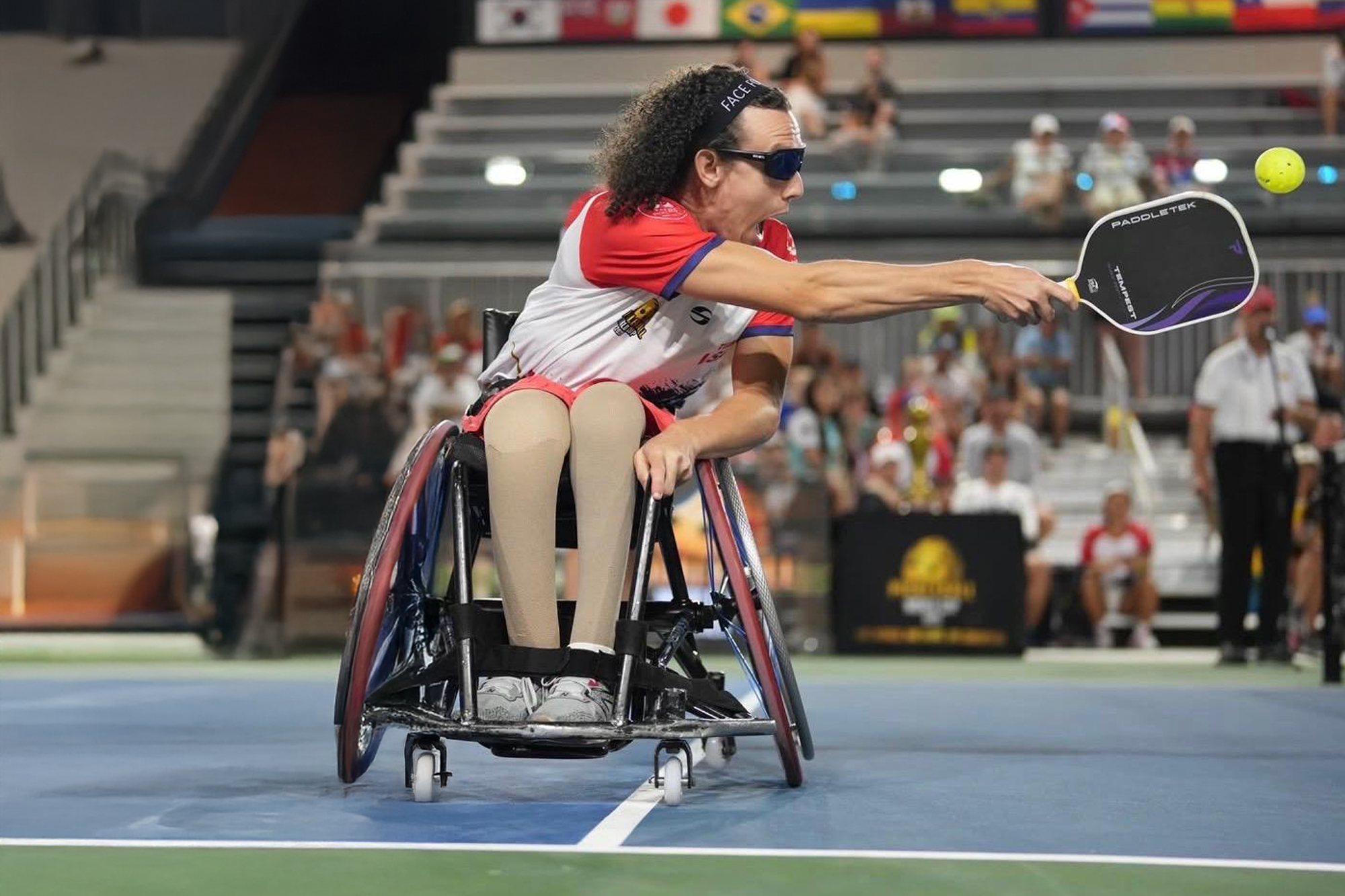
ON A BUSY PICKLEBALL court in Naples, Florida, it would be easy at first glance to notice the chair before the athlete. But watch Robert Doyle play for a few minutes and the chair quickly becomes secondary. What stands out instead is the speed of his hands, the way he positions himself for the next shot, and the constant communication with his partner.
Doyle is a 4.0+ wheelchair pickleball competitor, a certified instructor, and an adaptive sport ambassador. Originally from Minneapolis, Minnesota, he now spends part of the year in Naples, where the sport has exploded in popularity. He has competed at major events such as the US Open Pickleball Championships and has become an advocate for wheelchair divisions and hybrid play, where wheelchair and standing athletes compete together.
But his story is not simply about competition. It is about perspective, resilience, and the way a sport can reconnect someone with purpose and community.
Doyle has been paralyzed for more than two decades. Yet the way he talks about sport today sounds less like someone overcoming limitations and more like someone rediscovering something essential. Pickleball entered his life almost by accident, but it quickly became a powerful vehicle for competition, connection, and encouragement for others navigating adaptive athletics.
Below is a conversation with Robert Doyle about his journey, the evolution of wheelchair pickleball, and why he believes the adaptive side of the sport is just getting started.

Q&A with Robert Doyle
Q: You have been paralyzed for more than 20 years. How did sports fit into your life before pickleball, and what did it take to return to competitive athletics?
Doyle: “Sports were always a huge part of my life. Before my injury, I played baseball, basketball, and ice hockey. Hockey was my first love. I only got to play for a year before I was paralyzed, but I absolutely fell in love with the game.
After my paralysis I knew my life still needed purpose and challenge. Sports had always given me that. I have always loved pushing myself to my limits physically, mentally, and spiritually. Athletics became a way for me to rediscover strength and direction. I truly believe God has used sports as one of the greatest blessings in my life. They have given me discipline, community, and a platform to encourage others.”
Q: You refer to April 4 as your “Celebration of Life Day.” How has that perspective shaped the way you approach competition?
Doyle: “April 4 is the anniversary of the day my life changed forever. Instead of seeing it as the worst day of my life, I call it my Celebration of Life Day. That perspective changes everything. I love competing, and that fire will always be there, but competition is what I do, not who I am. Winning is fun, but it is not the most important thing in life.
Every time I step onto a court, travel to a tournament, or meet someone through pickleball, I see it as a blessing. I get to play. I get to compete. I get to be part of something bigger than myself. That mindset brings freedom and joy to the game.”
Q: When you first tried pickleball, did you expect it to become such a central part of your life?
Doyle: “Not even close. A neighbor introduced me to the sport, and I thought it might be something I played a couple times a week. Instead, it turned into 21 straight days of playing.
Before I knew it, pickleball had completely reignited that competitive fire in me. What started as a casual activity quickly became a passion. Now it is a huge part of my life as a player, instructor, and advocate. More than anything, though, it introduced me to one of the most incredible communities I have ever experienced.”

Q: What do you remember about your first day playing at East Naples Community Park?
Doyle: “You always hear people say pickleball is an ‘old person sport.’ Within about five minutes of being on the court I thought, if this is an old person sport, then I guess I am officially old. Almost immediately, I realized how strategic and competitive the game could be. But what really stood out was incredible people who helped shape my journey in the sport.
I’ll always be grateful to my neighbor, John Hill, who first introduced me to pickleball. I’m also incredibly thankful for Joe Sullivan, who took me under his wing early on and helped me learn the game. His generosity, encouragement, and willingness to invest time in me meant a lot. And I have to thank Chip Parmelly, who became my first wheelchair doubles tournament partner. After I had only been playing for about three months, he partnered with me in an all able-bodied event. That experience gave me the confidence and motivation to keep pushing myself and aiming higher in the sport.
Looking back, that first day didn’t just introduce me to a new sport. It introduced me to a community that changed my life.”
Q: How did your basketball background help you transition into wheelchair pickleball?
Doyle: “Wheelchair basketball teaches you one critical thing first: how to move your chair. If you cannot move your chair effectively, nothing else matters. In fact, during parts of my basketball career we wouldn’t even touch a ball for weeks, it was all about chair skills. Those movement skills translated directly into pickleball.
Basketball also taught me the importance of communication. On the court, if you didn’t communicate, you were pushing your chair for hours in practice. So, when I’m playing pickleball, I’m constantly communicating with my partner. Maybe sometimes too much! But communication is critical for success, and it’s something I emphasize with every student I teach.”
Q: You compete in wheelchair doubles, singles, and hybrid divisions. How does each format challenge you differently?
Doyle: “Most people are surprised to learn that wheelchair doubles and hybrid play are completely different games. In wheelchair doubles, both players are allowed two bounces, which creates a very strategic pace. Sometimes the game is fast, but other times players intentionally use the second bounce to slow things down and reset the point.
Hybrid play is different because standing players only get one bounce while wheelchair players get two. That means my reaction time has to constantly adjust depending on the situation. It becomes a fascinating mix of speed, positioning, and strategy.”
Q: What makes wheelchair doubles exciting for players and spectators?
Doyle: “Someone once described wheelchair pickleball by saying, ‘There’s something poetic about the movement.’ I think that’s exactly right. Many able-bodied players have tried sitting down in a chair to play, and almost every one of them says the same thing: it’s way harder than they expected and incredibly humbling.
But beyond athleticism, what makes it special is the bond between wheelchair athletes. When you step onto the court with a partner who has also overcome significant challenges in life, there’s a level of camaraderie that’s hard to describe. It’s competition, but it’s also deep mutual respect.”
Q: Hybrid play brings wheelchair and standing athletes together. What does that format mean to you personally?
Doyle: “To me, hybrid play represents a bridge that society has needed for a long time. It wasn’t even 36 years ago that the Americans with Disabilities Act became law. Before that, life for people in wheelchairs looked very different.
Hybrid play breaks down those old perceptions. It shows people that wheelchair athletes aren’t fragile, we’re competitors. We welcome the hard drives, the topspin lobs, and the cross-court drops.
After playing hybrid for so long, many of my pickleball friends sometimes forget I’m even in a wheelchair. They just see me as Robert. And that means everything.”

Q: What do people misunderstand about wheelchair pickleball at the competitive level?
Doyle: “Some people assume we’re out there just to ‘get out of the house.’ That couldn’t be further from the truth. Wheelchair athletes train hard. We dedicate huge amounts of time and energy to improving our game, often just as much as able-bodied athletes. We’re not there for sympathy. We’re there to compete and have fun doing it.”
Q: As a certified instructor, how do you approach coaching adaptive athletes?
Doyle: “The first step is understanding the athlete’s physical capabilities. Every injury is different, and wheelchair basketball exposed me to a wide range of injury types and mobility levels. Once I understand what a player can and cannot do physically, I can adapt techniques and training methods to fit their abilities. The goal is always the same: help them maximize their strengths, play confidently, safely, and competitively.”
Q: What progress have you seen in wheelchair pickleball recently?
Doyle: “The growth and support have been incredible. For the first time ever, the US Open wheelchair divisions have a waiting list. That’s something we never would have imagined just a few years ago. We’re also seeing new rules and formats being adopted that better support wheelchair competition and help create a fun, fair, and competitive environment. The momentum right now is really exciting.”
Q: Do you believe wheelchair pickleball could eventually become a Paralympic sport?
Doyle: “Absolutely, 100%. Pickleball is one of the most accessible sports for people with mobility challenges. With continued growth, global participation, and support from the sport’s governing bodies, I believe a Paralympic pathway is very realistic.”
Q: What would you say to someone newly injured who might be hesitant to try the sport?
Doyle: “Go for it! It might feel intimidating at first, and yes, sometimes people may overlook you because of the chair. But I promise there are people out there who will welcome you and want to play. Pickleball can truly change your life. And if someone needs encouragement or guidance getting started, I’m always happy to help.”
Q: If readers take away one message from your story, what would you want it to be?
Doyle: “You can let hardship define you, or you can let it strengthen you. Yes, I’ve gone through some incredibly difficult and painful times in my life. But I don’t see myself as a victim. Through faith, perseverance, and the support of amazing people around me, I choose to live as a victor. God has blessed me with far more than I ever could have imagined. Pickleball is just one example of that blessing.
A sport I tried on a whim ended up giving me purpose, community, and an opportunity to encourage others who might be facing their own challenges. You only get one opportunity to live this life, so don’t waste it. Believe that you are capable of overcoming whatever stands in front of you.
Have faith, keep moving forward, and never give up on the life that is still ahead of you. The world needs the light you have inside you, so don’t dim it. And as I like to say, count it all joy!”
Q: Is there anything else you would like to add?
Doyle: “I am truly grateful to tournaments like the US Open, Spooky Spokes (Cincinnati), Kick Off Classic (PB1965), PicklePlex, Tunnels to Towers and the United States Wheelchair Pickleball Association (USWPA).
Thank you to the owners, directors, referees, and volunteers for the heart and dedication they have poured into the wheelchair division. Watching tournaments like the US Open grow year after year has been such a blessing, and it means so much to be part of tournaments that does not just include us but genuinely champions us. Their continued support inspires me and so many others to keep pushing forward and embracing every opportunity with joy.
Also, I thank God for every step of this journey, and I truly count it all joy. I’m so grateful to my family, friends, and everyone who has poured love, encouragement, and wisdom into my life. Through every high and every challenge, their support has carried me, strengthened me, and reminded me to keep going with faith and purpose. I would not be who I am today without them, and my heart is full of gratitude.”
The Pickleball Editorial Team produces in-depth reporting and cover features that examine the sport’s growth, innovation, competition, and culture. With contributors who understand both the strategy of the game and the forces shaping its future, the team is committed to telling the full story of modern pickleball.

Read the full magazine issue! Click below, then click on the X in the lower bar to enjoy a full screen view!