
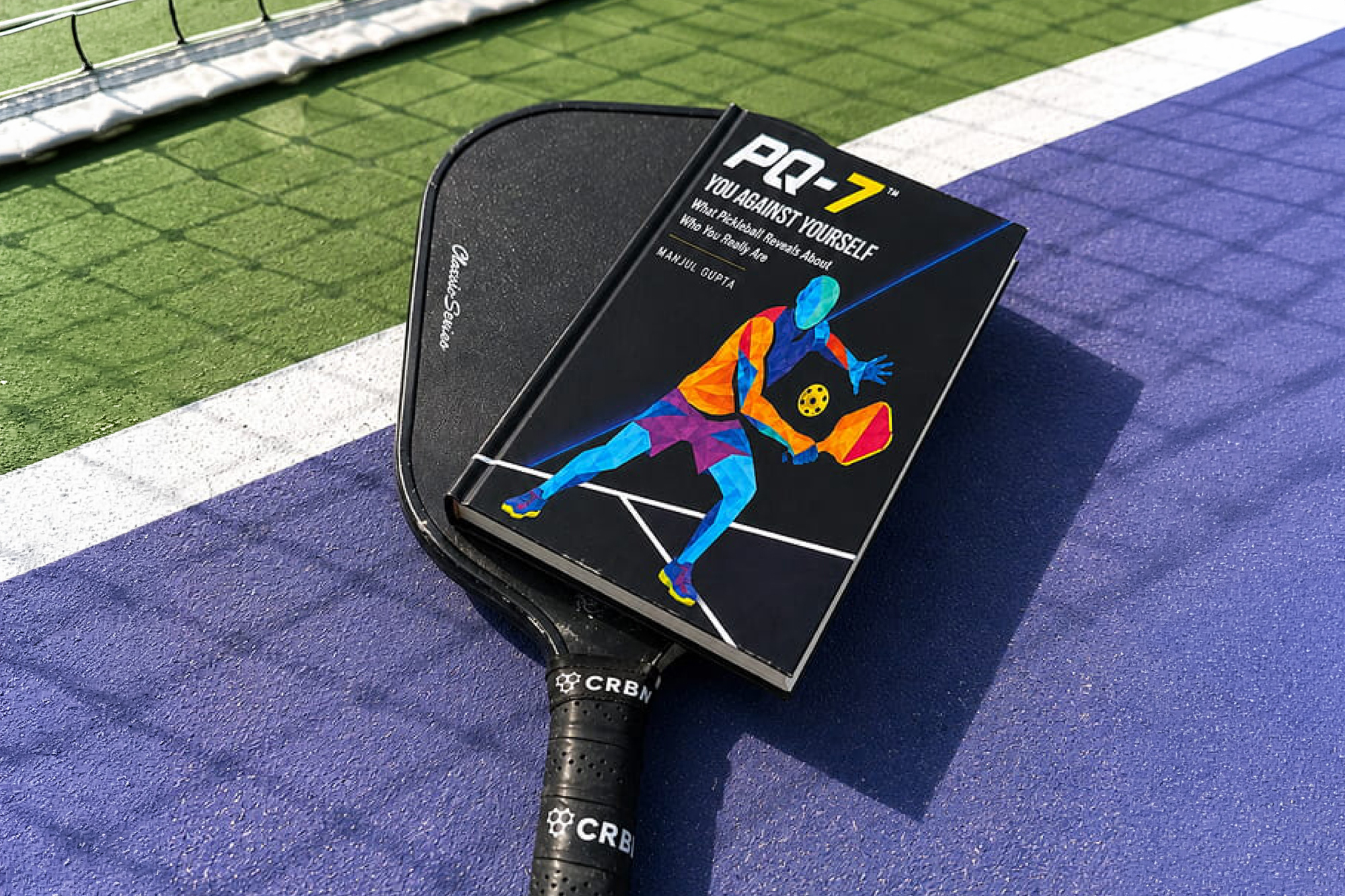
PQ-7 by Manjul Gupta, Ph.D.
You Against Yourself
What the game teaches about rivalries, community, resilience, and self
By Alexandra Sinopoli
October 21, 2026 • 5 min read
When most people think about pickleball, they probably aren’t thinking about philosophy. They are thinking about where the ball is going, whether that shot was in or out, who is serving, what the score is or whether they are about to win the point.
For Manjul Gupta, Ph.D., a business school professor and AI and human behavior scholar, the game became interesting for a different reason. The more he played, the more he started paying attention to how people’s personalities came out on the court.
“What I started to see was that human behavior becomes very apparent on the court,” Gupta told me. “So it’s not specific to pickleball, though I’m using it as a context.”
More Than Wins and Losses
Gupta’s observations became the foundation for PQ-7. The book introduces a “Pickleball Quotient” built around seven dimensions: Drive IQ, Heart IQ, Game IQ, Recovery IQ, Joy IQ, Post-Game IQ and Camaraderie IQ.
Instead of measuring players only by skill, rankings or wins and losses, Gupta examines harder-to-quantify aspects of the game, including emotional resilience, camaraderie, motivation, recovery and the stories players take with them after they leave the court.
The idea stood out to me because of my own background in competitive swimming. I understood what Gupta meant when he talked about “showing up” on the days when you really don’t want to.
In the first chapter, Gupta writes, “Sport at its most honest is not about winning; it’s about who shows up when the winning stops mattering.” For Gupta, showing up is about what a person does when participating would be easier to avoid.
What the Game Reveals
The book differs from a traditional pickleball book because Gupta isn’t trying to teach readers how to hit a better third-shot drop or become a tournament player. Instead, he asks readers to pay attention to what the game might reveal about them.
One area is emotional resilience, which Gupta calls Heart IQ. After losing a point, do you immediately move on, or do you spend the next several points thinking about the mistake? Can you reset, or does one bad shot affect the rest of your game?
Gupta sees this in his own experiences playing with his son. Both can get frustrated, which can take away from the reason they started playing in the first place.
“I always tell my son, don’t forget, we are here to have fun,” he said. “Because I get upset, he gets upset, and then it’s no fun.”
Gupta’s book asks what gets lost when the score starts to matter more, mistakes become more frustrating and winning begins to overshadow the joy of playing.
The Camaraderie Factor
Camaraderie IQ explores one of pickleball’s most recognizable qualities: its ability to create community quickly. Four people can walk onto a court, rotate partners and spend an hour together without necessarily knowing anything about each other.
“It builds a community very fast,” Gupta said.
For Gupta, camaraderie isn’t simply about being friendly. It is also about whether you made the experience better for someone else. He gives the example of four people playing when a fifth person stops to watch. Inviting that person to play means someone has to give up court time, but the newcomer might eventually become part of the regular group.
The Stories We Take Home
Post-Game IQ looks at what happens after play ends and the experiences people continue talking about.
One example is Gupta’s “blood blanket” story. He and a group of friends arrived to play pickleball, but rain had left the court wet. Instead of going home, one player returned with a blanket from OneBlood, the nonprofit blood donation organization, and the group used it to dry the court.

They spent about 15 to 20 minutes removing the water, then played for another two hours. The blanket eventually became part of their unofficial pickleball equipment.
“We still talk about that blood blanket two years after,” Gupta told me.
The story explains Post-Game IQ better than a definition could. It doesn’t appear in a win-loss record or make anyone a better player, but the people who were there still remember it.
You Against Yourself
Gupta doesn’t see the seven PQ-7 dimensions as permanent personality traits. Instead, he describes them as states that can change depending on the person and situation.
After a game, players can ask themselves: Did I enjoy today? Did I reset quickly? Did I learn how to let go? Did I make the experience better for somebody else?
It is what makes PQ-7 interesting to me. It isn’t asking whether someone is simply a “good” or “bad” pickleball player. It asks what kind of player, teammate and person you were on a particular day.
Gupta is also developing a PQ-7 app that would allow players to reflect on their experiences across the seven dimensions.
“I have this tagline,” Gupta said. “What if your pickleball life had a score?”
The score would not be a traditional ranking or rating. Instead, it would evolve as players play, reflect and engage with the game.
In or Out?
The concept comes back to the title: You Against Yourself. The person across the net isn’t necessarily your biggest competition. Sometimes the bigger challenge is managing frustration, motivating yourself, supporting the people around you and remembering why you started playing.
Gupta doesn’t pretend winning doesn’t matter. He enjoys competition and understands why people care about improving. But as he tells his son, “Don’t forget, we are here to have fun.”
Maybe that is why the book isn’t really about becoming a better pickleball player. It is about becoming more aware of the person you are while you play.
The score can tell you who won. It can’t tell you who encouraged a stranger to join the game, who stayed positive after losing five points in a row or who came back carrying a blood donation blanket because six people weren’t ready to go home.
Sometimes, the most important competition isn’t happening across the net at all. Sometimes, it is simply you against yourself. ●

Specs at a Glance
Title: PQ-7: You Against Yourself, What Pickleball Reveals About Who You Really Are
Author: Manjul Gupta, Ph.D.
Genre: Pickleball / Sports Psychology / Personal Development
Focus: Seven dimensions of the recreational pickleball experience: Drive IQ, Heart IQ, Game IQ, Recovery IQ, Joy IQ, Post-Game IQ and Camaraderie IQ
Best For: Recreational pickleball players interested in the mental, emotional and social sides of the game
Formats: Hardcover, paperback, eBook, audiobook
The Takeaway: Pickleball can reveal far more about a player than a rating, ranking or final score
Page Count: 152
Publication Date: June 11, 2026
About Alexandra Sinopoli
Alexandra Sinopoli is a media and communications student in her senior year at Arizona State University and an editorial intern with The Pickleball Weekly. Originally from Southern California, she has always enjoyed reading, traveling, and learning about new people and places. Alexandra previously wrote for The Moorpark Reporter, where she covered the performing arts, and has experience in journalism, social media, and content creation through her social media accounts. She especially enjoys travel and lifestyle writing and finding ways to make a story feel relatable to the people reading it. Outside of work and school, she’s usually planning her next trip, exploring somewhere new, or spending time with friends and family.

Read the full magazine issue! Click below, then tap Full Screen for the best reading experience.
