The Simulator That Ate the Kitchen Line
By Adam Bricker • September 16, 2026 • 5 min read
How Playkout is rethinking pickleball facility space
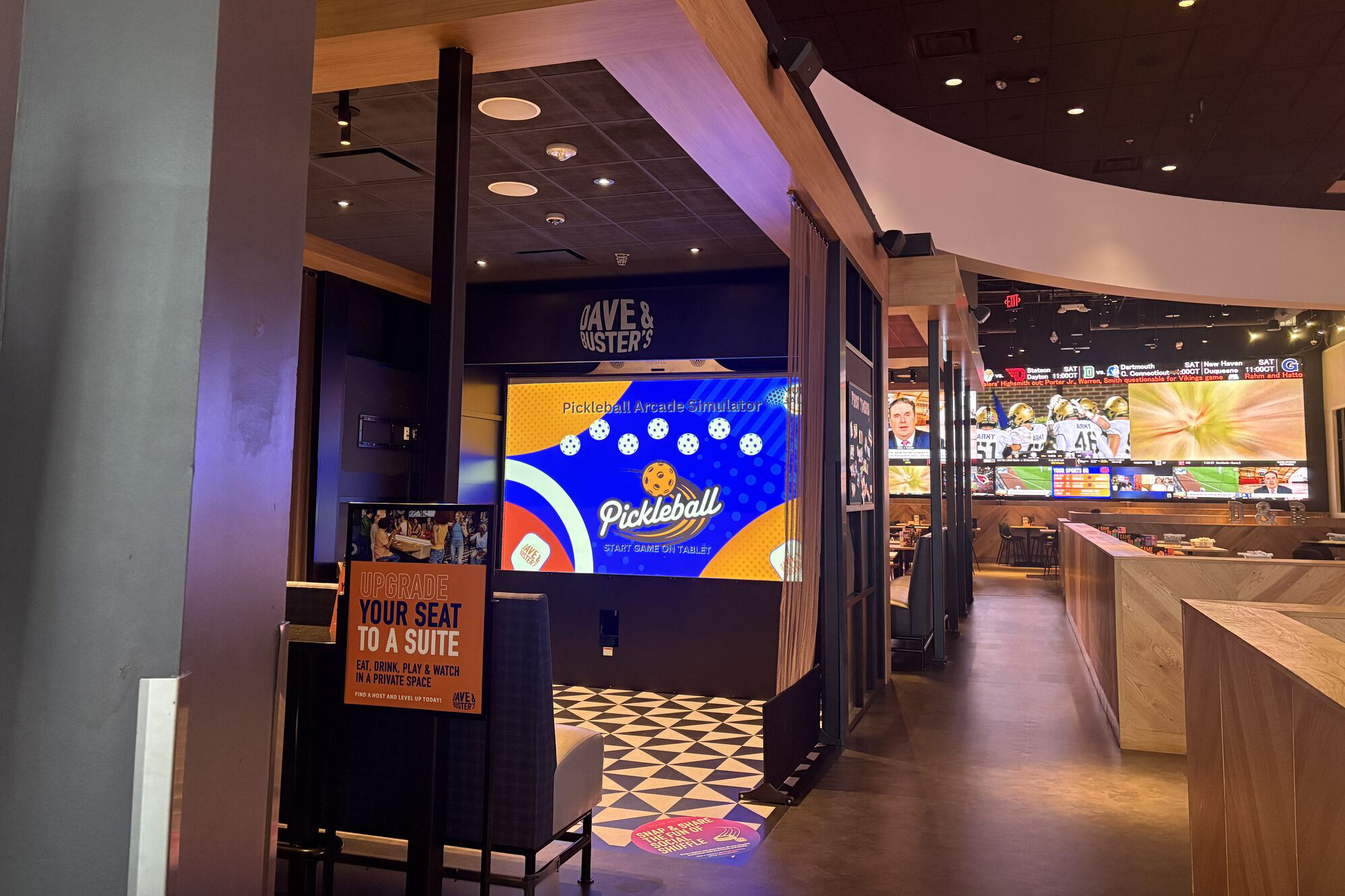
THE SOUND IS unmistakably familiar, yet entirely out of place. It is the sharp, hollow pop-clack of graphite striking polymer, echoing not across an 880-square-foot asphalt rectangle, but within a compact 150-square-foot enclosure tucked discreetly behind a clubhouse smoothie bar.
Inside the bay, an animated wall of colorful digital targets shatters on impact as a player drives a forehand directly into an 11-foot impact screen. There is no net to trip over, no sun glaring off painted acrylic, and no queue of impatient regulars waiting for the next open-play rotation.
This is Playkout, a Dallas-born sports-tech venture designed to address one of the challenges facing modern racquet sports: the physical limitations of court real estate.
While pickleball’s rapid growth has fueled an expansion of commercial facilities, operators must balance demand for courts with the realities of brick-and-mortar economics. Pickleball courts require significant square footage when recommended playing areas and runoff space are taken into account, along with sufficient ceiling clearance for indoor facilities, while other areas of a facility, including pro-shop hallways, mezzanine lounges, and secondary lobbies, may remain underutilized.
Rather than competing with traditional court construction, Playkout created an interactive, phygital simulator designed to turn some of that unused space into an additional training and entertainment option.
Building the Team
At the helm of product and strategy is CEO and co-founder Jorge Guerrero, whose background in the automotive software industry eventually led him to explore a technology solution for one of the country’s fastest-growing sports. Guerrero saw an opportunity to rethink the traditional ball machine, taking a familiar training tool and adding an interactive and social component.
“We never set out to replace the twenty-by-forty-four,” explains Guerrero. “Our mission is to unlock the ninety percent of venue space that sits idle and turn it into an addictive, phygital playground where anyone with a paddle can find immediate joy.”
Alongside Guerrero is Playkout COO Shawn Edwards, who focuses on facility scalability, venue integration, and client experience. Edwards, a director of racquet sports with more than 15 years in the racquet industry, brings an operator’s perspective to the team and considers how the system can function within private clubs, urban sports lounges, and family entertainment centers.
“For club owners, every square foot has to justify its existence on the balance sheet,” says Edwards. “We built an automated, plug-and-play experience that delivers high-margin engagement all day long without requiring an extra person on payroll.”
The technology side is led by Playkout CTO Jorge Romero-Trejo. With 25 years of experience in technology across transnational companies, Romero-Trejo holds a degree in Telematics Engineering from ITAM and an MBA from IPADE Business School and has completed studies in AI and Machine Learning at MIT.
Guerrero and Romero-Trejo came together on the venture through an existing friendship, while Edwards was introduced to the project during his time as a member of the executive team at Dallas’ Banner House at T Bar M.
Edwards had also recently opened and operated Preston Playhouse, an indoor pickleball and padel concept that combined traditional play, leagues, and tournaments with Major League Pickleball exhibitions and corporate events. His experience provided another perspective on how technology and alternative programming could fit within a racquet-sports facility.
With the goal of creating a system that would be useful for high-level players while remaining approachable and entertaining for beginners, the trio combined their backgrounds in technology, product development, racquet sports, and facility operations to develop the Playkout simulator.

More Than Court Hours
For the Playkout team, the concept also addresses a business question confronting many pickleball facilities: how can operators generate additional revenue beyond court reservations, membership dues, and tournaments?
The simulator is designed to operate in an automated, self-service format, allowing a single bay to serve several purposes. It can accommodate casual bookings, provide an activity during rain delays, support corporate team-building events and youth programs, and host leagues and competitions using cloud leaderboards and tournament modes.
Because the system requires considerably less space than a regulation pickleball court, Playkout sees an opportunity for facilities to use areas that might otherwise generate little or no direct revenue. The company also envisions the simulator as a potential platform for equipment brands and local corporate sponsors.
“There are so many opportunities I see pickleball facilities not taking advantage of with their space,” Edwards says. “Your revenue potential should not have to be limited by the number of courts you have.”
A Different Approach to Pickleball Space
As pickleball facilities continue to evolve, operators are increasingly looking beyond the number of courts they can fit inside a building. Technology, entertainment, programming, and the efficient use of space are becoming additional pieces of the business equation.
Playkout represents one approach to that challenge.
By combining Guerrero’s product vision, Romero-Trejo’s technology background, and Edwards’ experience in racquet-sports operations, the team has created a simulator designed to serve multiple audiences, from experienced players looking for another way to train to newcomers interested in a more accessible introduction to the sport.
Whether simulator-based experiences become a significant part of the pickleball facility model remains to be seen. But as operators search for new ways to use space, engage players, and diversify revenue, Playkout is betting that the future of a pickleball facility may involve more than simply adding another court.
About Adam Bricker
Adam Bricker is a prominent American pickleball promoter, marketing executive, and entrepreneur known for his leadership in the business and commercial development of the sport. Based out of Las Vegas, Nevada, he serves as the Director of Marketing for the World Pickleball Conference and the CEO of Pickleball Cards. He is a frequent speaker and guest media personality who drives industry growth by connecting brands, facilities, and professionals across the sports entertainment landscape.

Read the full magazine issue! Click below, then click on the X in the lower bar to enjoy a full screen view!