
If Pickleball Was Monopoly: One Company Would Own Most of the Properties
By The Pickleball Weekly Editorial Team
June 3, 2026 • 7 min read
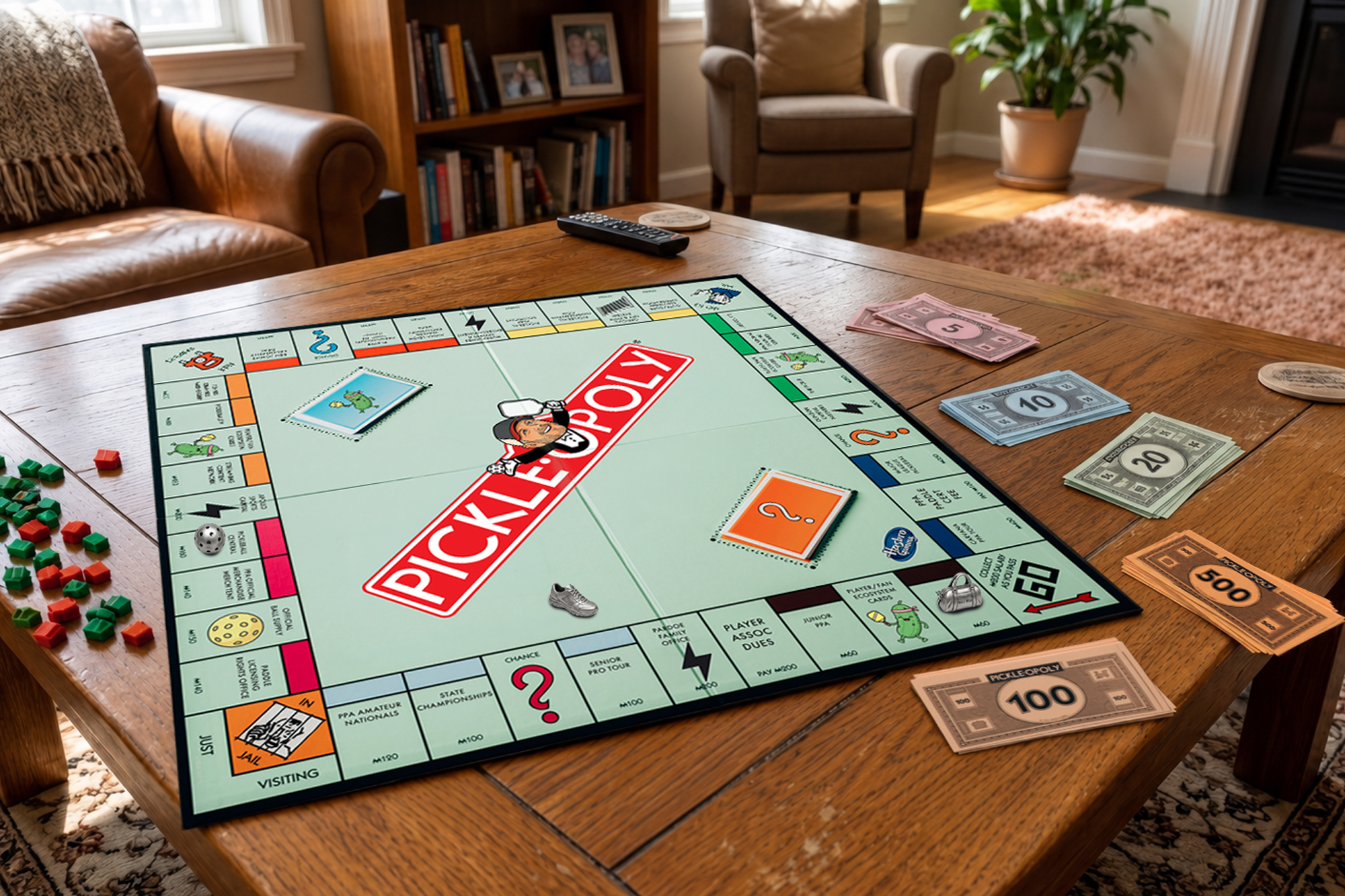
IMAGINE SITTING DOWN to play a game called Pickle-Opoly.
At first glance, the board looks familiar. There are properties to buy, railroads to acquire, utilities to control, and Chance cards capable of changing the course of the game. Instead of Boardwalk and Park Place, however, the spaces represent the most valuable assets in pickleball. One square is MLP Pickleball. Another is the Carvana PPA Tour. Nearby sit Pickleball Central, PickleballTournaments.com, Pickleball Play Solutions, PickleballTV, The Picklr, and Just Courts.
Now imagine one player gradually acquiring nearly every important square on the board. That player is not fictional. It is Pickleball Inc.
Following a recent $225 million investment led by Apollo Sports Capital, the company now carries a reported valuation of $750 million while overseeing what has become the largest integrated business platform in pickleball. Professional tours, tournament software, media distribution, retail sales, facility development, and court construction all sit within a rapidly expanding ecosystem.
Five years ago, few outside the sport could have imagined such a scenario. Pickleball was growing quickly, but it remained fragmented. Professional tours competed for athletes. Facilities expanded independently. Software providers, retailers, media companies, and infrastructure firms all pursued their own paths.
Today, much of that landscape is connected through a single corporate platform.
Buying Boardwalk and Park Place
Every Monopoly player knows Boardwalk and Park Place are the most valuable properties on the board. In Pickle-Opoly, those spaces belong to the Carvana PPA Tour and Major League Pickleball.
The PPA Tour established itself as the premier destination for individual professional competition. Major League Pickleball introduced a team-based format built around franchise ownership and city-based competition. For years, the two organizations competed for talent, sponsors, media attention, and market share.
Eventually, they aligned under a shared vision and became the foundation of what would evolve into Pickleball Inc. Owning both properties changes the game.
Professional leagues are more than tournaments. They generate media inventory, attract sponsors, showcase athletes, and provide the public face of the sport. Every major sports ecosystem begins with a compelling professional product, and Pickleball Inc. now controls the two most significant properties in professional pickleball.
Controlling the Digital Game
While professional tours generate headlines, software powers the daily experience for players.
Platforms such as PickleballTournaments.com and Pickleball Play Solutions have become deeply embedded in the sport’s infrastructure. Tournament directors rely on them to organize events. Facilities use them to manage leagues and registrations. Players depend on them to register, check results, and track competition.
Together, these platforms form part of the digital backbone of competitive pickleball.
As participation continues to grow, technology becomes increasingly important. Registration systems, ratings, scheduling tools, and event management software help transform a rapidly expanding sport into an organized ecosystem capable of serving millions of players.
The platforms may not receive the same attention as championship matches, but they are among the most valuable properties on the board.
Selling the Dream
Every growing sport needs equipment.
Through Pickleball Central, Pickleball Inc. controls one of the most recognizable retail brands in pickleball. From first-time players purchasing their first paddle to experienced competitors seeking the latest technology, the company touches nearly every segment of the market.
Retail does more than generate revenue. It creates daily interaction with consumers and provides valuable insight into buying trends, product demand, and player behavior.
Every purchase becomes another connection point within the broader ecosystem.
Controlling the Broadcast Window
In sports, attention is currency.
PickleballTV, streaming platforms, and broadcast partnerships represent some of the most valuable assets in the company’s portfolio. Media serves as the bridge connecting players, fans, sponsors, and future participants.
The Apollo investment arrives at a time when pickleball is working to expand beyond its existing player base. Every viewer represents potential growth. Every broadcast increases awareness. Every successful media partnership strengthens the overall business model. Without media, even the best professional product struggles to scale.
Building Hotels on Every Court
If professional tours provide visibility and software provides infrastructure, facilities provide access.
The Picklr, Just Courts, and training centers represent the physical side of pickleball’s expansion. Across North America, warehouses, retail locations, and commercial spaces are being transformed into dedicated pickleball venues.
The Picklr has emerged as one of the industry’s fastest- growing franchise operators, while Just Courts helps build the physical infrastructure required to support that growth.
Every new court creates opportunities for players to learn, compete, and build community. While professional tours often capture headlines, the long-term future of pickleball ultimately depends on how many places people have to play.
Following the Money
Every Monopoly player understands the importance of the railroads. Individually they are useful. Collectively they connect the board.
In Pickle-Opoly, the railroads are represented by Apollo Sports Capital, Dundon Capital Partners, the Pardoe Family Office, and Hurricanes Sports & Entertainment.
Apollo’s $225 million investment attracted headlines because of its size, but the significance extends far beyond the dollar figure. Institutional investors seek businesses capable of long-term growth, recurring revenue, and market expansion. Apollo clearly believes pickleball possesses those characteristics.
Tom Dundon reached that conclusion years earlier. Long before Wall Street arrived, he invested heavily in pro pickleball when many questioned whether the sport could sustain itself.
Meanwhile, the Pardoe family helped build the PPA Tour into the foundation upon which much of today’s ecosystem now stands.
Together, these investors and operators have created something unusual in sports: an interconnected platform spanning professional competition, amateur play, technology, media, retail, and facilities.
Chance, Community Chest, and the Future
No Monopoly game unfolds exactly as planned.
A decade ago, few predicted major television networks would broadcast pickleball, dedicated facilities would spread across North America, or institutional investors would value a pickleball company at $750 million.
At the same time, every rapidly growing sport faces challenges. Expansion creates complexity. Increased visibility brings greater scrutiny. New opportunities create new expectations. Pickleball is moving through those stages at remarkable speed.
For most players, the Apollo investment will not change tomorrow’s rec game. Players will still show up at local courts, compete in leagues, and enter tournaments. The impact will be felt gradually through more facilities, expanded programming, improved technology, larger events, and increased media coverage.
Players may never study a valuation report or sit in a board meeting, but they will experience the results through the opportunities available to them.
Passing GO
In Monopoly, the goal is simple: acquire the most valuable properties and control enough of the board that every path eventually leads back to you.
Pickleball is obviously not a board game, and Pickleball Inc. does not own the sport. Independent facilities, manufacturers, coaches, tournament operators, media outlets, and entrepreneurs continue shaping pickleball every day.
Yet it is difficult to ignore how many of the sport’s most valuable properties now sit within a single ecosystem.
Professional tours, tournament software, media distribution, retail operations, court construction, and facility development increasingly appear connected. What once looked like a collection of independent businesses now resembles a coordinated platform designed to support growth across nearly every corner of the sport.
Not long ago, players were carrying portable nets into church gyms and public parks. Today, institutional investors are writing nine-figure checks, professional tours are broadcast nationally, and a pickleball company carries a valuation measured in hundreds of millions of dollars.
If nothing else, the game has changed. And on today’s Pickle-Opoly board, Pickleball Inc. owns many of the most valuable squares. ●
About The Pickleball Weekly Editorial Team
The Pickleball Weekly Editorial Team produces in-depth reporting and cover features that examine the sport’s growth, innovation, competition, and culture. With contributors who understand both the strategy of the game and the forces shaping its future, the team is committed to telling the full story of modern pickleball.

Read the full magazine issue! Click below, then tap Full Screen for the best reading experience.
