When A New Racket Sport Wants Your Court
By The Pickleball Weekly Editorial Team • Feb 4, 2026 • 7 min read
As emerging paddle sports like TYPTI look for space, will pickleball have to share?
PICKLEBALL DIDN’T JUST grow. It occupied.
Across parks, schoolyards, tennis facilities, gyms, and converted warehouse spaces, the sport expanded by claiming underused real estate and repurposing it with tape lines, portable nets, and community enthusiasm. What began as a grassroots takeover has evolved into infrastructure; dedicated courts, permanent facilities, and municipal investment.
But now, something interesting is happening.
For the first time, a new racket sport isn’t asking for different space. It’s asking for the same space.
One of the most prominent examples is TYPTI (pronounced “TIP-tee”), officially launched in January 2026 and designed to be played on a standard 20’ x 44’ pickleball court.
That’s not accidental. It’s foundational to its strategy.
The Founder and the Launch
TYPTI was founded and created by Steve Bellamy, founder of The Tennis Channel and a veteran sports executive. Bellamy now serves as Chairman and CEO of TYPTI Inc., bringing significant media and industry experience into the paddle-sport space.
The sport launched in early 2026 with backing from a high-profile investor group of more than 80 individuals, including athletes like Drew Brees, entrepreneurs such as Tony Robbins, and actors including Chris Pine and J.J. Abrams.
The inaugural TYPTI event was scheduled for February 25, 2026, at the Calabasas Pickleball Club, according to reporting by the Los Angeles Times, a symbolic choice that reinforces the sport’s reliance on pickleball infrastructure.
Supporters have described TYPTI as “the snowboarding of the racquet world,” a modern rethink of traditional paddle sports.
What Is TYPTI?
TYPTI positions itself as a hybrid between tennis, pickleball, and badminton, designed to bridge the gap between larger-court racquet sports and smaller-court accessibility.
It is played on a standard pickleball court but introduces different equipment, different rules, and a distinct style of play.
Where pickleball emphasizes control and kitchen play, TYPTI leans toward spin, bounce, and creative rallies.
The Gear: A Different Feel
The Racket
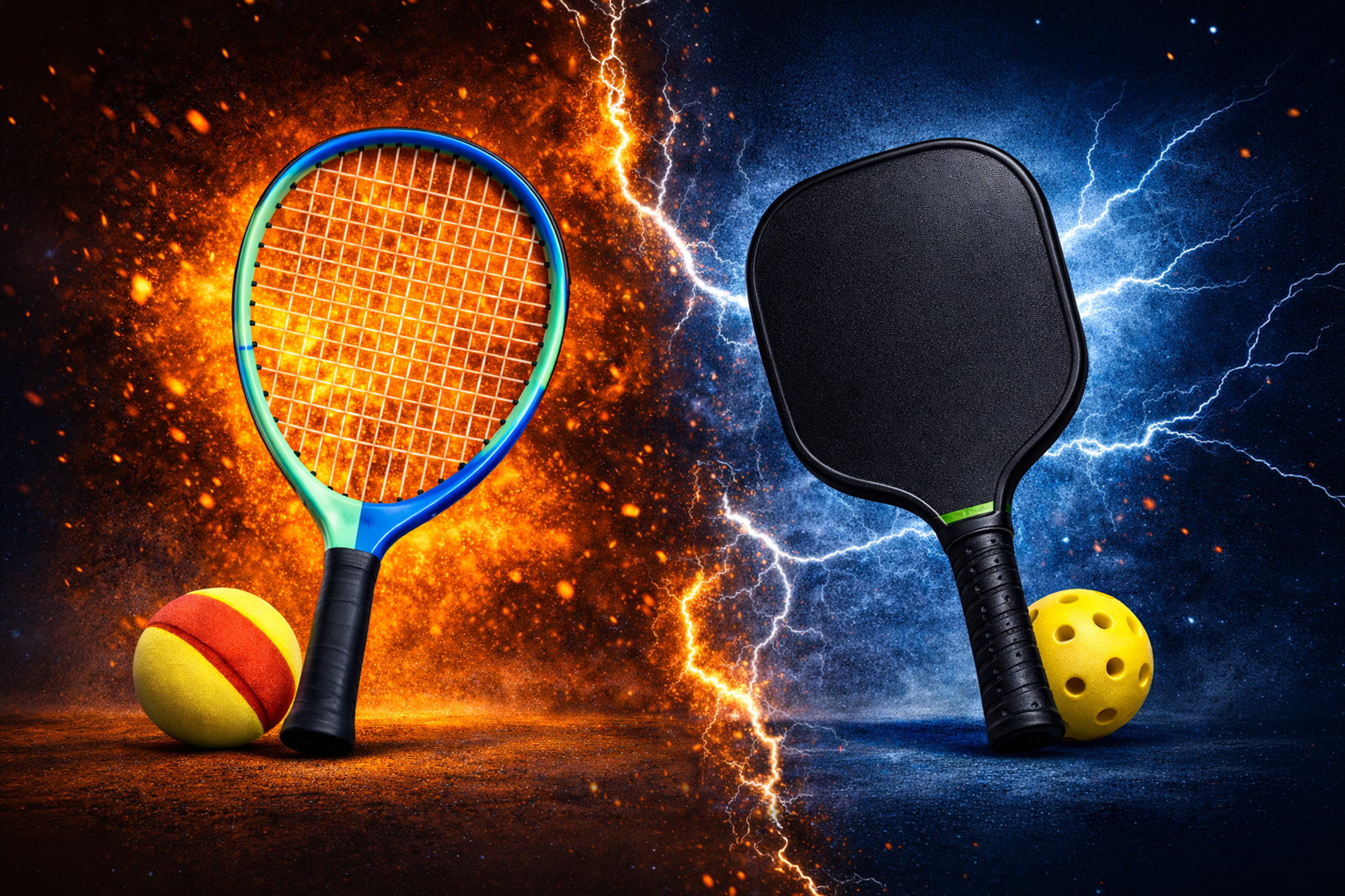
TYPTI uses a 22-inch strung racket, shorter than a tennis racket but long enough to allow full swings and advanced spin production. The presence of strings, rather than a solid paddle face, fundamentally changes contact dynamics. The result feels closer to mini-tennis than traditional pickleball.
The Ball
The sport uses a 3.5-inch channeled dense foam ball. Compared to pickleball:
• It is significantly quieter.
• It moves slower through the air.
• It bounces higher.
That higher bounce allows players more reaction time and enables longer, spin-heavy rallies, a sharp contrast to the low, skidding trajectory of a pickleball.
Noise reduction may prove politically significant. In communities where pickleball’s distinctive “pop” has triggered noise complaints or restrictions, a quieter alternative could gain traction.
Unique Rules of Play
TYPTI doesn’t simply modify pickleball. It rethinks several structural elements.
No Non-Volley Zone
There is no kitchen. Players may volley from anywhere on the court. This removes one of pickleball’s defining strategic zones and encourages continuous offensive positioning.
Net Continuation Rule
If the ball hits the net on your side, the rally does not automatically end. As long as the ball has not bounced twice, players may continue the point, using their racquet, hand, or even foot in certain situations.
This adds improvisation and extended defensive creativity.
The Serve
All serves must be struck below the waist. Overhead serves are not permitted, making the game more approachable and reducing shoulder strain.
The Stakes Scoring System
TYPTI introduces a distinctive scoring method known as the Stakes system. To win a game:
• A player must win three consecutive points.
• Scores are described as “Up” or “Down.”
• First point: 1-Up
• Second consecutive point: 2-Up
• Third consecutive point: game won
• If a player at 2-Up loses a point, the opponent becomes 1-Up.
Sets are typically first to five games, and matches are played best-of-three sets. This format emphasizes momentum and creates fast, intense swings.
Why This Matters for Pickleball
Pickleball’s growth story was one of disruption. It entered tennis courts, taped lines over unused surfaces, and built demand faster than municipalities could respond.
Now pickleball is the established presence.
TYPTI, and potentially other emerging paddle formats, are leveraging that success. They do not require new dimensions. They do not require new facility construction. They use what already exists.
That changes the dynamic.
The Real Issue: Court Allocation
This is not necessarily rivalry. It’s resource management.
• Communities already struggle with:
• Open play congestion
• Wait times
• League scheduling conflicts
• Noise complaints
If a quieter paddle sport enters the same footprint, facility managers may face difficult questions:
• Should courts rotate between formats?
• Does reduced noise merit scheduling preference?
• Will private clubs diversify offerings?
• Could purpose-built pickleball complexes become more necessary?
Pickleball once fought for access. Now it may have to negotiate it.
Could Coexistence Work?
It could. Facilities may expand. Paddle sports may develop separate time blocks. Players may cross-train. Partnerships with organizations such as the Racquet Sports Professional Association (RSPA) and the Intercollegiate Tennis Association (ITA) suggest TYPTI is positioning itself within the broader racquet-sport ecosystem rather than outside it.
But the infrastructure overlap is real.
A Mature Sport Faces Its First Real Space Rival
Pickleball thrived because it was adaptable, portable, and efficient with space. Now another sport is adopting the same model with investor backing, celebrity support, and a strategic infrastructure plan.
That doesn’t diminish pickleball. But it does signal something new: pickleball is no longer the only paddle sport built for the 20’ x 44’ court. For years, pickleball players asked for room. The next phase may be deciding how much of that room they’re willing to share.
The Pickleball Editorial Team produces in-depth reporting and cover features that examine the sport’s growth, innovation, competition, and culture. With contributors who understand both the strategy of the game and the forces shaping its future, the team is committed to telling the full story of modern pickleball.

Read the full magazine issue! Click below, then click on the X in the lower bar to enjoy a full screen view!