
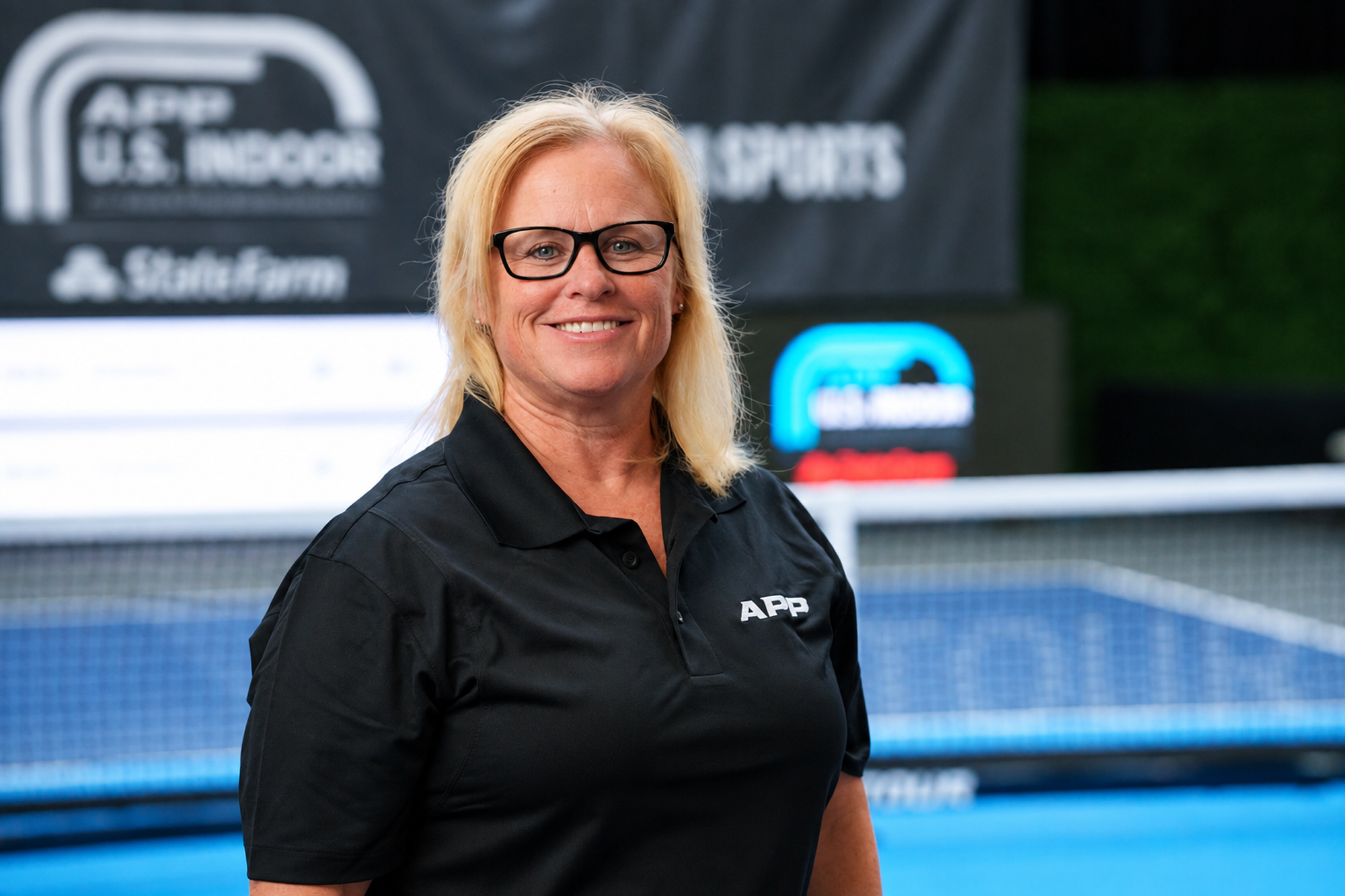
Beyond the Tournament Desk
Melissa McCurley has spent more than a decade helping pickleball grow through technology, competition and leadership
By Carl Foster
October 7, 2026 • 17 min read
Growing Pickleball
Melissa McCurley is often referred to as “the hardest working person in pickleball.” This may very well be true, but it tells an incomplete story of Melissa and her contributions to our society, and to pickleball in particular.
Following her career as a U.S. Navy Hospital Corpsman, Melissa continued to serve the country, going to work for Ross Perot’s information technology services company, EDS. There, she led the installation and technology buildout of the Navy and Marine Corps’ first common infrastructure and office environment through the Navy Marine Corps Intranet (NMCI). Melissa’s leadership resulted in the highest customer satisfaction results across the Echelon II Commands for which she was responsible.
She was also responsible for setting up and supporting the technology for the Navy’s Crisis Response Center at the Washington Navy Yard, which supported families impacted by the 9/11 terrorist attack on the Pentagon. She also established and led the Navy’s Emergency Response Team responsible for restoring naval communications that were wiped out along the Florida Panhandle and the New Orleans coast following Hurricane Katrina.
EDS eventually promoted Melissa to Global Service Delivery Executive and put her in charge of a high-profile client, American Express. In that role, she was responsible for ensuring mission-critical data and voice communications were available to call centers, merchants and customers worldwide.
Those experiences would eventually influence how Melissa approached some very different challenges in the growing world of pickleball.

A Family Game Becomes Something More
Melissa’s pickleball story started in the most unlikely place: her family driveway in Texas on Christmas Day in 2007. She relayed to me how pickleball changed her life.
“My family was always competitive at the holidays. One year it might be potato sack races, another year ping pong, checkers or darts. That Christmas, my cousin Evelyn showed up with a pickleball set. We put it up in the driveway and started playing. And we couldn’t stop.
Christmas pickleball eventually became Thanksgiving pickleball, and then late-night pickleball,” she continued. “We actually installed shop lights in the driveway so we could keep playing after dark. The funny thing is that I genuinely thought this was just some quirky game our family had discovered. I had no idea there was an entire pickleball world out there,” Melissa added.
Melissa later moved to Phoenix. In 2010, a woman on her tennis team casually mentioned that her father was a national pickleball champion.
“I remember thinking, ‘National champion? There are enough people playing this game to have a national championship?’”
Melissa learned about the Nationals in Buckeye, Arizona, and went that November. It was the first time she realized her family wasn’t alone on this pickleball island. There was an actual sport here.
Eventually, Melissa convinced her mom, Linda, and her stepdad, Bruce, to move from Texas to Surprise, Arizona. Her mom became very active in pickleball and started playing tournaments. Then, in April 2014, Linda needed a last-minute partner for a tournament in Surprise. Melissa filled in. They won silver, and when the tournament director handed them their medals, he made sure to tell Melissa that her mother normally won gold.
That silver medal ended up changing her life.
Some of Linda’s friends invited Melissa to play socially with them on Sundays. In May, she showed up and met Jettye Lanius. Her husband, Bob, had created PickleballTournaments.com. Jettye knew Melissa worked in technology and asked if she would take a look at what they had built.
Melissa’s brother Greg also had a technology background, so they spent about three months evaluating the software and the opportunity. In August 2014, Melissa and Greg bought PickleballTournaments.com. Her life changed forever.
Taking a Chance
“What’s easy to forget today is how crazy that decision looked at the time,” Melissa reflected. “There were only 93 tournaments on the platform and roughly 15,000 users according to the records from that period. There were only a few tournaments nationwide where younger players could even compete. There were no major professional tours, no big television contracts and certainly no guarantee that pickleball would become anything close to what it is today.”
For the first time in her life, Melissa said she felt called to do something.
“There wasn’t a business case I could put in front of everybody that made the decision make sense. I didn’t know why I felt so strongly about it, and I didn’t know where it would lead. I just knew I was supposed to do it.”
Things were not easy in the early days. Fortunately, Melissa’s boss believed in her enough to allow her to continue consulting while she built PickleballTournaments.com. For the next several years, she traveled around the country on her own dime, teaching people how to use the system and how to run tournaments. She rented her house to help make ends meet and lived out of a motorhome while doing it.
Melissa and Greg were players, too. They eventually competed at the 5.0 level around the United States and Canada. But as PickleballTournaments.com grew, something had to give, and eventually Melissa’s own competitive play took a back seat.
People would sometimes ask whether Melissa and Greg somehow knew pickleball was going to explode.
“We didn’t,” Melissa said. “I thought I was buying tournament software. What I didn’t understand yet was that we were going to help build part of the infrastructure the sport would need in order to grow.”
Everything that followed can be traced back to a family Christmas, a pickleball net stretched across a driveway and a decision in 2014 that Melissa couldn’t logically explain but somehow knew she was called to make.
More Than Tournament Software
When Melissa and Greg bought PickleballTournaments.com, she thought they were buying software. She quickly learned they were taking responsibility for much more.
Tournament directors didn’t just need a registration system. They needed help understanding brackets, scheduling, court utilization, player communication, ratings, results and all the details that determine whether hundreds, or eventually thousands, of players have a good tournament experience.
Melissa and Greg went where the tournaments were, traveling around the country helping directors run events and learning alongside them. It became incredibly important because they weren’t designing tournament technology from an office. They were standing behind tournament desks using it under real-world pressure.
“And sometimes that pressure was intense,” Melissa laughed.
One story from the US Open probably explains her philosophy better than anything. The system went down while the tournament was running more than 100 matches an hour. Melissa knew they had a major problem. The team broke the event into sections, handed brackets to people who could help and temporarily ran the tournament manually until the system returned.
“Most players never knew what had happened,” Melissa said. “That is tournament operations. Success is often measured by the problems nobody realizes you had.”
The company grew from 93 tournaments into a platform supporting more than 1,200 events annually and hundreds of thousands of players. Melissa worked with grassroots tournaments, Nationals, the US Open and eventually the emerging professional tours.
As those tournaments grew, the technology had to grow with them. The platform enabled events to expand from several hundred participants to 3,000 or more, operating on as many as 58 courts simultaneously. Melissa and her team also developed best-practices operating methods that helped major tournaments continue through weather problems, power outages, internet disruptions and other challenges.
The sport also needed better competitive data.
“We also realized the sport needed better competitive data. I helped co-create the USA Pickleball Tournament Player Rating system, UTPR, the sport’s first algorithmic, data-driven tournament rating system. It wasn’t about claiming we’d created something perfect. It was about moving pickleball toward more objective competition,” Melissa said.
Her work extended beyond technology. Melissa also developed certified educational programs for facility professionals and owners to provide continuing education about event operations best practices.

Growth and a Changing Industry
By 2017, investors and potential buyers were approaching Melissa. She wasn’t looking for the biggest check. She felt an enormous responsibility to Bob and Jettye Lanius and to the sport because PickleballTournaments.com had become part of pickleball’s infrastructure.
When Anna Copley introduced her to the leadership of Pickleball Central, Melissa recognized people who shared her philosophy of serving the sport. The businesses merged in February 2018. Then, in 2021, the combined businesses were sold to Dundon Capital Partners, and Melissa stayed another two years before stepping away.
“Selling was emotional. You don’t spend that many years building something, sacrificing for it and developing relationships with people around the world and simply view it as a transaction,” Melissa said. “But I never measured Pickleball Tournaments’ success by the sale. I measure it by what it enabled.”
She helped give tournament directors tools to grow events, gave players places to compete, created data the sport didn’t previously have and built systems that helped pickleball scale. Melissa said that is what she is proudest of.
There were many mentors and supporters along Melissa’s road because nobody built early pickleball alone. Bob and Jettye Lanius changed the course of her life. Bob planted the seed with PickleballTournaments.com, and Jettye made the introduction. There were other people interested in buying the company, but they trusted Melissa and Greg to carry forward what Bob had created.
Melissa’s mom, Linda, was also a driving force on the journey. She spent about 10 years traveling with Melissa and helping run tournaments because she wanted her daughter to succeed. Then there were tournament directors all over the country. Melissa said she learned from every one of them because every tournament exposed another problem they could solve.
From Tournaments to the Pro Game
The US Open became another enormous chapter. Working alongside Chris Evon, Terri Graham, Jim Ludwig, Bryan and Lisa McKenzie taught Melissa what happens when you stop thinking about a pickleball tournament merely as a bracket and start thinking about it as an experience.
Melissa also worked closely with USA Pickleball and virtually every major tournament operator during that era, both commercial and nonprofit. As professional pickleball began to emerge, those relationships expanded into the developing pro game.
Melissa met Ken Herrmann when he drove six hours from Chicago to play singles at a tournament she was running in Owensboro, Kentucky.
“He came to the tournament desk afterward and started telling me about this idea he had for a professional tour. We talked about what I thought would work and what wouldn’t. That concept ultimately became the APP, and PickleballTournaments.com became its registration and tournament-management partner,” Melissa said.
What Melissa loved about those years was that none of them were sitting around saying, “We’re building the future of pickleball.” They were doing the work needed to help the sport grow.

Leadership Under Pressure
Melissa’s military service was instrumental in building her leadership foundation.
She served as a U.S. Navy Hospital Corpsman, including during Operation Desert Storm. Later, during her technology career, she worked in environments where crisis management wasn’t theoretical. Her career included supporting the Navy’s Crisis Response Center after 9/11 and emergency communications work associated with hurricanes including Ivan and Katrina.
Those experiences put tournament problems into perspective. A server going down at the US Open with more than 100 matches an hour moving through the system is a serious tournament problem, but Melissa had also been in situations where communication systems mattered for reasons far beyond whether someone’s match started on time.
“You learn to break a large problem into manageable pieces. You communicate. You give people clear responsibilities. You don’t waste time looking for someone to blame. You solve what’s in front of you. And perhaps most importantly, you don’t allow the people you’re serving to absorb your panic,” Melissa said.
The Navy also reinforced something that has become central to her life: service. Melissa has always believed that whatever abilities or talents you’ve been given come with some responsibility to use them for something beyond yourself, and that became her philosophy in pickleball, too.
Her motto: “Life isn’t about what you try to control. It’s about what you try to contribute.”
Building the US Open
Melissa was at the forefront of helping build the US Open in Naples, Florida, where the team understood something very early: Don’t just build a tournament. Build a place people don’t want to leave.
From that first event in 2016, it felt different to Melissa. Chris, Terri, Jim and the entire team were thinking bigger. The competition mattered tremendously, but so did everything surrounding it.
Players could finish playing and spend the rest of the day watching professionals, seeing friends, shopping, eating, having a drink and simply being around pickleball. It turned Naples into an annual reunion.
People didn’t simply register for the US Open. They planned vacations around it. Eventually, walking onto those grounds meant seeing people they might not have seen since the previous April.
Then television elevated it again.
“I’ll never forget seeing the CBS Sports equipment hanging over center court. That was one of those moments when you realized, this sport is changing,” Melissa said.
Technology helped manage the extraordinary scale. The 2023 event alone produced 5,155 matches, but numbers aren’t why people fell in love with the US Open.
The secret was much simpler: People came for pickleball. They came back because they felt like they belonged there.
From Tournament Desk to Broadcast Booth
Melissa has loved broadcasting, particularly because she never planned on doing it. After the first US Open, organizers asked her who she thought should commentate future broadcasts. Apparently, the answer was Melissa.
It eventually led to her becoming the first woman to commentate pickleball on national television, working with CBS Sports Network, continuing as an analyst for the US Open and later co-hosting Inside WORLD Pickleball with me.
What Melissa brought to the booth was different because she had seen pickleball from so many sides. She had been a 5.0 player and taught the game. She had operated thousands of tournament matches. She worked with the data. She knew many professional players personally and watched some of them develop from amateurs into professionals.
Melissa is one of the early pioneers who has seen pickleball’s transformation firsthand, and she remembers the sport before much of today’s infrastructure existed. When she acquired PickleballTournaments.com in 2014, there were only a handful of tournaments where younger players could even compete, and some of the country’s leading players were considerably older than today’s professionals.
Today, teenagers can legitimately think about becoming professional pickleball players. We’re seeing juniors, collegiate pickleball and development pathways that didn’t exist when Melissa entered the sport. The athleticism, speed, training and strategy have changed dramatically, but there is something Melissa hopes the sport protects.
“I don’t want the arrival of younger athletes to somehow diminish what older players built or the enormous role they continue to play,” she said.
Her own pickleball story spans generations. She learned the game with her family. Her mother became her tournament partner. Her stepfather played. Her brother played and now teaches. Her sister and cousins play.
That’s one of pickleball’s superpowers. We don’t need to choose between generations. We can connect them.
A sport where a teenager and a 75-year-old can both find meaningful competition, and potentially share a court, is something incredibly special.
The Next Global Chapter
Now actively working with the APP Tour, Melissa sees global growth as the next great chapter of pickleball.
“We’ve moved beyond the stage where international pickleball simply means Americans traveling somewhere else to play,” she said.
Countries are developing their own players, professional events, clubs and communities. Professional tours are expanding internationally, and increasingly sophisticated pickleball ecosystems are developing throughout Asia, India, Australia, Canada, Europe and elsewhere.
Melissa believes that matters because a truly global sport can’t depend on one country for its players, infrastructure and leadership. Success isn’t simply putting an American professional tournament in another country and saying pickleball has gone global. Real international growth means helping countries develop their own players, coaches, officials, tournament directors, clubs and fans.
The exciting possibility is that the next player who changes this sport may be someone none of us knows today, a kid in India, Vietnam, Australia or another country who gets an opportunity because we’re building pathways that didn’t previously exist. That’s global pickleball.
Building an Olympic Pathway
The future of pickleball in the Olympics is a topic we discuss at our World Pickleball Conferences, and Melissa has strong insight into how the sport needs to approach the International Olympic Committee.
“I think we have to be careful about putting an Olympic date ahead of building the structure required to deserve Olympic consideration. Professional tours are important to growing pickleball, but professional tours are businesses. They aren’t governing bodies,” Melissa said.
The Olympic pathway requires international governance, broad participation across countries and continents, standardized rules and competition structures, athlete protections, credible anti-doping programs and an international federation structure capable of meeting the standards of the Olympic movement.
This is one reason Melissa has become interested in athlete education around anti-doping. If pickleball has Olympic aspirations, she believes athletes should begin preparing for those standards now rather than suddenly introducing them when Olympic recognition appears close.
Rather than focusing on 2028 or 2032, Melissa feels pickleball needs to ask a harder question:
“What does our sport need to become so that we’re truly ready when that opportunity arrives?”
If the international infrastructure is built correctly, Olympic recognition can become a result of pickleball’s maturity.
“I’d much rather see us earn our way there than rush toward a date before the sport is structurally prepared for it,” Melissa said.

Preserving Pickleball’s History
Melissa was inducted into the Pickleball Hall of Fame as a contributor in 2025. The recognition was incredibly emotional for her because much of what she has done in pickleball happened behind the scenes.
“There are many people who make what I call Hall-of-Fame-level contributions to a sport who may never receive Hall of Fame recognition. I feel incredibly blessed that my work was recognized that way,” Melissa said.
Today, as acting president, she feels a responsibility that goes well beyond her own induction. The Pickleball Hall of Fame mission says exactly what she believes: Honor the Past. Connect Generations. Inspire the Future.
Pickleball is moving at such an incredible pace that we’re in danger of creating history faster than we’re preserving it. Many of the people who built the sport are still here. We can still sit across from them and ask what happened. We can record their voices. We can preserve their paddles, photographs, documents and stories.
That window will not stay open forever.
It is why Melissa has developed initiatives such as Keepers 100 and is building sustainable relationships throughout the pickleball industry. There is an important principle behind that work: The Hall of Fame cannot belong to one tour, one organization or one commercial interest. It has to belong to the sport.
Melissa wants the Hall of Fame to have a permanent home, but her dream isn’t a room full of plaques. She envisions an interactive home for pickleball history, a place where people can hear the voices of those who built the game, see the paddles that changed it, understand how competition evolved, experience its defining moments and learn about people whose names today’s players may not know but whose contributions made today’s opportunities possible.
Then she wants a young player to leave that building inspired to become part of the next chapter. Preservation isn’t really about looking backward. It’s about making sure the next generation understands what it’s standing on.
Melissa uses a phrase often because she genuinely believes it:
“History doesn’t preserve itself. People do.”

Back to the People
Melissa competed at the 5.0 level around the United States and Canada and still loves competition. But as PickleballTournaments.com and her responsibilities grew, there eventually weren’t enough hours in the day to compete at the level she wanted.
“And yes, my body occasionally reminds me that it has been part of this journey too! But I still love being on a pickleball court,” Melissa said.
After the business, the US Open, professional tours, broadcasting, the APP and the Hall of Fame, what matters most to Melissa is probably the same thing that mattered in the beginning: the people.
Her mom traveled with her for roughly 10 years helping run tournaments and still plays. Her stepdad played. Greg teaches pickleball. Her sister and cousins play. Melissa and her mom have continued getting on the court together.
Her entire journey began because her cousin Evelyn brought a pickleball set to Christmas and her family started hitting a plastic ball around a driveway. Nearly two decades later, Melissa has been a player, business owner, technology executive, tournament operator, broadcaster, professional tour executive and Hall of Fame inductee, and pickleball is still something her family shares.
“I’ve said before that those of us living through this period are all pioneers in some way because what we’re creating today will create opportunities for people tomorrow. At this point in my life, that’s what excites me.
“I still want to play. I still want to laugh with my friends on a pickleball court. I still have a competitive side that isn’t going anywhere. But I also recognize how fortunate I’ve been to have a front-row seat while this sport grew up,” Melissa said.
For a long time, Melissa’s job was helping pickleball handle its growth. Now she feels part of her responsibility is helping make sure that growth leads somewhere meaningful and that we don’t forget the people who got us here.
Today, Melissa serves as Executive Vice President, Competition for the APP Tour and as acting president of the Pickleball Hall of Fame. She was also instrumental in getting me involved in pickleball more than six years ago when I began running tournaments and later joined me as a co-host for two years when we aired on CBS Sports Network.
On October 16, Melissa will deliver the opening keynote at the World Pickleball Conference at the Palm Beach Convention Center, sharing the history and growth of the sport and her vision for preserving the legacy that began in 1965.
Melissa is still excited about what’s next. And she’s definitely not finished yet.
Major Contributions
Melissa’s impact on pickleball reaches well beyond tournament operations. From 93 tournaments on PickleballTournaments.com in 2014 to more than 1,200 events serving more than 200,000 amateur and professional players by 2023, she helped build the infrastructure needed to support the sport’s rapid growth.
Her contributions include online bracketing and seeding systems, tournament operations technology capable of supporting events with 3,000 or more participants across as many as 58 courts, and best-practices methods that helped tournaments continue through weather, power and internet disruptions. She also helped move tournaments to text-based player communication and, in conjunction with USA Pickleball, co-created the UTPR system.
Her influence extended beyond technology. Melissa became the first woman to broadcast pickleball events on CBS Sports, the first co-host of the syndicated Inside WORLD Pickleball Show and developed certified educational programs for facility professionals and owners focused on event operations best practices.
Through it all, her focus remained on the people serving the tournament community and helping those who wanted to help pickleball grow.
Competition and Awards Recognition
Melissa has earned multiple medals at the 4.0, 4.5 and 5.0 levels. Her recognition also includes the 2020 Racquet Sports Industry Service Award, the inaugural McCurley Cup in 2022 and the 2022 US Open Impact Award. ●
About Carl Foster
Carl Foster is the Chairman of the World Pickleball Conference and the CEO of Foster Events Group, LLC, where he specializes in the production and management of high-profile sports and entertainment events. With over 50 years of experience in broadcasting, fundraising, and event leadership, he produces Inside WORLD Pickleball and serves as a lead moderator for industry summits. He is a central figure in the professionalization of pickleball, connecting technology experts, organizational leadership, and the player community to elevate the sport’s presence on a global scale.

Read the full magazine issue! Click below, then tap Full Screen for the best reading experience.
