
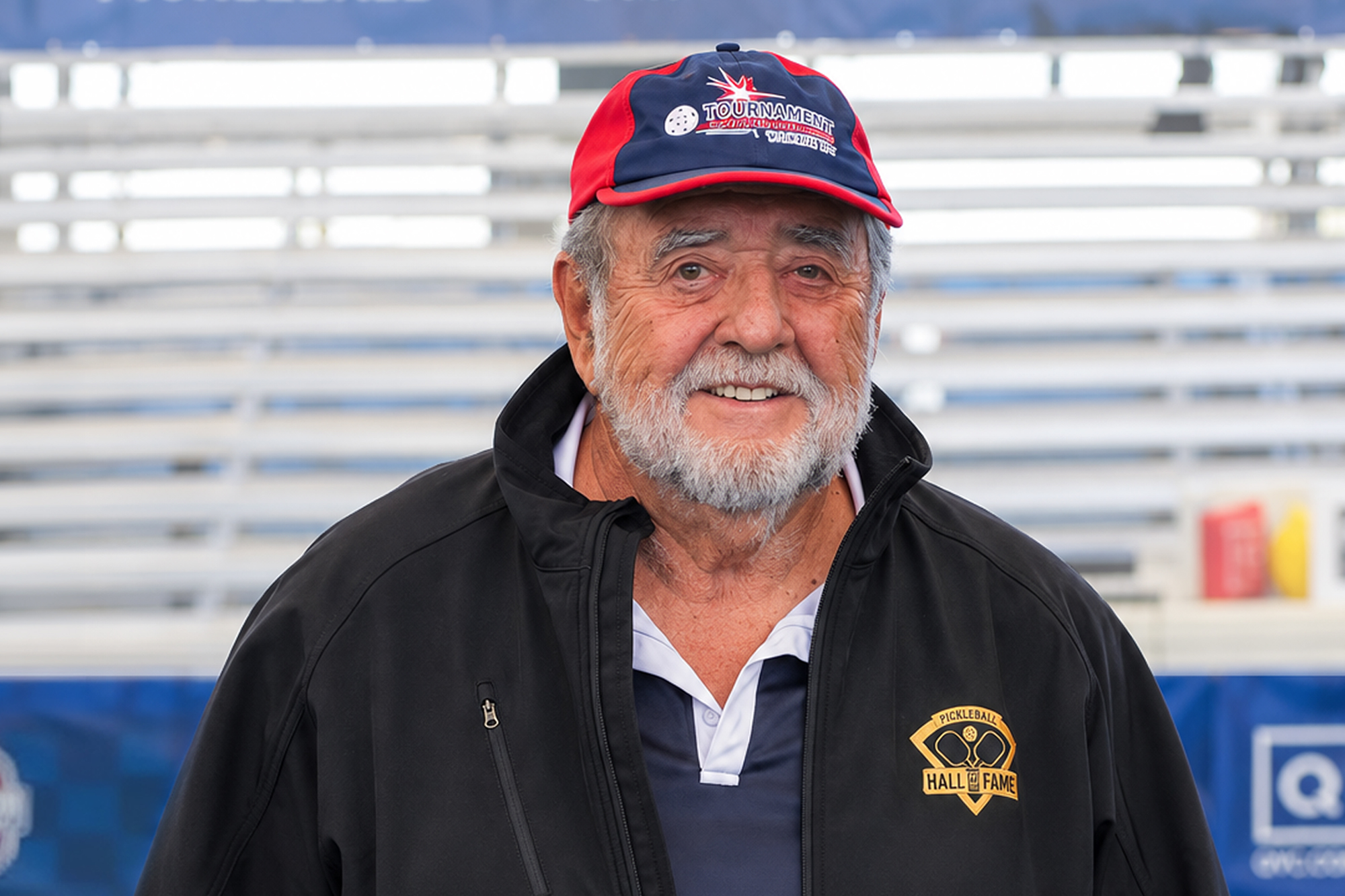
The Father of Professional Pickleball
Before professional pickleball became a business, John Gullo was building the foundation for what it could become
By Adriana Falco
October 28, 2026 • 16 min read
Ahead of His Time
John Gullo was 64 years old when his heart nearly killed him.
It was 2008, and Gullo was attending a Burger King convention in Puerto Rico when he went snorkeling on the first day of the trip and experienced congestive heart failure in the water. He eventually made it home, and on November 1 underwent major bypass surgery. Weighing more than 300 pounds, the longtime businessman found himself facing a recovery that would unexpectedly redirect the next chapter of his life.
Cardiac rehabilitation took him to St. George, Utah, where the prescribed routine included treadmills and the familiar machinery of recovery. Gullo hated it, but then he noticed a sign advertising something he had never tried before: pickleball. He went out and played, and what began as an alternative to rehabilitation became something much larger. Gullo eventually lost roughly 100 pounds, dropping from more than 300 pounds to just over 200, and credits pickleball with playing an important role in the transformation.
The entrepreneur in him quickly began looking beyond what the sport was doing for his health. Within a few years, Gullo was putting his own money behind some of the best players in the country, creating the Tournament of Champions and introducing elements that are now taken for granted in elite pickleball. He put up significant prize money, paid referees, housed them, live-streamed matches and created a championship court designed for spectators.
Today, Gullo is known as the ‘Father of Professional Pickleball,’ a title rooted in his role in helping create a professional framework at a time when pickleball was still widely viewed as a recreational game. Years before today’s professional tours, team franchises, player contracts and expanding commercial ecosystem, he was asking whether pickleball’s best players could be treated as professional athletes and what would have to change to make that possible. His Tournament of Champions became an early proving ground for those ideas.
But the story of how Gullo became the person willing to bet on that future began decades earlier, in a Buffalo neighborhood where he learned some of the lessons that would shape the rest of his life.
A Goodfellas Neighborhood
Gullo was born in Buffalo, New York, on February 29, 1944, the youngest of seven children in an Italian-American family with roots in Sicily. Ask him what his childhood neighborhood was like, and he does not reach for a complicated description.
“If you ever saw the movie Goodfellas, that was my neighborhood.”
Organized crime was not an abstract cultural reference in the world around him. Gullo grew up in an environment where questionable characters, street influence and complicated family relationships were part of everyday life. His childhood, by his own account, included plenty of opportunities to head in the wrong direction.
His life began to change when his mother remarried while Gullo was a teenager. He makes a point of calling the man who entered his life his father, not his stepfather, and the distinction matters. One conversation with him when Gullo was 15 would remain with him for the rest of his life.
Not long after the marriage, Gullo was left alone while his parents went out for the evening. A party followed, and wanting to show off, he got behind the wheel of the family’s Austin-Healey 3000. He put the car into the wrong gear and drove it beneath a boat parked in the driveway.
His father did not immediately explode or deliver a punishment. Two weeks later, he sat Gullo down and asked whether he understood what he had done. Gullo thought he did. He had wrecked the car. His father had something else in mind.
“When you’re born, you got a name. It’s a good name. What you do with that name is important. Now, you’ve lost my trust. You have to understand the impact of losing my trust on your name.”
His father then told him to punish himself. Gullo paid to repair the car and did not drive again until he was 18.
“But that was the turning point from where I was going.”
The teenager growing up around one definition of power had been introduced to another: accountability. A name meant something. Trust could be lost. Actions carried consequences. Those ideas would surface repeatedly throughout Gullo’s life, in business, philanthropy and eventually pickleball.
Learning to Build Something
Gullo did not go to college. During high school, he worked as a cleanup boy in a meat department, then became an apprentice meat cutter and eventually built a career in the grocery business. He worked for Tops Markets and moved into supervision, but his ambitions kept pulling him toward something of his own.
An early venture with his brother in Henry’s Drive-In restaurants ended badly, sending Gullo back into the grocery industry. By 1970, however, another opportunity had appeared. Pillsbury had acquired Burger King, and Gullo decided to leave a good-paying position at Tops and start over as a Burger King night manager. It was a step backward financially, but he believed he could work his way forward again.
He did. Gullo eventually became a franchise district manager responsible for franchisees and restaurants across New York State and western Pennsylvania. The corporate environment taught him about operations, marketing and managing people, while also teaching him something about himself.
“My personality could never survive in a corporate environment.”
When one of his franchisees introduced him to a potential financial partner, Gullo saw an opportunity to become an owner. In 1976, after an eight-hour meeting with the man who would back him, he applied for a franchise and moved his family to Logan, Utah. He had never been west of Chicago, but the gamble became the beginning of a business operation that would eventually grow to 54 Burger King restaurants across Utah, Arizona and Wisconsin.
The significance of that career to his pickleball story is not simply that it made him successful. Decades in the restaurant business taught Gullo how to build organizations, market ideas, develop people, recognize opportunities and make decisions before the outcome was guaranteed. He learned how to look at something that already existed and imagine a larger version of it.
Years later, he would bring exactly that instinct to pickleball.
Business Builder to Community Builder
Community service had entered Gullo’s life long before pickleball. As a young man, he joined the Jaycees, an experience that pulled a self-described introvert into civic involvement and exposed him to the satisfaction of helping build something that benefited other people.

“I was the first one to do a high-money tournament,” he said. “I was the first one to pay referees. I was the first one to house referees. I was the first one to ever live-stream pickleball.”
He created a championship court with spectator seating and introduced the Lanius Cup, named for Bob Lanius, who developed software used to run the tournaments. Gullo was not merely staging matches. He was trying to create an environment in which the athletes, officials and audience experienced pickleball as a professional sporting event.
The distinction is important because professionalization is not created by prize money alone. It requires infrastructure around the competition. Gullo understood that instinctively from business. A product could be excellent, but how it was presented, supported and experienced helped determine how seriously people took it. Pickleball had the players, and Gullo wanted to build the stage.
The Tournament of Champions
The Tournament of Champions became the place where Gullo could put his ideas into practice. It was competitive pickleball presented with an ambition that exceeded what the sport had traditionally expected of itself.
Even the awards reflected that thinking. Instead of simply handing champions conventional medals, Gullo introduced oversized championship rings. The awards were intentionally substantial, something players could associate with winning a major event rather than another weekend tournament.
Over time, players who would become major figures in modern pickleball passed through the Tournament of Champions. Gullo remembers Anna Leigh Waters winning there when she was only 11 or 12 years old. The championship ring she received was comically large on a child’s hand, and Gullo remembers her mother quickly stopping her from sliding it onto her finger out of fear they would not be able to get it off.

Ben Johns became another familiar presence at the tournament. Gullo presented money winners with John Gullo Award rings, and Johns accumulated plenty of opportunities to receive them.
Those stories carry more significance in retrospect. Players who would later become recognizable stars were competing during a period when pickleball itself was still learning how to support stardom. The sport had talent, but talent alone does not create a professional industry. Events, audiences, media, sponsors, officials, prize money and opportunities to build careers have to develop around it.
For Gullo, the Tournament of Champions was never merely about putting on another tournament. It was an opportunity to show players, spectators and the wider pickleball community what the top of the sport might look like if someone treated it differently.
Giving Players a Voice
Gullo’s vision eventually expanded beyond tournaments. His business experience had exposed him to the early development of the NFL Players Association through a former business partner, giving him a view into the complicated relationship among athletes, ownership, money and organized professional sports.
As pickleball became more competitive, he began seeing a structural problem. Players were spending money to travel and compete, but there was little infrastructure to protect their interests or help them turn elite competition into a sustainable profession.
Gullo established the Professional Pickleball Federation with the idea of creating a player-driven organization. One conversation in particular captured why he believed something needed to change. Gullo remembers sitting with players and asking whether it was time to take professional pickleball to another level when Kyle Yates described the financial reality facing athletes trying to compete.
“I love this sport, but I can’t keep paying for it out of my pocket. I got to start earning money,” Gullo remembers Yates telling the group.
The comment went directly to the contradiction at the heart of early professional pickleball. Players could train like professionals, travel like professionals and compete like professionals, but passion could carry the financial burden only for a limited time. If pickleball wanted professional athletes, it eventually had to create a way for those athletes to make a living.
Today, the question sounds obvious. Professional tours, player contracts, sponsors, team owners, agents and investors are now part of the landscape. When Gullo was raising it, however, getting paid to play pickleball was itself a developing concept.
Learning From What Did Not Work
Not every idea Gullo pursued worked exactly as he intended, and he does not pretend otherwise. The Professional Pickleball Federation was structured around the players, but he later recognized limitations in trying to sustain an organization without a sufficiently independent for-profit business structure behind it. Money was depleted, and the model proved difficult to maintain.
The experience fits into a philosophy Gullo developed through decades of business. He distinguishes between what he calls positive and negative mistakes. A positive mistake happens while someone is attempting to accomplish something. A negative mistake comes from failing because a person never really tried.
“Life is about learning. It’s an everlasting process.”
Professional pickleball ultimately developed through structures different from some of those early experiments, but the questions Gullo was trying to solve did not disappear. How should elite players be compensated? Who represents their interests? How do tournaments become commercially sustainable? What does a professional presentation require? How does the sport create enough economic opportunity for its best athletes to make pickleball their career?
Those questions continue to shape the industry. Gullo was asking them when the industry itself barely existed.

Pro Pickleball Needed a Foundation
For all his association with professional pickleball, Gullo never viewed the top of the sport as separate from its foundation. Professional athletes could not exist without players discovering the game, communities providing places to play and younger generations seeing a future in it.
His investment in courts reflected that philosophy. His commitment to juniors made it even clearer. Through the American Dream Foundation, Gullo supported junior players with scholarship funding designed to help cover tournament entry and travel expenses. His research materials document more than $25,000 in scholarship funding dedicated to teenagers competing in Junior Play at the Tournament of Champions.
As his business career developed, philanthropy became increasingly important. Through the American Dream Foundation, Gullo supported children, families, schools and community organizations. His success had given him resources, but what increasingly interested him was what those resources allowed him to do for someone else.
That philosophy helps explain what happened after he discovered pickleball. When Gullo returned north from St. George and found that there was nowhere nearby to play, he did not simply complain about the lack of courts or search for another game.
“I donated the first four courts in Northern Utah,” he said.
Gullo helped organize the sport locally, formed a nonprofit pickleball association and began staging tournaments. His research notes credit him with helping establish the first dedicated public pickleball courts in Northern Utah and expanding access into additional communities. Gullo estimates that he personally helped finance roughly 30 courts.
What had begun as part of his recovery was becoming something else entirely. The player in Gullo enjoyed the sport. The community builder wanted more people to have access to it. The businessman, however, was beginning to see an opportunity that extended well beyond recreational play.
Was Pickleball Ready to Go Pro?
By 2012, Gullo had become deeply involved in the game, and a question was taking shape in his mind.
“I said, ‘You know, is pickleball ready for professional pickleball?’”
At the time, the question was far more audacious than it sounds today. The modern professional ecosystem of tours, contracts, team franchises, sponsorships and substantial purses did not exist. Pickleball was still widely associated with recreational play, particularly among older adults, and there was no established blueprint for turning its best competitors into professional athletes.
Rather than wait for someone else to create one, Gullo decided to test the idea himself. He invited 36 of the best players he could find and put his own money behind the competition. The following year, he established the Tournament of Champions and began building an event around a simple premise: if elite pickleball players were expected to perform like serious athletes, the tournament surrounding them should treat them that way.
That meant rethinking nearly every part of the experience. Prize money mattered because winning needed to carry financial value. Professional officiating mattered because serious competition required consistency and credibility. Presentation mattered because spectators needed to feel that they were watching something important. Gullo began assembling those pieces before there was an established professional model to copy.
The investment was consistent with a pattern that had followed him from business into philanthropy. Gullo believed people needed opportunity before they could demonstrate what they were capable of doing with it. His own life had been shaped by people who intervened at important moments, from the father who taught him about trust to business partners who were willing to take a chance on him.
As his resources grew, Gullo increasingly tried to become that person for others. Pickleball simply gave him another place to do it.
Watching the Sport Change
Gullo eventually stepped away from running the Tournament of Champions in 2021. By then, pickleball was accelerating toward the commercial future he had imagined years earlier. Professional tours expanded, investors arrived, team ownership became a business, sponsorship opportunities grew and players began signing contracts that would have been difficult to imagine when Gullo first put his own money behind elite competition.
He appreciates what that growth has made possible, particularly the ability of athletes to earn money from the game. Yet he also remembers an earlier pickleball culture in which financial considerations were less central and the distance between the sport’s strongest and weakest players felt smaller.
“The pros really loved the sport,” he said of the earlier era. “The money was secondary. That’s the biggest change I’ve seen in the pro end of it.”
He remembers open play in which advanced competitors mixed with beginners and instruction happened naturally as players shared courts. “The really good players played with everybody. Everybody taught everybody.”
The nostalgia does not erase the value of what professionalization has created. It does, however, reveal one of the complicated realities of success. Growth creates opportunities while changing the culture that existed before them. A sport with serious money, professional careers, investors and commercial interests cannot function exactly like the smaller community that preceded it.
Gullo has lived through both versions. He helped push pickleball toward one while retaining affection for the other.
Why His Role Mattered
Professional pickleball did not emerge because of one person. Its development has involved generations of players, tournament directors, volunteers, governing bodies, entrepreneurs, brands, investors and communities.
Gullo’s contribution sits at a particular turning point in that history. He looked at high-level pickleball and recognized that improving the athletes alone would never be enough. The environment around them also had to change. A professional sport needed credible officiating, money worth competing for, an audience that could watch beyond the venue and an event experience that communicated that what happened on the court mattered.
His importance lies not simply in being early, but in acting on those ideas. He used his own resources to test whether a more professional version of pickleball could work, then kept expanding the experiment. The Tournament of Champions became the most visible expression of that effort, while his work with player organization, courts and juniors addressed different parts of the same larger question: what would pickleball need if it were going to become more than it was?
The industry that eventually emerged was far larger and more complicated than any one person could have created. Yet many of the things Gullo was trying to establish no longer require an argument. Professional players expect to be paid. Major matches are broadcast. Officials are part of serious competition. Events are built for spectators. Young athletes can look at pickleball and see possibilities that barely existed when Gullo first asked whether the game was ready to go pro.
The title ‘Father of Professional Pickleball’ rests in that transition. Gullo did not invent the sport. He helped push it toward seeing its best players, and presenting them, as pros.
Beyond Pickleball
Pickleball occupies only one chapter in an unusually full life. Gullo has been a meat cutter, grocery manager, restaurant operator, entrepreneur, marketer, philanthropist, tournament founder and sports organizer. He has built businesses, supported community projects and worked with young people, and he recently put many of those experiences into a memoir, Extraordinary Adventures of An Ordinary Man: Determination, Creativity and Love for Country.

The title captures something essential about how he views himself. There is little ordinary about a life that began in a difficult Buffalo neighborhood, moved through a 54-restaurant business empire, survived a life-threatening cardiac event and then intersected with a paddle sport at precisely the moment when someone with Gullo’s instincts could begin asking what it might become
Yet he does not frame the story primarily around the size of the business he built or the money he made. During his interview, he repeatedly returned to young people, role models, mistakes, happiness and the responsibility to pass along what a person has learned.
He once spoke to junior pickleball players about his two sons, whose lives followed very different educational and professional paths, before giving the young athletes the lesson he wanted them to remember.
“It’s more important to be happy than it is to make money.”
Coming from a businessman, the statement could sound contradictory. In Gullo’s life, the two ideas are connected. Business success gave him the ability to invest in communities, courts, tournaments, players and young people. Money was useful because of what it allowed him to build and whom it allowed him to help.
The Legacy Beyond the Firsts
There is a temptation when writing about pioneers to reduce their stories to a list of firsts. Gullo has plenty of them, particularly in the early professional presentation of pickleball. But firsts are historical markers. Legacy is what remains after other people adopt the ideas and no longer think of them as unusual.
Paid referees no longer sound revolutionary. Neither does live streaming a major pickleball tournament, constructing a championship court for spectators or offering meaningful prize money to elite competitors. The professional game has advanced far beyond the scale of Gullo’s early Tournament of Champions events, but the fact that those elements now feel ordinary is part of what makes his story significant.
The same is true of the larger question he asked in 2012. Whether pickleball was ready for professional pickleball no longer needs an answer. Professional athletes now build careers around the game, companies invest in them, fans follow them and businesses have been built around the sport.
Gullo’s own definition of legacy is much more personal. After decades of building businesses and organizations, his focus increasingly rests on whether the lessons of his life can make a difference to someone coming behind him.
“If I help one kid to live my life, it’s all been worth it.”
The statement brings his story back to the lesson he received at 15. His father had taught him that what he did with his name mattered. Gullo spent the decades that followed building that name through business, community service, philanthropy and eventually a sport he discovered almost by accident while recovering from heart surgery.
Pickleball did not need John Gullo to invent it. By the time he arrived, people had been playing the game for decades. What he recognized was something different: the possibility that the best players could become professionals and that the sport around them could begin behaving professionally before the rest of the world was convinced it belonged there.
He put his money behind that belief. He built courts, created opportunities, paid officials, increased prize money, streamed matches, supported players and tried to give them a voice. Some of his ideas endured directly, while others became early attempts at solving problems the sport would continue working through as it grew.
More than a decade later, professional pickleball bears little resemblance to the small competitive world Gullo first encountered. The money is bigger, the organizations are larger, the athletes are more visible and the stakes are higher. Yet the central idea he was pursuing is no longer in question.
John Gullo saw professional pickleball before professional pickleball had fully learned to see itself.
That is how he became the ‘Father of Professional Pickleball.’ ●
About Adriana Falco
Adriana Falco is the Founder and Editor-in-Chief of The Pickleball Weekly, a global digital magazine reaching readers in over 125 countries across six continents. A pickleball player since 2012, she combines more than 25 years of executive leadership with a passion for storytelling that captures every facet of the sport. With a career from international technology companies to major news organizations, Adriana covers the people, businesses, innovations, and global trends shaping pickleball’s future, with a mission to connect and inspire the worldwide pickleball community through credible journalism and compelling stories. She is also the author and creator of the Pickleball Pip children’s book series.

Read the full magazine issue! Click below, then tap Full Screen for the best reading experience.
