
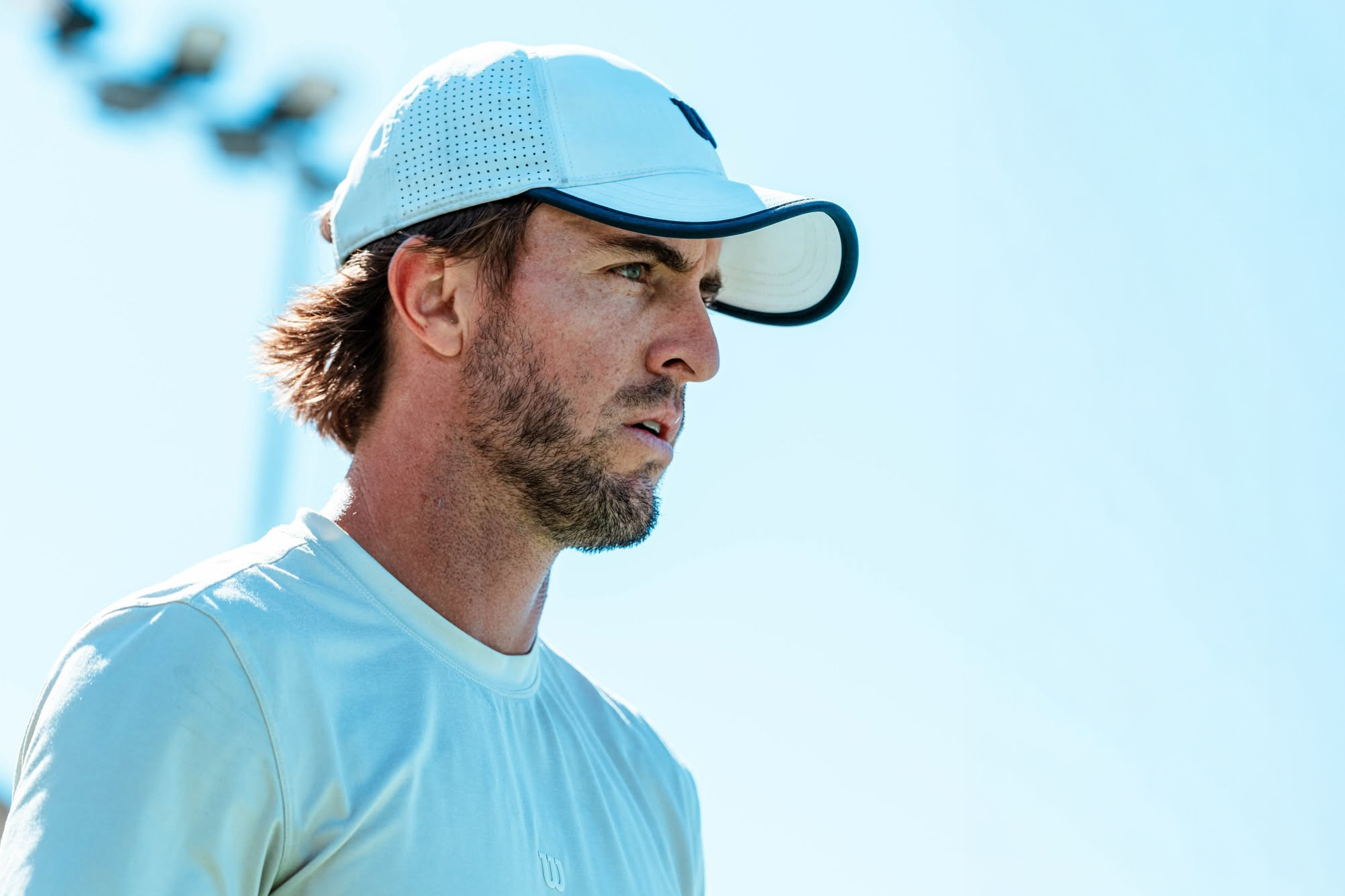
Hunter Johnson: Big Fish, Small Pond
Why Hunter Johnson traded a promising tennis career for a sport that barely existed
By Adriana Falco
August 19, 2026 • 16 min read
MOST RALLIES IN professional pickleball start and end the same way. All two or four players race to the kitchen line to trade polite, soft, and patient dinks until someone finally blinks, slips, slams, or misses and the net battle begins.
Hunter Johnson is one of the few pro players who often just does not rush the net. Instead, he stays back, arm loaded with a tennis swing built over two decades and lets his heavy topspin groundstrokes do the work that a trip to the kitchen line is supposed to do for everyone else.
At first glance, it looks like the wrong way to play America’s fastest-growing sport. But this move, or perhaps a premeditated tactic, has helped make Hunter one of the most dangerous singles players in the world of pickleball, a former World No. 1 who still sits at No. 3 in the men’s singles rankings on the PPA Tour as of mid-2026.
Hunter did not arrive at that style of play, or the ranking, by accident. He and his identical twin brother, Yates, spent years grinding through professional tennis before either of them had ever picked up a paddle, with Hunter achieving a career-high ATP doubles ranking of 198 and collecting 14 professional titles along the way. The decision to walk away from that career for an unproven sport was as calculated as anything he does from the baseline today.
He broke through in 2024, and by August 2025 he had overtaken Federico Staksrud to reach the World No. 1 ranking in men’s singles, the two of them trading the top seed back and forth in what has become the tour’s most watched rivalry. The 2026 season has kept both of them near the top of the sport: Johnson opened the year with a dominant gold medal run at the Minneapolis Open, took silver at the Cape Coral Open after a final’s loss to Staksrud, and answered it a few weeks later at the SXY Newport Beach Open, beating Staksrud in a tight two game final to reclaim the title.
What follows is a conversation with Hunter Johnson about the decision that got him here, the brother who has shaped nearly every step of the way, and the singles style that broke the sport’s own rulebook on the way to the top.

“My dad even built a tennis court in our backyard … He was our coach in basically every sport we played, our whole lives.” — Hunter Johnson
Playing His Own Game
Q: Before pickleball was in your life, there was tennis. What was it like growing up in a tennis family in a ski town?
JOHNSON: I was born and raised in Taos, New Mexico, a little ski town on the border of Colorado. My dad moved there out of college and taught tennis in the warm months and skiing in the cold ones and met my mom bartending at a lodge. My mom had come in looking for aspirin, and my dad offered her a ski lesson instead. They dated long distance for about a year before she moved back to Taos for good.
Back then, my dad taught tennis for six months of the year, skiing for four, and for two months my parents would go to South Padre Island so he could windsurf. Yates and I were always too young to do that ourselves, but we were already living a pretty on-the-go childhood before we ever went pro at anything.
We played hockey, skiing, baseball, soccer, and tennis in whatever season called for it. My dad even built a tennis court in our backyard, and he’d shovel snow off it for two hours some mornings just so that Yates and I could get 30 minutes of hitting in before a weekend tournament. He was our coach in basically every sport we played, our whole lives.
Q: You and Yates ended up choosing tennis over baseball and eventually left New Mexico for it. How did that unfold?
JOHNSON: We moved to Arizona for better tennis opportunities before eighth grade, and by our sophomore year of high school we couldn’t keep playing both baseball and tennis at a competitive level, so we had to choose. It wasn’t really about one sport having less competition. We were small and lanky, which fit tennis better than it fit baseball, and honestly, we were tired of wearing long pants in that Arizona heat.
We moved again before senior year, this time to New Braunfels, Texas, to be closer to our grandparents. From there I went to college in Louisiana-Lafayette before transferring to SMU in Dallas, where Yates and I became the winningest doubles team in the school’s history. We turned pro in doubles right after, and we both made it to the top 200 in the world on the ATP tour. We did that for about four years.
Q: What finally convinced you to walk away from that and try pickleball?
JOHNSON: It was the end of 2021, going into our tennis off-season, when a company called Diadem asked if a couple of tennis players wanted to come try it out.
At first, we said no. We weren’t going to give up our dream of playing Wimbledon and the U.S. Open to go play pickleball. But we thought about it more, and the truth was, pro doubles tennis is a very tough lifestyle. There was no real pathway for it on TV, you had to get really lucky in the sport. We’d also already picked up some injuries along the way. Senior pro Beth Bellamy was actually a part of it, too. She kept encouraging us and convinced us to give the sport a real shot.
So, we said, “you know what, let’s be big fish in a small pond. Let’s get in before everyone else does.”
We saw the future of pickleball and what it could become, and I think we got in at the perfect time. We made the jump and got punched in the mouth for about six months figuring out the pro game, and then we started getting big wins. We couldn’t have made a better decision in our lives at our age, and we haven’t looked back since.
It ended up coming full circle later on when Yates and I later convinced Beth’s son, Roscoe Bellamy, to join the PPA Tour. His dad, Steve Bellamy, was the guy who founded the Tennis Channel. So, when Roscoe and I played each other at a tournament in Lakeland and it was broadcast live on the Tennis Channel, Steve was watching. It was this awesome full-circle moment where everything came back around to where we all started.

“There are a lot of different chess pieces moving, a lot of different strategies, and one approach doesn’t work against every player.” — Hunter Johnson
Q: You and Yates have spent your entire athletic lives training and competing together. What’s that dynamic actually like?
JOHNSON: You’re kind of a built-in hitting partner. It was the same in tennis, so pickleball is no different. When we’re not together, we practice with other people, but for the most part we practice together quite a bit. We don’t really have a coach, honestly, we coach each other.
We’re both very analytical, we get that from our dad, and we’re pretty observant of ourselves. My dad is more of a superfan at this point. He loves watching and supporting us and he’ll give us his two cents, but for the most part it’s me and Yates in it together.
Q: Is there a rivalry when you two end up on opposite sides of the net?
JOHNSON: It’s not always simple. We share the exact same strengths and weaknesses, so playing each other is like playing a mirror image of yourself. We played each other in the Masters tournament earlier this year, in the third round, and it went 11-9 in the third. I was able to squeak it out, but Yates was playing really well.
Yates is older by 22 minutes, but I’m the taller one. I joke that I stayed in a little longer to get more nutrients, while he’s got the bigger legs and calves. He had been out with a hip injury before the tournament. Before he got hurt, Yates was ranked No. 13 in singles, while I was No. 42. I kept losing in the second round to top five seeds, and then he got injured. That ended up being the same tournament where I won my first PPA title. It’s strange how that worked out. Even then, Yates was on the bench coaching me that entire Sunday. I couldn’t have done it without him.
Q: You’ve become known for staying back at the baseline instead of rushing the net like most singles players. How much of that is a strategic choice versus just instinct?
JOHNSON: It really depends on who you’re playing and what you’re doing in that point. If I’m going to drive hard, most of the time my read is to stay back and wait for an easier ball to come in on, especially if someone’s first volley at the net is really good. There are a lot of different chess pieces moving, a lot of different strategies, and one approach doesn’t work against every player. You always have to be willing to switch it up.
Q: You’ve mentioned Mike and Bob Bryan as mentors going back to your tennis days. How did that relationship start?
JOHNSON: They were the greatest doubles team in tennis history, and also identical twins, so that was always something we looked up to.
We met them when we were younger through their dad, Wayne Bryan, and once we got old enough, in college, we started being their hitting partners at big pro tournaments. Every time we were in the same town or at the same event, they’d give us advice, we’d hit with them, and we’d go to dinner.
We still keep in touch with them today. We’ve always wanted them to get into pickleball, even at the senior level, but they’re still so heavily involved in tennis that it hasn’t happened yet.
Q: You play both MLP and the PPA Tour. How do you balance the two, and how has your team situation evolved?
JOHNSON: Honestly, I like the switch up. MLP has its own season in the summer now, and since I play all three disciplines in PPA, singles, doubles, and mixed, MLP ends up being almost like a little off-season where my body gets some rest and I can get stronger.
I was with the Mad Drops for a couple of years after getting drafted. You don’t get a say in that. They draft you and you try to convince them to keep you. It was an amazing two years, and honestly, I wish I was still part of it. It’s a great organization. But with the rule changes in MLP, everybody is always moving around.
Earlier this season, I was with the Chicago Slice. We were building something there and it was a lot of fun.
Right now, I am with the St. Louis Shock. We are looking to win a championship and take home the MLP title.

“In singles, I naturally fall into a different kind of ‘aura,’ as Anna Bright complimented me on.” — Hunter Johnson
Q: You are a dominant singles player and have proven to be a true “DreamBreaker Equalizer,” recently executing a dramatic walk-off win at MLP Orlando to secure a 21-17 victory right after your high-profile trade to the St. Louis Shock. When everything is on the line in those final points, what is your mindset, and how do you mentally shift gears from playing doubles in MLP to absolute singles domination?
JOHNSON: Getting traded from the Chicago Slice to the St. Louis Shock, I was needed to fill the gaps at the No. 1 spot for the DreamBreakers. They needed me to give them the best chance to win a championship. I humbly accepted and came onto the team knowing my role was for singles and not so much doubles. It’s not an easy transition, but in singles, I naturally fall into a different kind of “aura,” as Anna Bright complimented me on. I just have to lock in and do what I do best and try to win as many singles points as I can for the team to help give us that advantage. I finally got to show them my worth and clinch the match in Orlando. It was an amazing feeling to share with the team!
Q: Professional pickleball has you on the road 25 to 30 weeks a year. What’s that lifestyle really like?
JOHNSON: We joke that we don’t really live anywhere, we just stay in places. Some stretches we’re only home a week out of every two months. But we grew up doing the exact same thing in tennis, so it’s really all we’ve ever known, and I think that gives you a certain perspective. It’s better than an office job. Traveling is hard, sure, but you get to wake up somewhere new, and there’s always time to settle down later. Right now, this is what you’re supposed to be doing at this age.
Q: You’ve built quite a life off the court too, with sponsorships, a docuseries appearance, and clinics. How does that side of things work?
JOHNSON: It kind of happened naturally. With Picklebalm®, I actually started using their product in the players’ lounge in Las Vegas. My knees were hurting that week, and it had way better ingredients than an Icy Hot, ingredients that won’t irritate your eyes if you accidentally touch them after applying it. It smelled great, so I just kept using it every day. Somehow, they got connected with my agent, and it was an easy, organic transition into a sponsorship.
I’m also currently in talks with a couple of paddle companies too, nothing signed yet, but I’m looking to eventually sign with a brand I can really grow alongside long term.
As for Partners, they reached out to a handful of players, and, at the time, I was working my way up to number one in singles. So, the story ended up being about how I got through some tough stretches on tour and eventually got there.
I’ve also started doing some high performance clinics when my schedule allows it, including one recently in Sarasota. I don’t have a YouTube channel yet, that’s not really my forte, but I do some content on Instagram, and I’d like to eventually get into more instructional videos, especially around singles strategy, since I think that’s a side of the game a lot of players don’t fully understand yet.
Q: Where do you see the business of pickleball heading, especially globally?
JOHNSON: What I love most about pickleball is, honestly, the connections you make. The relationships happen faster than they ever did in tennis. Yates and I like to look for opportunities to invest in companies or be part of them before we stop playing, so we’re always planting those seeds.
Globally, I think the Asian market is exploding right now, like the way pickleball was exploding here two or three years ago. The PPA is doing good work trying to expand internationally. The one thing they have that we don’t yet is real structured player development, actual pathways to develop someone into a pro. It’s still pretty slow here on the pro development side, even though the rec and amateur side has boomed.

“We saw the future of pickleball and what it could become … We couldn’t have made a better decision.” — Hunter Johnson
Playing It Differently
There is a version of Hunter Johnson’s story that reads as pure calculation, a series of bets that all happened to land: tennis over baseball, Texas over Arizona, a paddle sport with no television deal over the pro doubles tour he had already spent four years building.
There is another version that is really about a brother, a shared childhood spent on the same courts, under the same coach, that somehow never curdled into resentment even when their paths through pickleball briefly diverged, one twin injured and coaching from the bench while the other finally broke through.
Both versions are true, and neither one fully explains a player who still plays pickleball like it owes something to tennis, refusing to abandon the baseline just because everyone else in the sport agreed the net was the better real estate.
Johnson is already thinking about the version of his career that comes after the rankings, the relationships he can turn into equity, the technology he thinks the sport still needs, the brand he wants to grow alongside rather than simply endorse. For now, though, he is still the player staying back while everyone else rushes forward, patient enough to wait for exactly the right ball to attack. It has worked so far. There is no obvious reason to think it stops working anytime soon. ●
About Adriana Falco
Adriana Falco is the Founder and Editor-in-Chief of The Pickleball Weekly, a global digital magazine reaching readers in over 100 countries across six continents. A pickleball player since 2012, she combines more than 30 years of executive leadership with a passion for storytelling that captures every facet of the sport. With a career from international technology companies to major news organizations, Falco covers the people, businesses, innovations, and global trends shaping pickleball’s future, with a mission to connect and inspire the worldwide pickleball community through credible journalism and compelling stories.

Read the full magazine issue! Click below, then tap Full Screen for the best reading experience.
