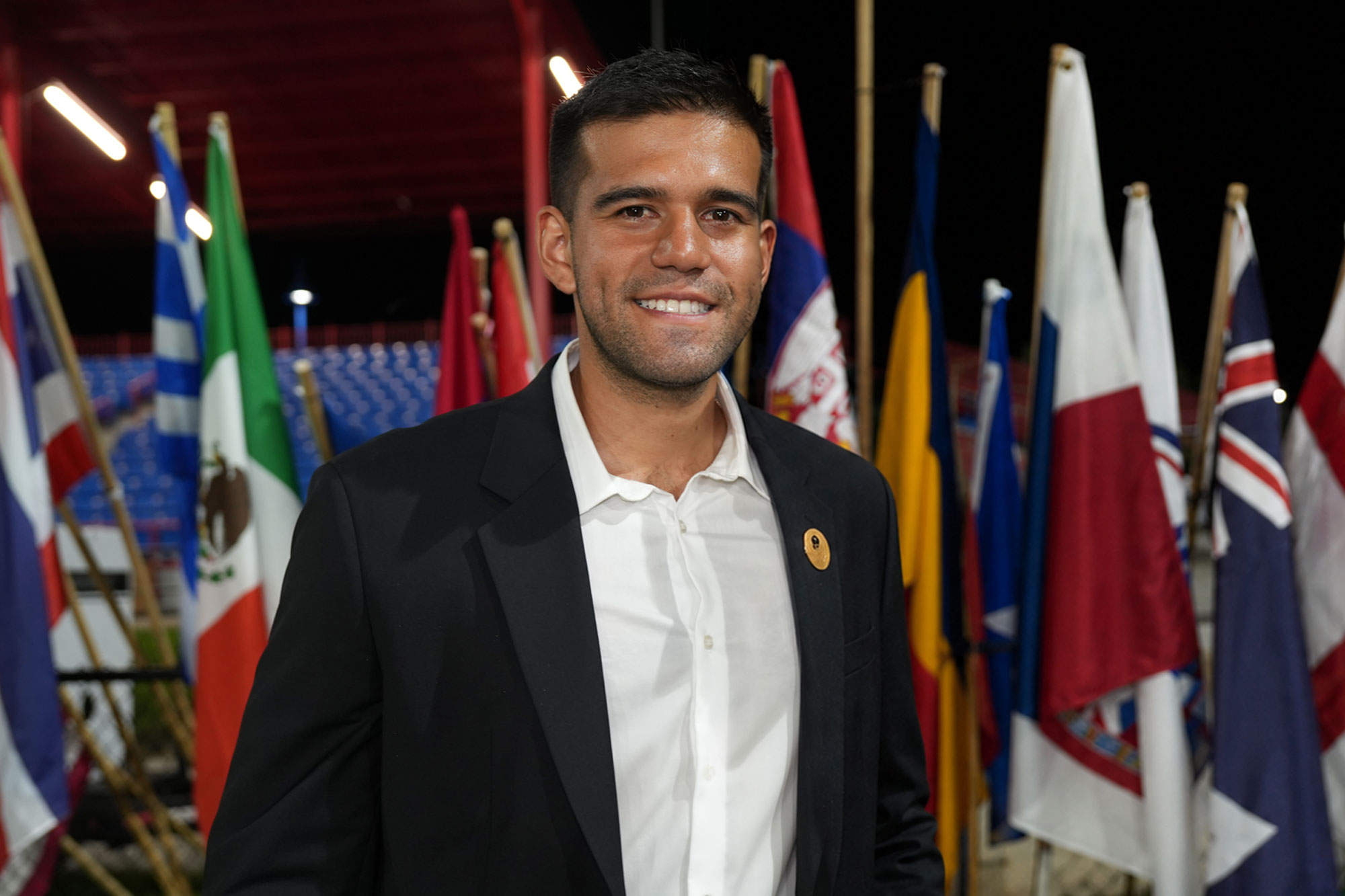
Hercilio Cabieses on Building the World Cup
By Carl Foster • August 26, 2026 • 16 min read
One world. One game. One champion.
IF PICKLEBALL IS to reach the Olympic stage one day, Hercilio Cabieses wants to help build the international foundation that gets it there.
The Peruvian professional pickleball player has become a driving force behind the sport’s international growth. Alongside his sister, Miranda Cabieses, he co-founded the Cabieses Foundation to expand access to pickleball in Peru, provide resources to underserved communities, and organize tournaments and clinics.
Cabieses also played a pivotal role in creating the Pickleball World Cup. What began as a pilot tournament with 14 countries in 2023 grew into the first full World Cup in Lima, Peru, in 2024, with 32 countries. In 2025, the competition moved to The FORT in Fort Lauderdale, Florida, where 68 countries and more than 2,500 athletes participated.
Now the World Cup is heading to Asia for the first time.
From August 30 through September 6, Da Nang, Vietnam, will welcome thousands of athletes from around the world for the 2026 Pickleball World Cup, continuing a remarkable expansion of an event built around national pride, international competition and the belief that pickleball can become a truly global sport.
Cabieses’ work extends well beyond the World Cup. As president of Pickleball Peru, he has focused on expanding the sport’s reach and accessibility while helping introduce pickleball to communities throughout Latin America. Through the Cabieses Foundation, that mission has grown to include children, schools, universities, underserved communities and people with disabilities.
He has also shared that vision at the World Pickleball Conference, where he has spoken about the growth of pickleball in Peru, the development of the World Cup and his larger ambition for the sport.
Now, with the World Cup preparing for its biggest international stage yet, Cabieses is looking beyond Da Nang toward an even bigger goal: seeing the world’s best pickleball players one day walk onto an Olympic court representing their countries.

“The difference between an international tournament and the World Cup is national identity.” — Hercilio Cabieses
From Peru to the World Stage
CARL: Give us some background on how you found and started playing pickleball? Did you play other sports growing up that you feel have helped you grow in Pickleball?
HERCILIO: My journey into pickleball actually started at the beginning of 2020, when I was living in Indianapolis, Indiana. I grew up playing tennis. I started going to tennis clubs looking for groups to join or people to play with, and I realized that there were a lot of people playing pickleball. It looked like such a fun and social sport, so I decided to give it a try.
My sister Miranda joined me in February 2021 when she traveled to the United States. She immediately fell in love with the sport and began playing every day.
We both grew up playing tennis and representing our club in Peru. Miranda also practiced gymnastics, swimming, chess and billiards, so she developed a very diverse athletic background.
CARL: When did you start playing competitively and what has been your best result and highlight of your on-court tournaments?
HERCILIO: A couple of months later, I connected with some of the best players in town, and they introduced me to the tournament scene. I decided to give competitive pickleball a try, and I made the podium right away. That experience gave me the confidence to take the next step, and just a couple of months later, I decided to join the professional tour.
Without a doubt, one of my biggest highlights on the court was winning gold in both Mixed Doubles and Men’s Doubles at the 2021 US Open. Winning at one of the biggest and most prestigious events in the sport so early in my pickleball journey was an incredible experience and gave me even more motivation to continue competing at the highest level.
We started competing almost immediately after discovering pickleball. Miranda played her first tournament only about two weeks after starting and finished fourth in mixed doubles. Months later, she won two gold medals at the Juniors US Open tournament.
CARL: You and your sister have a great bond and story of growing pickleball worldwide and in your home country of Peru. How did this start, and what are your vision and mission for the Cabieses Foundation?
HERCILIO: I have always been very proud to be Peruvian, so every time I compete, I wear a Peruvian shirt. As more people began to recognize me and I was eventually approached by the international federation, we realized that we shared a bigger vision for the sport, including the dream of one day seeing pickleball in the Olympic Games.
At that time, pickleball was unknown in Peru, and there was very little awareness of the sport throughout Latin America. That’s when we decided to establish Pickleball Peru, with the mission of making the sport accessible to everyone and introducing it to communities across the country.
As we started growing, we recognized that we needed resources to make that vision sustainable. That led us to create the Cabieses Foundation, which not only helped create job opportunities for local communities, but also allowed us to manufacture pickleball equipment and bring the sport to different parts of Peru.
What started as a mission to grow pickleball in our own country eventually became something much bigger. We were able to travel throughout the region, introduce pickleball to new communities, and help other countries discover and develop the sport. For us, it has always been about using pickleball as a vehicle to create opportunities, connect people, and make a positive impact beyond the court.

“When an athlete walks onto the court carrying the flag of their country, they are not simply playing for a ranking or a medal. They are representing their family, their community and millions of people who identify with that flag.” — Hercilio Cabieses
Building the Pickleball World Cup
CARL: How did the idea of The Pickleball World Cup get started and how long were you working on making the first one come to fruition at The FORT in FTL in 2025? Was there a driving force or partner mentoring or encouraging you to bring all these countries together?
HERCILIO: With the idea of growing pickleball throughout Latin America and globally, which started in 2021 with organic growth across the region, we decided to hold our first tournament in November 2023. With only eight weeks of preparation, we launched the first pilot edition and had 14 countries show up, including Peru. The response was far beyond what we expected, and that was the moment we realized we were building something much bigger.
That success gave us the confidence to take the next step. In 2024, we launched the first full edition of the Pickleball World Cup, bringing together 32 countries at the Pan American Games facilities in Lima, Peru. It was an important milestone, but we knew it was only the beginning.
In 2025, we took the World Cup to Fort Lauderdale, Florida, where more than 60 countries came together at The FORT. Seeing athletes from around the world competing under their national flags confirmed the power of the concept and the appetite for this type of event.
There have been many people and organizations who have supported us along the way, but the driving force has always been our belief that pickleball needed a truly global team competition built around national pride, representation, and unity.
What started as an idea to bring countries together has now become a mission: to build a World Cup that represents the global growth of pickleball and gives athletes everywhere the opportunity to proudly compete for their country.
CARL: What were your biggest challenges to get all the countries, and how many participated in your inaugural tournament in Florida? Was this event DUPR rated and what was the team format?
HERCILIO: I wouldn’t say there were major challenges when you work with passion. But if I need to mention one challenge, it would be to find the time to connect with each country to share our vision, and make them feel that they were not just participating in a tournament, but becoming part of something bigger.
The response was incredible. In 2025, we welcomed 68 countries to Fort Lauderdale, Florida, making it our largest edition at the time. More than 2,500 athletes participated across the World Cup and its associated competitions.
DUPR was an important part of the event and served as the Official Rating of the 2025 Pickleball World Cup. Our partnership with DUPR helped us create a transparent and measurable system for evaluating players and supporting the selection of national teams, while giving athletes from different countries a common competitive standard.
The World Cup itself is built around a national team format, with countries competing head-to-head across men’s, women’s, and mixed doubles, as well as men’s and women’s singles. Each team match combines these disciplines to determine which country advances. We wanted the format to reflect the strength of the entire team, not just one or two players, while giving athletes the opportunity to represent their country in different ways.
What makes the format special is that every point matters, because you are not playing only for yourself. You are playing for your country.
CARL: Was your first event televised? If so, where? How successful were you getting sponsors to participate in the first event and who were you able to attract? Do you feel the visible success of the previous World Cup has increased the response for Vietnam? If so, how?
HERCILIO: Yes. International visibility has always been an important part of our strategy. The Pickleball World Cup was first broadcast in Peru through Movistar Deportes in 2024, and in 2025, the event reached an even wider audience through Telemundo Deportes Ahora in the United States, along with additional international platforms.
Behind that growth, we have built a strong team and a network of partners who have believed in our vision from the beginning. For the 2026 Heineken Pickleball World Cup, we are taking another major step forward with Heineken as the Title Sponsor and Franklin as the Official Ball, alongside other key partners supporting the event.
The 2025 edition proved that there is a real audience for international team competition and that brands can connect with fans through the emotion of national pride and representation. That success has significantly increased interest in the 2026 edition.
For Vietnam, we are expecting more than 3,000 athletes from more than 64 countries and territories. The event will take place in Da Nang from August 30 to September 6, 2026, marking the first time the Pickleball World Cup will be hosted in Asia.
For us, bringing the World Cup to Asia is more than simply moving the event to a new continent. It is an opportunity to showcase the global growth of pickleball and connect established pickleball markets with the rapidly expanding communities across Asia and beyond.

“The Foundation and the World Cup are connected by the same belief: pickleball can change lives.” — Hercilio Cabieses
The Road to the Olympics
CARL: Do you see bringing so many countries together for the Pickleball World Cup as a stepping stone toward pickleball becoming an Olympic sport? What is your number of countries looking like for Vietnam in late August?
HERCILIO: Absolutely. The Olympics have been part of our vision from the very beginning. We have always believed that the Pickleball World Cup was created to be a cornerstone in bringing the sport’s international community together, creating a platform where countries compete, athletes represent their nations, and the sport continues to develop in a more structured and unified way. We see that unity, combined with strong international representation and high-level competition, as an important step on pickleball’s path toward the Olympic Games.
But we understand that simply saying “pickleball should be Olympic” is not enough. A sport needs international participation, strong governance, standardized competition, national federations, youth development and a truly global footprint. That is why the World Cup is so important. We are creating a competition where countries from different continents compete under their national flags and build the infrastructure necessary for international sport.
For Vietnam, our current target is approximately 64 countries and territories, with more than 3,000 athletes expected.
But the goal isn’t simply to reach a number. We want every continent represented and every delegation to feel that they belong on this stage.
CARL: We see global growth of pickleball exploding in Southeast Asia, India, Australia, China and many countries besides North America. How do you truly make this an international flavor event like a World Cup soccer and the Olympics? I know you held a Parade of Nations at the previous World Cup. What will be special about Vietnam?
HERCILIO: This is exactly what we have been building from the first edition. The difference between an international tournament and the World Cup is national identity.
When an athlete walks onto the court carrying the flag of their country, they are not simply playing for a ranking or a medal. They are representing their family, their community and millions of people who identify with that flag.
That is why the Parade of Nations is so important to us. We want athletes to feel the same pride that you see in the FIFA World Cup or the Olympic Games.
Vietnam is particularly special because it represents a new chapter for the sport. This will be the first Pickleball World Cup in Asia, and Da Nang is a natural bridge between the established pickleball markets and the enormous growth happening across Asia-Pacific.
For 2026, we want Da Nang to feel like a true global festival: flags from around the world, cultural experiences, national delegations, athletes of different generations and communities coming together.
The message is simple: one world, one game, one champion.
A Legacy Beyond the Court
CARL: How does your Foundation fit into the Pickleball World Cup and what is your vision and mission with your sister to keep growing the sport in Peru and South America?
HERCILIO: The Foundation and the World Cup are connected by the same belief: pickleball can change lives. The World Cup is our international platform. The Cabieses Foundation is our social-impact platform.
We want to create access. That means introducing the sport to children, schools, universities, underserved communities and people with disabilities, while providing equipment, education and opportunities to compete.
That work started in Peru and has expanded into other parts of Latin America. We have seen first hand how quickly pickleball can bring people together because it is accessible and multigenerational.
Ultimately, we want the region not only to participate in global pickleball, but to help lead it.
CARL: Finally, Hercilio, it’s exciting to see the vision you’ve shared at the World Pickleball Conference now heading to Vietnam. What are your goals for this year’s World Cup, and has a location been selected for 2027?
HERCILIO: First, I want to say thank you. Having the opportunity to speak at the World Pickleball Conference and share our vision before the World Cup reached this scale has been very meaningful to me. Seeing that vision now becoming reality in Vietnam is incredibly rewarding.
Our goals for the 2026 Pickleball World Cup are ambitious. We want to welcome approximately 64 countries and more than 3,000 athletes, deliver the most professional and globally connected World Cup we have ever produced, and showcase Asia as an essential part of pickleball’s future. We also want to leave a lasting legacy in Vietnam, stronger local participation, more opportunities for young athletes and deeper relationships between the Vietnamese pickleball community and the rest of the world.
As for 2027, the dreams are getting bigger. We will be sharing the news on our platform after the event.
We have built something that will last for generations, and ultimately, we want to see the world’s best pickleball players standing on an Olympic court representing their countries.

“We have built something that will last for generations, and ultimately, we want to see the world’s best pickleball players standing on an Olympic court representing their countries.” — Hercilio Cabieses
From World Cup to Olympic Dream
What began as an effort to grow pickleball in Peru became a mission to bring nations together through the sport.
The numbers tell part of the story: 14 countries at the pilot event in 2023, 32 at the first full World Cup in Lima in 2024, 68 countries in Fort Lauderdale in 2025, and now thousands of athletes preparing to gather in Da Nang for the first Pickleball World Cup held in Asia.
But for Hercilio Cabieses, the larger measure of success is what those numbers represent. Every new flag brings another country into the conversation. Every national delegation strengthens the international infrastructure of the sport. And every young player who sees an athlete competing for his or her country sees a pathway that did not exist only a few years ago.
The journey that began with a Peruvian shirt on a pickleball court has grown into something far larger. From Peru to Fort Lauderdale and now Da Nang, Cabieses continues working toward the same vision: building a sport capable of connecting countries, creating opportunities and, one day, placing the world’s best pickleball players on an Olympic court representing their nations.
About Carl Foster
Carl Foster is the Chairman of the World Pickleball Conference and the CEO of Foster Events Group, LLC, where he specializes in the production and management of high-profile sports and entertainment events. With over 50 years of experience in broadcasting, fundraising, and event leadership, he produces Inside WORLD Pickleball and serves as a lead moderator for industry summits. He is a central figure in the professionalization of pickleball, connecting technology experts, organizational leadership, and the player community to elevate the sport’s presence on a global scale.

Read the full magazine issue! Click below, then click on the X in the lower bar to enjoy a full screen view!