
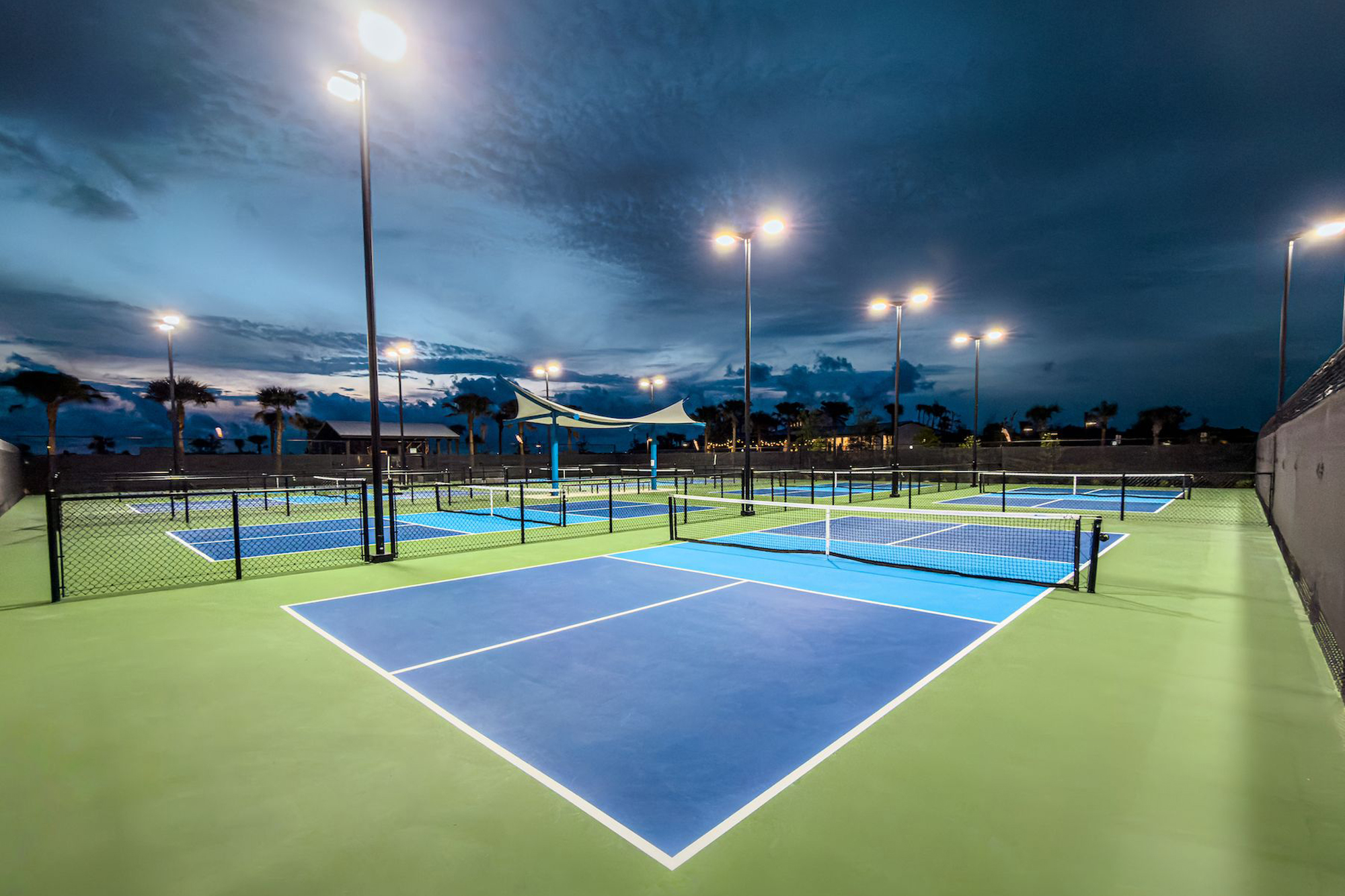
Photo credit: Fast-Dry Courts
Raising the Court Standard
Fast-Dry Courts’ Jeff McClure discusses the evolution of court construction, emerging trends and what it takes to build facilities that last
By Carl Foster
November 4, 2026 • 9 min read
In this week’s People Shaping Pickleball featured interview, I reconnect with Jeff McClure of Fast-Dry Courts, whom I first met at the Pickleball Minds business event in Princeton more than six years ago. It was the beginning of the pickleball boom, when courts could not be built fast enough to meet the demand for America’s fastest-growing sport.
Indoor facilities and franchises were beginning to open their doors, while municipalities and private country clubs were exploring ways to convert existing tennis courts or build new pickleball facilities to accommodate growing interest from members and their communities.
Recently promoted to Vice President of Sales at Fast-Dry Courts, Jeff has been at the forefront of major country club conversions, including Boca West and Boca Beach and Parks’ Patch Reef Paddle Club, where I play. I attended the opening of the first six pickleball courts at Patch Reef in 2001, when two of its 21 tennis courts were converted. Six additional courts were added before my third annual Boca Masters tournament in 2004. Just over a year ago, the facility expanded again with 18 covered pickleball courts.
Jeff has shared his expertise on panels at our World Pickleball Conferences over the past five years, offering insights into court construction and the potential pitfalls facility owners should avoid. He was recently honored with the prestigious 2026 Golden Pickle Business Award in Palm Beach.
Whether you’re considering a private backyard court or converting part of an existing tennis facility, Jeff and the Fast-Dry Courts team bring decades of construction experience and practical knowledge to the process.
Here are some insights from our recent conversation.
From Tennis Courts to Pickleball Facilities
CARL: Jeff, you’ve been involved in tennis court construction for years. When did you and Fast-Dry Courts first add pickleball to your business model?

JEFF: I’ve been in the industry for over 15 years, with my first seven spent in the field doing construction and the last eight in sales and management. Having worked on both sides helps me understand what we can deliver and what it takes to deliver it properly.
Fast-Dry Courts began incorporating pickleball around 2017–2018, with demand really gaining momentum during and after COVID. What started as requests for a few courts evolved into larger, dedicated facilities. Our background in tennis court construction gave us a strong foundation, but we also recognized that pickleball has its own needs when it comes to layout, fencing, lighting and the overall player experience.
CARL: How have you seen pickleball court construction grow over the past five years compared with tennis and the other sports you build?
JEFF: The pace has been remarkable. Five years ago, a customer might ask whether they should add a few pickleball courts. Today, the conversation is often about how many courts they need, whether they should cover them and how they can accommodate future growth.
Tennis is still a very important part of our business, particularly here in Florida. We continue to build and renovate quality tennis facilities. Pickleball has brought another level of demand, along with customers who are thinking much bigger about their racquet sports amenities. We’re seeing more interest in complete facilities, with seating, shade, lighting and gathering areas all considered from the beginning.
CARL: Since COVID, has your business been driven primarily by converting tennis courts or building new pickleball courts?
JEFF: It has definitely been a combination. Conversions gave many clubs and municipalities a practical way to introduce pickleball using space they already had. As participation increased, we saw more demand for dedicated facilities built from the ground up.
My advice is always to look at actual usage and long-term needs before removing tennis courts. We want to help customers accommodate pickleball while protecting the tennis programs their members or residents still enjoy.
An existing tennis court footprint also doesn’t automatically make a good pickleball layout. Safe spacing, access, drainage and fencing all need to be evaluated. Fitting the lines is only one part of building a court that works.
CARL: What are some of the biggest challenges with indoor courts compared with outdoor facilities?
JEFF: With outdoor construction, weather, drainage and site conditions are major factors. Indoors, particularly when converting an existing building, the challenge is often making the building suitable for the sport.
Column locations, ceiling clearance, lighting, air conditioning and acoustics can all affect the experience. The existing concrete slab also needs careful evaluation for moisture, cracks, joints and compatibility with the proposed surface.
A warehouse can look like the perfect space until you start laying out the courts and evaluating those details. Involving an experienced court builder early is valuable because you want to identify those limitations before signing a lease or committing to a layout.
CARL: Are covered outdoor courts, such as those at Patch Reef Park and Boca West, becoming a new phase of development?
JEFF: Yes, I see covered courts becoming a bigger part of the conversation, especially in Florida. Projects like Patch Reef Park and Boca West show how much thought is now going into player comfort and the hours a facility can realistically be used.
Shade can make a tremendous difference in our heat, and a properly designed cover can reduce some weather interruptions. It still requires careful planning for wind-driven rain, drainage, ventilation, lighting and the structure itself.
For clubs and municipalities, the value goes beyond adding an impressive amenity. It’s about making the courts more usable and giving members and residents a better experience throughout the year.
Designing Courts for Performance and Longevity
CARL: How involved does Fast-Dry Courts get with lighting, backdrops and windscreens?

JEFF: We get involved in all of it. A court can have a beautiful surface and still be frustrating to play on if the lighting is uneven or the ball disappears against the background.
We look at lighting placement, glare and uniformity, along with fencing, windscreens and surrounding sightlines. Indoors, wall colors and windows can be just as important. Outdoors, court orientation and the surroundings need attention early in the design.
My experience in the field taught me how closely these pieces are connected. I encourage customers to involve a court builder certified by the American Sports Builders Association (ASBA) from the beginning. Following our acquisition of Welch Tennis last year, Fast-Dry Courts became the only ASBA Certified Court Builder in Florida, bringing both certification holders under one roof. Both companies have been in business for over 40 years, providing a tremendous depth of construction knowledge and experience behind every project we take on.
As licensed general contractors, we also take the ASBA’s “Build it Right!” motto seriously. This means obtaining the required permits and building to applicable codes, including proper structural engineering for fencing, light poles and padel systems. The extreme wind loads we face in the southeastern United States, especially Florida, can require substantially larger foundations than standard installations elsewhere. Those details need to be addressed during design and permitting, even though customers may never see them once construction is complete.
CARL: How much of your business comes from private residential courts, and is that market still growing?
JEFF: Private residential courts are part of our business, alongside our club, community and municipal work. With the growth of pickleball and even padel, the smaller court footprint compared with tennis has made having a backyard court more realistic for many homeowners. People enjoy these sports and want to share them with family and friends at home.
Every residential project needs an honest discussion about available space, setbacks, drainage, lighting and proximity to neighbors. Noise should be addressed early as well.
We also have to be realistic about the layout. Having enough room for the playing lines doesn’t necessarily mean there’s enough room for a safe court. I would rather explain those limitations upfront than have homeowners invest in something they won’t be happy with.
CARL: How often do courts need to be replaced, and what maintenance do you recommend?
JEFF: The first thing I explain is the difference between resurfacing a court and replacing or reconstructing it. A worn acrylic surface doesn’t necessarily mean the court underneath has reached the end of its useful life.
A general rule of thumb is to plan for resurfacing every four to five years, but that depends on usage, exposure, the surface system and maintenance. The market the facility serves matters, too. A busy municipal facility or country club can have very different demands than a private residence or HOA. Busy indoor courts still experience wear, even without Florida’s sun and rain.
I recommend routine cleaning, keeping drains clear and addressing cracks, standing water or changes in traction promptly. Follow the surface manufacturer’s maintenance instructions and have a qualified contractor evaluate developing problems. Waiting until a court becomes a safety concern usually makes repairs more disruptive and expensive.
CARL: What surfaces do you recommend for player comfort, and which colors improve visibility?
JEFF: For customers concerned about comfort, I recommend discussing a properly designed cushioned court system. There are several options, and they don’t all perform the same way. We help customers understand the differences in cushioning, maintenance and cost while keeping consistent ball response and traction in mind.
The right system also depends on where and how the court is built. Geographic location, climate, underlying soil conditions, whether the substrate is concrete or asphalt, and whether the court is indoors or outdoors all influence our recommendation. A system that works well on one project may not be the right choice for another.
I wouldn’t promise that a surface will eliminate joint pain, but cushioning is an important option to evaluate.
For colors, contrast matters. Blues and other darker colors can provide good contrast with a yellow ball, along with clearly visible white lines. We also consider the background and lighting. The Fast-Dry Courts Color Selector Tool helps customers visualize different combinations and gives us a starting point for that conversation. Ultimately, a color combination should not only appeal to spectators entering the facility but also meet the practical needs of the players on the court.
The Future of Court Construction
CARL: Finally, Jeff, do you see padel, TYPTI and multisport facilities becoming part of Fast-Dry Courts’ growth over the next three to five years?

JEFF: I see opportunity in offering customers a broader range of racquet sports, and padel is certainly part of that conversation. TYPTI is interesting because it uses a pickleball-sized court, which creates opportunities to introduce another activity within an existing facility.
Over the next three to five years, I expect more owners to consider a mix of sports and social amenities. The right combination will depend on their members, customers, available space and operating plans.
What’s important for people to understand is that our relationship with customers extends well beyond the initial construction. Fast-Dry Courts is an ASBA Certified Court Builder and a licensed general contractor. Our sister company, 10-S Tennis Supply, which also houses the Dinkshot brand, is a national supply company providing the products and equipment customers need to operate and maintain their courts.
Together, we’re here for the lifespan of the court or facility. We begin with design and construction, support customers through maintenance and resurfacing, and eventually help with reconstruction when a court reaches the end of its useful life. We want to be the team they can call at every stage.
A Foundation for the Future
Having watched pickleball grow from a handful of converted tennis courts into a thriving industry, I’ve seen firsthand how important experienced court builders are to the sport’s future. Jeff McClure brings both practical knowledge and a clear understanding of what players and facility owners need. As pickleball continues to expand, the quality of the courts we build today will help shape the playing experience for years to come. ●
About Carl Foster
Carl Foster is the Chairman of the World Pickleball Conference and the CEO of Foster Events Group, LLC, where he specializes in the production and management of high-profile sports and entertainment events. With over 50 years of experience in broadcasting, fundraising, and event leadership, he produces Inside WORLD Pickleball and serves as a lead moderator for industry summits. He is a central figure in the professionalization of pickleball, connecting technology experts, organizational leadership, and the player community to elevate the sport’s presence on a global scale.

Read the full magazine issue! Click below, then tap Full Screen for the best reading experience.
