
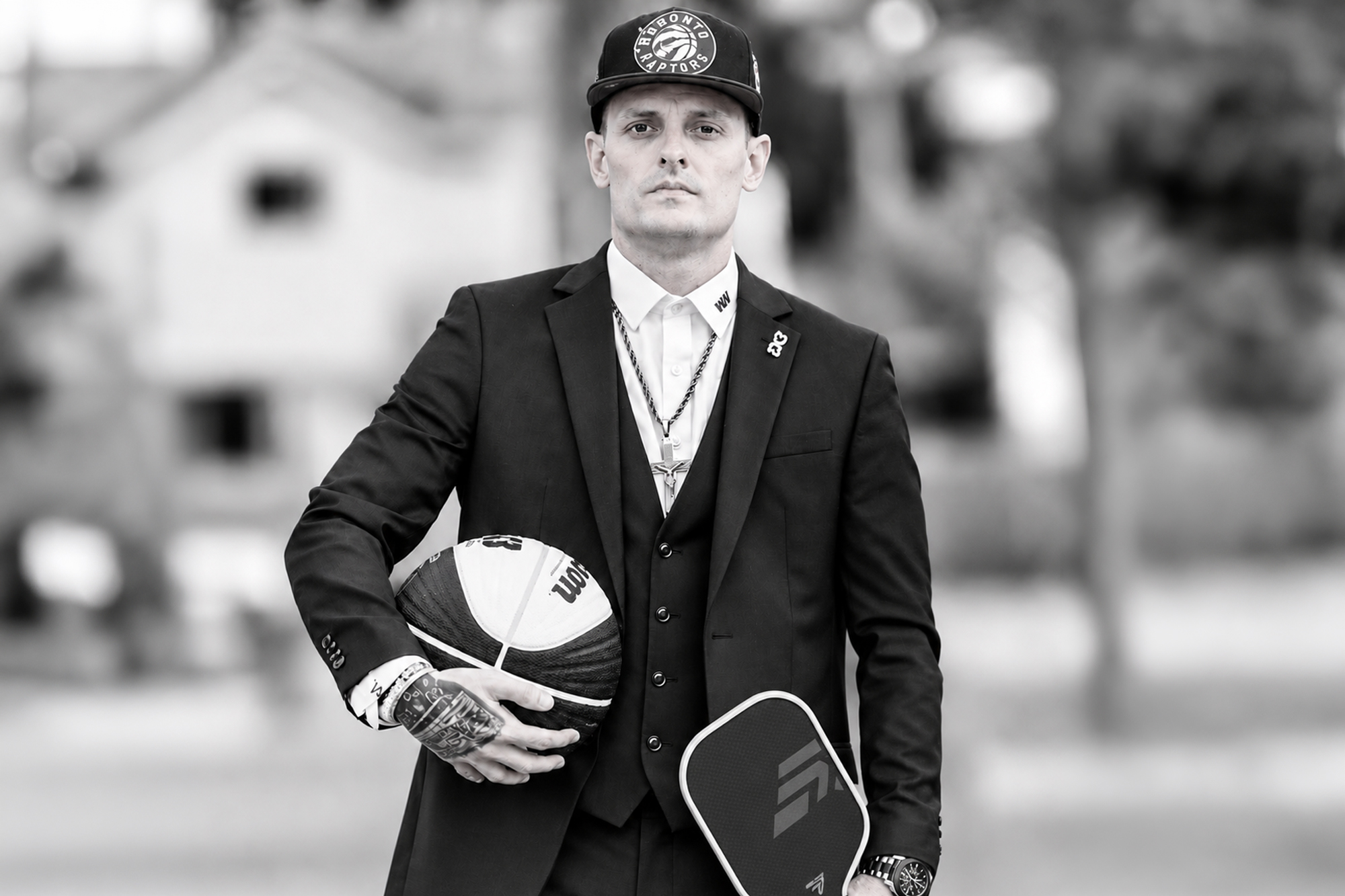
Photo credit: Michelle Ward
Become the King
“It’s like the Pokémon GO of sports.”
By Jacob Burton
October 21, 2026 • 8 min read
Filling a Gap
David Finlay grew up and is based in Hamilton, Ontario, Canada. He was raised in a single-parent household with his mother and four brothers. Growing up was not easy for the family. They lived in a low-income part of the city, where civic leaders were not prioritizing improvements to recreational and entertainment opportunities. Finlay recognized this gap growing up, and he has taken it upon himself to provide opportunities for children who need them, just as he once did.
Meeting his future wife and her then-two-year-old child rekindled his entrepreneurial mindset. He and his fiancée opened a clothing store in a mall, and the location initially proved successful. Throughout the COVID-19 pandemic, the store remained open and was one of the few businesses in the mall that did. However, as more stores closed, it became increasingly difficult to remain in business, and Finlay eventually decided to close.
Basketball players from around the city were frequent customers, and many expressed disappointment when they learned the store was closing. Their conversations turned to basketball tournaments and cash prizes available in Hamilton, but there were none.
Finlay recognized another gap in the city and was determined to fill it. He decided to invest $1,000 from the store’s earnings into organizing a three-on-three basketball tournament.
“The first year was nuts. There were like 16 vendors that showed up and barbers cutting hair in the parking lot and there’s musicians there. We had a Juno Award winner from Canada, [who] sang at our halftime show. We had an indigenous drum squad banging on the drums while he was singing. It was really cool. So, like I’m looking back at all this with my wife and I’m like, look at what we just did. We just whipped this together and we didn’t even really put any thought into it and look how good it turned out. So, I was like, let’s keep doing this. We closed the store, let’s do this full time. Let’s start doing events. Let’s start getting out there as the basketball events people for Hamilton.”
Over the last five years, Finlay has awarded $125,000 in prize money, with individual tournament prizes reaching $50,000 over the past two years. He had already accomplished significant things for the city through his tournaments and park renovation, but he was not finished. While discussing ways to keep the park active with his wife, the idea for King’s Court began to take shape.
“We got to thinking about a platform that we could make that would enhance the everyday recreational players life and make it fun to just go to the park again,” Finlay said.
The concept started with basketball, including one-on-one, three-on-three and five-on-five games. King’s Court is currently a web application that allows users to find courts and other players in their neighborhoods using an interactive map. Players can claim courts and become their “king,” while others can challenge them to a game to take over the title. Participants earn Power Score points and tokens by winning games, maintaining their status as king and climbing global leaderboards.
As Finlay and his wife, who is also his business partner, developed the platform, they began questioning why they should limit it to basketball. They decided to expand into other court sports, adding pickleball and tennis with the same competitive features.

An Innovative Platform
King’s Court recently introduced a redesigned user interface as the platform continues to develop. Its clean appearance creates a fun, game-like experience without sacrificing the competitive elements. When users visit the website, they can create a free account and select their primary sport, with the option to switch between sports at any time.
Players are assigned to divisions based on age: 13–17, 18–20, 21+ and 55+. They can also describe their playing styles and preferences for each sport.
To find courts and matches, users simply open the map tab to view available locations in their area. Finlay explained that King’s Court works alongside parks, municipalities and facilities rather than interfering with existing reservation systems. Players do not book courts through King’s Court. Instead, they can reserve a facility separately, then use the platform to organize and record their games.
The platform’s check-in system also allows Finlay to provide municipalities with information about park and facility usage. He can track participation at different locations, while players can share feedback about the quality of the facilities.
A player’s Power Score functions as a competitive rating, similar to a chess rating. Players improve their scores by winning matches, becoming king of individual courts and maintaining those positions. The longer they hold a court and the more courts they control, the more points they accumulate. Losing matches or being dethroned can lower their scores.
The platform also features crowns, an in-app currency that functions as tokens. Players can earn crowns by winning games and maintaining control of courts, or they can purchase additional crowns. Users older than 16 can wager tokens during matches, whether competing against friends or other opponents, adding another competitive element to recreational play.
A social tab allows players to post game highlights filmed by friends and communicate with other users.
Every city has its own leaderboard, allowing players to compare their performances with friends and neighbors. Global leaderboards provide an additional level of competition. King’s Court includes more than 1.5 million courts across approximately 200 countries, giving users access to court locations around the world.

A Bright Future
Looking ahead, Finlay hopes to incorporate his experience in event planning and tournament organization into King’s Court as the platform grows and its leaderboards become more competitive. His goal is to invite top-ranked players from city leaderboards to participate in large, multi day national tournaments featuring substantial cash prizes.
He also plans to introduce sponsored rewards. The concept would involve partnering with brands such as McDonald’s or Gatorade to offer rewards that players could earn through activities on designated sponsored courts.
The platform is currently in beta testing, following the launch of its minimum viable product (MVP) two weeks before the interview. Finlay plans to begin a major marketing campaign focused on New York City and Toronto, allowing his team to evaluate what works and identify areas for improvement.
Although the platform is available worldwide, the initial marketing and data collection efforts will concentrate on those two cities.
Finlay is also considering adding three-on-three futsal to King’s Court if the current sports prove successful. Recognizing futsal’s popularity in Europe, particularly in the United Kingdom, he sees an opportunity to expand the platform into another growing recreational sport.
Finlay has established a partnership with the National Pickleball League and is pursuing additional partnerships with Major League Pickleball (MLP) and Tracy McGrady’s Ones Basketball League.
His long-term vision is to create opportunities for top-ranked recreational players to earn tryouts with these leagues. Such a pathway could provide talented athletes with opportunities to advance into higher levels of competition.
A Redeemed Life
David Finlay’s journey has not been easy. Despite considerable challenges throughout his life, he has remained determined to create recreational opportunities for others through King’s Court and his basketball tournaments.

His father left when he was two years old. While pursuing his music career, Finlay struggled with drug and alcohol addiction. After leaving the music industry and returning to Hamilton, he witnessed his friend, Brandon Musgrave, being shot and killed at a party.
The experience left Finlay in a dark place, and he became increasingly withdrawn. He recalled sitting in his mother’s attic, where he was living at the time, when he heard a voice twice telling him to get up and attend a party with a friend.
He eventually went to the party, where he met the woman who would become his wife. She provided him with a home and helped him begin rebuilding his life. Finlay has now been sober for 11 years. Together, they have a nine-year-old child, along with the older child she had when they met.
“I almost died a few times. And I picked myself back up. I found God and literally changed my life. Like you’re wearing a cross right now. I don’t know if you are a Christian or if you do believe in God, but I fear God, brother. I fear him. And I don’t fear anything else in life. Not even death itself, because that’s how much I’ve put myself into faith now. Faith saved my life and faith brought me this app. Faith brought me forward. Faith brought me through the darkness. Faith brought me through everything.
“I got blessed with them and I and I truly believe it’s the Lord, bro. I help others now. That’s what I do. I help others. When you start helping others, the Lord blesses you. I did it all for myself earlier, like the jobs and the music. I thought I was a musician and I thought I was this cool guy. My ego was through the roof, and God was just showing me what was going to happen if I kept going down that road. I went to 22 funerals in three years, a lot of them my friends from overdoses and a lot of them from murders and a lot of them from hanging themselves or killing themselves in jail. Like I’ve had so many friends die. Over 20 friends of mine have died. And that was in a span of like 5 years of my life. And I had to change my life, you know? And I heard that voice in my mom’s attic and it changed my life forever. My baby mom saved my life, and we just decided to do business together and It’s become the best relationship I’ve ever had in my life. And I praise the Lord. I praise the Lord for that, brother.”
Finlay has an extraordinary personal story, and he has used his experiences to build a business that addresses another gap in recreational sports. Through King’s Court, he hopes to make casual competition more engaging and accessible, bringing players and communities together while encouraging people to return to the courts.
Finlay recently finished renovating T.B. McQuesten Community Park in Hamilton. He raised $388,000 for the renovation and designed the basketball and pickleball courts himself. Finlay is not afraid of a challenge, and he welcomed the opportunity to provide a better recreational experience for people in Hamilton.
Strange Succession of Dreams
When Finlay was 12 years old, he dreamed of becoming a hip-hop musician, and he pursued that dream for years. He traveled to Atlanta, where he won several music awards, and even spent time in Los Angeles. Once he started a family, however, he realized that the career was not right for them, particularly because he was spending considerable money pursuing his musical ambitions. ●
About Jacob Burton
Based in West Chester, PA, Jacob Burton is a senior at West Chester University who covers tournaments and other stories in pickleball. His work has also been featured in The Quad newspaper at West Chester University. When he isn’t writing, you can find him on the soccer field playing his childhood sport.

Read the full magazine issue! Click below, then tap Full Screen for the best reading experience.
