
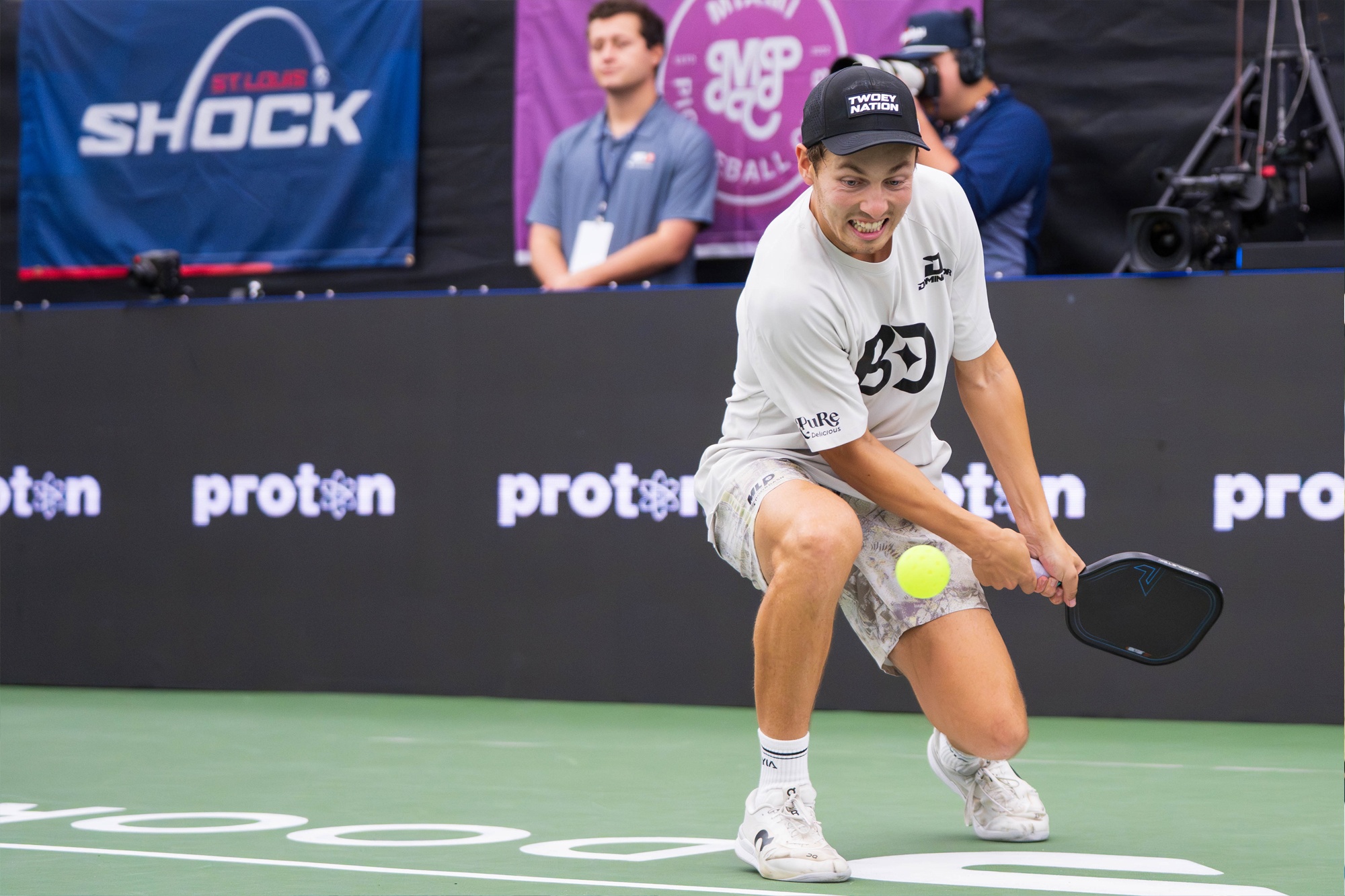
Building a Better Two-Handed Backhand
By Connor Garnett • July 22, 2026 • 4 min read
The fundamentals on power, control, and smarter offense
THE TWO-HANDED backhand has become one of my favorite shots because it gives you so many options. Whether you’re driving the ball, rolling it crosscourt, attacking from the kitchen, or speeding it up off the bounce, it’s a shot that can create offense from almost anywhere on the court. Once you understand the fundamentals, it becomes much more than another way to get the ball back. It becomes a weapon.
One of the biggest mistakes I see players make is trying to generate power with their upper body. They’ll jerk their shoulders or swing harder with their arms, thinking that’s where the speed comes from. In reality, that usually costs them both power and consistency because they’re leaving the strongest parts of their body out of the shot.
Start with the Grip
Everything begins with your grip. Think about your dominant hand as if you’re shaking someone’s hand, then place your second hand directly behind it. If you’re using an elongated paddle, both hands may fit comfortably on the handle. If not, don’t force it. Slide your top hand down slightly or allow a little overlap until the grip feels natural.
The key detail is placing the index finger of your top hand along the back of the paddle. That gives you better feel for the paddle face and allows your top hand to control the shot. Your bottom hand provides stability, but it’s the top hand that’s really driving the stroke.

Build Power from the Ground Up
Once your grip is set, everything comes from the torso using the hips and core to prowl your swing. Good players don’t create power with their arms. They create it from the ground up by using proper footwork, weight transfer, and hip rotation.
As you move into the ball, get your weight moving forward. Plant your heel first, transfer your weight toward your toes, and let your hips begin rotating before your upper body follows. The paddle comes through naturally, and your arms simply finish the motion. Everything works together as one kinetic chain.
When players skip their footwork and try to muscle the ball with their shoulders, they lose both power and control. Let your lower body do the work, and you’ll find the shot becomes much easier.
“The two-handed backhand can become one of the most versatile weapons in your game. Learn the fundamentals that create more power, better control, and smarter offense.” — Connor Garnett, Pro Pickleball Player for PPA and MLP
Aim Before You Swing
One of the simplest ways to improve accuracy is to imagine an arrow running through your paddle. For a down-the-line backhand, keep that imaginary arrow pointed at your target for as long as possible before allowing your hands to naturally follow through.
That’s an important distinction because placement almost always beats power. A well-placed shot that forces your opponent into a difficult position is far more effective than trying to hit every backhand as hard as you can.

Keep the Swing Compact
One thing you’ll notice about almost every successful two-handed backhand is how compact the swing is. Whether I’m driving from the baseline, attacking from the kitchen, or speeding the ball up off the bounce, I’m not taking a huge backswing.
A shorter motion gives you better timing, faster recovery, and more control. At the kitchen line especially, I use a small, efficient swing whether I’m dinking or attacking. When the opportunity comes, I don’t suddenly swing harder. I simply drive through the ball using the same compact motion.
About Connor Garnett
Ranked fifth in the world in men’s singles, Connor Garnett is a professional pickleball player competing on both the PPA Tour and Major League Pickleball. Known for his athleticism, analytical approach, and his signature two-handed backhand known as the “Twoey”, Garnett has established himself as one of the sport’s most respected competitors and educators. Through his instructional series, Twoey’s Tips, he shares the technical insights, strategies, and training methods that have helped shape his professional game, giving players of all skill levels practical advice to elevate their performance on the court.

Read the full magazine issue! Click below, then click on the X in the lower bar to enjoy a full screen view!
