Building the Next Move
Chris Cantino is bringing a builder’s mindset to the Mad Drops and the future of pro pickleball
By Adriana Falco • September 16, 2026 • 16 min read
Applying life lessons
THERE IS A phrase Chris Cantino uses when talking about building a Major League Pickleball roster that could just as easily describe his entire career.
“Standing still is usually the biggest risk.”
It is an appropriate philosophy for someone whose professional life has moved through consumer brands, venture capital, technology and now professional sports. Cantino helped build Schmidt’s Naturals, founded by his wife and business partner, Jaime Schmidt, from an emerging personal-care company into an international brand acquired by Unilever. He went on to invest in more than 100 early-stage companies through Color Capital, with investments spanning some of the most recognizable names in modern consumer business and technology.
Then came pickleball.
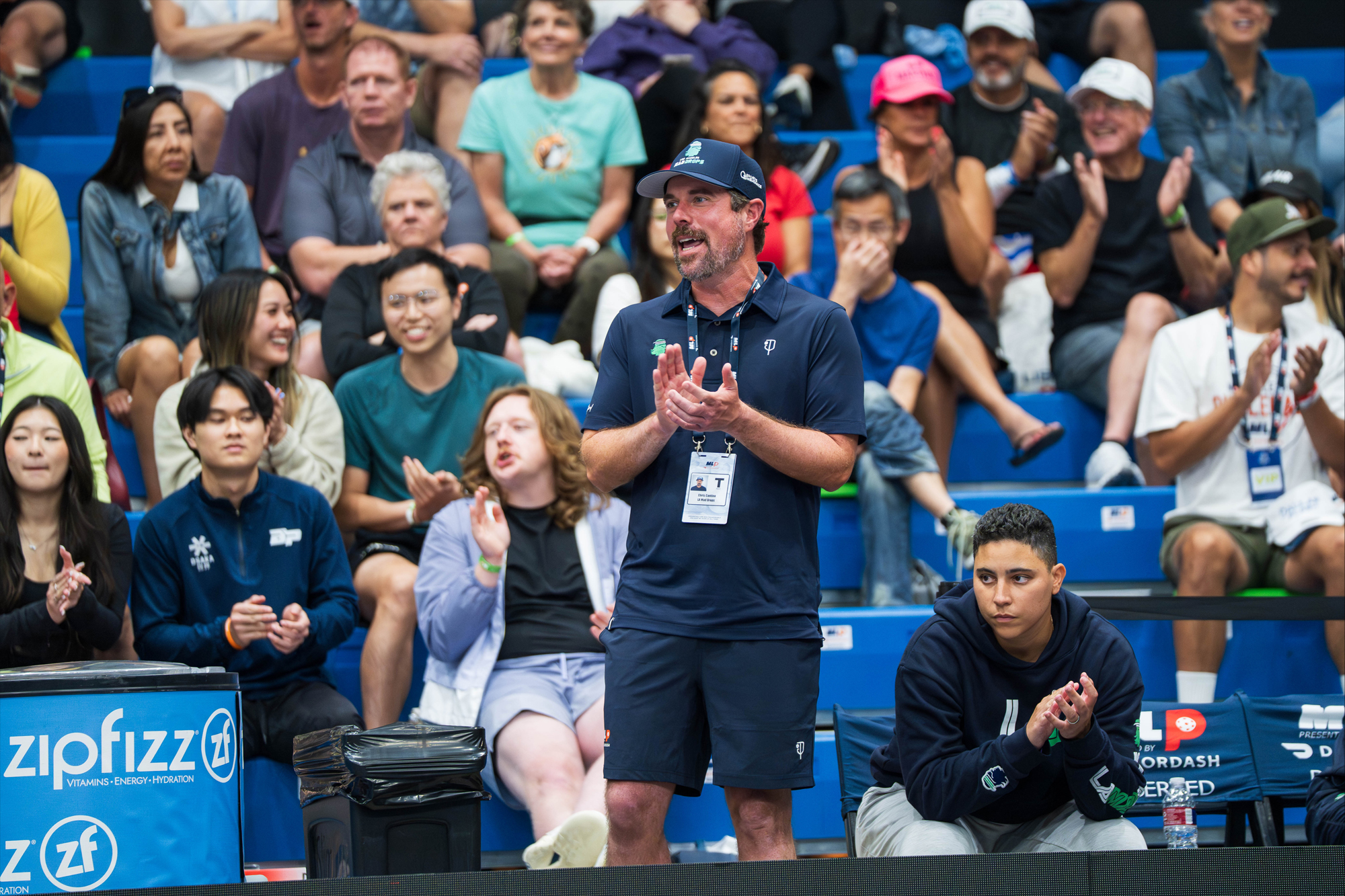
Today, Cantino is one of the owners, Chief Player Officer and General Manager of the LA Mad Drops, an early investor in the United Pickleball Association and now its Executive Advisor for Digital Transformation and Experience. He is one of the people thinking about professional pickleball not simply as a sport, but as an emerging business ecosystem still early enough to be shaped.
His fingerprints can already be found in several corners of it.
He built PBLFG, an independent platform created to make professional pickleball easier to follow. It evolved into MATCHDAY, bringing live scores, schedules, brackets, statistics and interactive fan experiences into one destination. He has invested in the sport. He advises its governing business organization. And with the Mad Drops, he is now applying the same instincts that helped him identify and build consumer companies to perhaps the most human startup of all: a professional sports team.
His involvement has even taken him behind the microphone, providing commentary at professional pickleball events including the PPA Masters, giving him yet another vantage point on the sport he is helping build.
For Cantino, all of those roles are connected by one question: How do you build something people care enough about to keep coming back?

Building to Win
The LA Mad Drops have provided Cantino with an unusually visible laboratory.
The franchise has become one of Major League Pickleball’s most aggressive roster builders, with a series of major moves designed around competing for a championship. Its roster has included some of the sport’s biggest names, with Ben Johns and Catherine Parenteau at its core and a series of moves around them as the team has continued to evolve.
In July, that philosophy produced another major move when the Mad Drops acquired Connor Garnett in a three-team trade, adding one of the game’s top singles players and another high-level doubles option for their postseason push.
To an outsider, that level of activity could look restless. Cantino sees it differently.
“Our philosophy is that roster building is never static,” he said. “Keeper fees and roster rules create constraints, but they also create opportunities if you’re willing to make tough decisions.”
Every potential move begins with a deceptively simple test.
“Standing still is usually the biggest risk.” — Chris Cantino
“Does this give us a better chance to win a championship? If the answer is yes, we’re willing to be aggressive.”
But Cantino is quick to push back against the idea that aggressive roster construction means treating players like interchangeable pieces. With so few roster positions available, he says chemistry, partnerships and long-term fit can matter nearly as much as individual performance.
“That’s why we’ve stuck with players, invested in their development, and resisted making moves simply because they looked like a short-term upgrade on paper,” Cantino said. “This is part of the reason we’ve been successful.”
The balance is difficult by design.
“We owe it to our players, our owners, and our fans to keep looking for ways to improve, even in the middle of the season,” he said. “Standing still is usually the biggest risk.”

Beyond the Spreadsheet
Cantino comes from a world where data can determine which companies receive investment, which products scale and which opportunities deserve another look.
Professional sports provide another flood of numbers. Power rankings. Win percentages. Matchup projections. Partnership results. Performance trends. The Mad Drops use all of them.
But Cantino has learned that pickleball creates a complication no spreadsheet can completely solve. Partnerships.
“Players can be outstanding individually, but not necessarily bring out the best in each other,” he said. “Trust, communication, complementary styles, and confidence under pressure all have a massive impact on winning, especially at the highest level.”
That means the front office has to evaluate not only how a partnership has performed, but how high its ceiling might be against the specific opponents it is likely to encounter when a championship is on the line.
As Cantino explained ahead of the postseason, the calculation changed as the field narrowed. The question was no longer simply which pairing produced the best overall numbers, but which pairing gave the Mad Drops their greatest upside against the league’s top teams.
“The best decisions happen when the data, the matchups, and what we see on the court all point in the same direction.”
That philosophy was tested almost immediately this season. The Mad Drops opened 2026 by winning MLP Dallas, an early validation for a roster still developing its chemistry. But tougher stretches followed, including matches against the St. Louis Shock and Dallas Flash.
Cantino did not see Dallas as proof that the work was finished. He saw it as proof of what might be possible.
“Our roster hadn’t spent years building chemistry together, so we’re asking all of our partnerships to lean in, to learn each other’s tendencies and build trust in real time,” he said.
“The best decisions happen when the data, the matchups, and what we see on the court all point in the same direction.” — Chris Cantino
At the time, Cantino viewed the Garnett trade as part of that championship calculation.
“Adding Connor Garnett gave us greater flexibility and a higher ceiling in mixed doubles while making us an incredibly scary DreamBreaker team and increasing our odds of winning the championship.”
Following the trade, the emphasis shifted from roster construction to postseason preparation. The team trained together, reviewed film, refined game plans and prepared for specific playoff scenarios.
“When the margins are this thin,” Cantino said, “preparation is the difference between winning and going home.”
He Saw the Friction
Cantino’s route into pickleball’s front office did not begin with a trade. It began with frustration.
As professional pickleball expanded, fans were being asked to follow a growing sport through a fragmented collection of websites, livestreams, bracket systems and social media accounts.
The interest was there. The infrastructure was not.
“When building MATCHDAY, I recognized the problem wasn’t a lack of interest,” Cantino said. “It was a lack of accessibility.”
Fans trying to find out who was playing, what the score was or when the next match began could find themselves moving between multiple platforms.
“For a sport growing as quickly as pro pickleball, that kind of fragmentation created way too much friction for anyone trying to follow the action.”
Cantino originally built PBLFG as an independent professional pickleball tracking app. The platform ultimately evolved into MATCHDAY and joined the PPA Tour ecosystem. The concept was straightforward: create one destination where fans could follow the sport in real time.
But Cantino did not want MATCHDAY to become merely a scoreboard. He wanted participation.
Live scores and brackets expanded into statistics, alerts, predictions and interactive experiences. MATCHDAY Pick ’Em, prop bets and prediction games gave fans another reason to care about matches they otherwise might not have followed.
“The on-court product is already world-class. Now it’s about building a digital experience that matches it.” — Chris Cantino
“One of the comments I hear most often is, ‘This is exactly what the sport needed,’” Cantino said.
What happened next taught him something larger about sports fandom.
“The evolution of PBLFG into MATCHDAY tells me the biggest opportunity isn’t simply providing information, it’s creating engagement.”
He sees deeper statistics, predictive games, fantasy markets, personalized experiences and stronger integration among broadcasts, live events and mobile platforms as part of professional pickleball’s next phase.
“The on-court product is already world-class,” he said. “Now it’s about building a digital experience that matches it and gives fans a reason to engage every day, not just on Championship Sunday.”

Building the Ecosystem
Cantino is now taking that thinking beyond MATCHDAY. In February 2026, he became Executive Advisor for Digital Transformation and Experience at the United Pickleball Association.
His vision reaches beyond improving the experience of watching professional matches. Cantino sees an opportunity to connect the different ways people interact with pickleball, from organizing recreational games and entering tournaments to shopping, tracking their development, consuming content and following the professional game.
In addition to MATCHDAY, Cantino developed the Mad Drops Team Hub, an internal team app already in use that brings schedules, game plans and strategy notes into one place, allowing the organization to build a running catalog of its approach to specific teams and players.
Those experiences, he argues, should not feel like unrelated pieces.
“They should all be connected parts of a single journey that becomes more rewarding the more someone engages with the sport.”
It is an important distinction because pickleball possesses something most emerging professional sports desperately want but cannot manufacture: millions of people already play it.
Cantino believes participation can become the bridge to fandom.
“The most successful sports platforms don’t just give people something to watch, they give them something to do.”
That philosophy leads to an ambitious view of what the UPA could ultimately become.
“I don’t think the UPA should think of itself as only a professional sports league,” Cantino said. “It’s building something much broader. A technology company, a media company, a retail business, and the digital infrastructure for the entire sport.”
The objective is not simply getting someone to watch a match. It is giving that person reasons to interact with pickleball every day.
His instinct for building experiences did not begin with pickleball. Long before the sport entered the picture, Cantino’s career moved through media, music and creative production. He produced and directed content for companies including VICE, Warner Brothers and Budweiser, worked in talent management and publicity, and served as artistic director for Portland music organization PDX Pop Now!

From Deodorant to the Mad Drops
On the surface, building a natural deodorant brand and running a professional pickleball franchise would appear to have very little in common. Cantino sees almost the opposite.
Before his work in professional sports, he was CMO of Schmidt’s Naturals, a personal care company known for making plant- and mineral-based products and founded by his wife, Jaime Schmidt. Together, they helped grow what began as a small business into an international consumer brand before selling it to Unilever in a nine-figure deal.
The couple later chronicled their entrepreneurial journey in the book Supermaker: Crafting Business on Your Own Terms and launched Supermaker, a media platform supporting independent entrepreneurs.
Along the way, Cantino also battled thyroid cancer, undergoing surgery and radiation treatment, and recently shared that he no longer requires ongoing monitoring for a recurrence.
“A sports team isn’t just competing to win. It’s competing for attention, loyalty, and fan connection.” — Chris Cantino
Cantino and Schmidt also founded Color Capital, an investment firm focused on consumer products, technology and emerging commerce. Together, they expanded their investment portfolio into professional pickleball, including an investment in the LA Mad Drops. Through Color Capital, Cantino has also invested in companies and brands including Feastables, Athletic Greens, Seed, Ledger and others.
The products change. The fundamental challenge does not.
“The biggest lesson I’ve carried from building consumer brands is that you’re not only selling a product, you’re building a relationship,” Cantino said. “The strongest brands become part of people’s identity and daily habits. The exact same principle applies to building a sports franchise.”
A professional team may compete on a court, but its real competition extends far beyond the scoreboard.
“A sports team isn’t just competing to win,” he said. “It’s competing for attention, loyalty, and fan connection.”
That relationship is built through everything surrounding the game: the venue, merchandise, social media, digital experiences and interactions with the team. And unlike most consumer brands, pickleball franchises begin with an extraordinary advantage. Many of their fans already play the sport themselves.
“Community is a competitive advantage,” Cantino said. “The best consumer brands find their top customers and convert them into superfans that advocate for the brand.
Sports has that same opportunity, especially in pickleball because the fans are already participants.”
For someone who has spent years investing in companies, that combination of consumer participation and professional sport helps explain why he believes pickleball remains such an unusual business opportunity.
Taking Pickleball to Bhutan
Cantino’s investment in pickleball has extended far beyond the professional game. Through Color Capital, Cantino is helping fund pickleball courts at monasteries, schools and sports complexes across Bhutan, working with organizations including the Bhutan Cultural Exchange, Pickleball Unites, Passport2Pickleball and Pickleball in Bhutan.
For Cantino, the project represents another side of the sport’s opportunity. Pickleball does not need a professional league or packed arena to create an impact. Sometimes growth begins with something much simpler: a court, a paddle and a place to play.
“In pickleball, we’re at a stage where we can still influence what the future looks like.” — Chris Cantino
Investing in an Expanding Category
Major League Pickleball franchise values have risen dramatically in a relatively short period. In 2025, a majority interest in the Mad Drops was purchased by Mad Drippin, LLC, led by Alex Geesbreght, in a transaction that valued the franchise at $13 million.
Cantino does not expect that early trajectory to continue at the same pace. But as a venture investor, he sees something underneath the numbers that may be more important than the valuation of any single team. Pickleball is expanding the potential sports audience itself.
“What makes pickleball so compelling to investors isn’t just the growth of a single league, it’s that the sport is expanding the overall sports category,” he said. “It’s bringing millions of new participants into the broad category of sports, many of whom never saw themselves as traditional athletes or fans.”
For Cantino, that is the long-term opportunity. He points to the WNBA as an example of how years spent building infrastructure can eventually intersect with a catalyst capable of accelerating attention and value.
“We’re still early innings, and our responsibility is to keep strengthening the foundation,” he said. “As the ecosystem matures, I believe franchise values over the next three to five years will see meaningful growth from where they’re at today.”

The Rare Chance to Write the Rules
There is an unusual thread connecting Cantino’s different roles in pickleball. With the Mad Drops, he is trying to build a championship roster. With MATCHDAY, he helped build a better way to follow the sport. With the UPA, he is thinking about how the pieces of the professional and recreational game can become one connected digital ecosystem. And as an investor, he is watching an emerging category develop while much of its future value is still being determined.
For someone accustomed to startups, that may be the most compelling part.
“The most rewarding part has been having the opportunity to help shape something that’s still being built, and all the friendships made along the way,” Cantino said. “And as a person deeply obsessed with the sport, the proximity to play and the pro tour has made for one of the most enriching experiences of my career.”
In established industries, disruption usually means confronting decades of assumptions, infrastructure and entrenched ways of doing business. Pickleball is different.
“Most industries reach a point where the rules are already written, and then the challenge is figuring out how to disrupt them,” Cantino said. “In pickleball, we’re at a stage where we can still influence what the future looks like.”
For the Mad Drops, all of those decisions ultimately came back to the same objective: win. The trades, statistics, partnership analysis, film study and roster decisions were all driven by the question Cantino said sits behind every move: Does this give us a better chance to win a championship?
But beyond wins, losses and championships is something much larger. Professional pickleball is still deciding what kind of sports business it wants to become, how its fans will interact with it, how its franchises will build loyalty, how technology will connect millions of recreational players to the professional game, and ultimately how valuable all of it can become.
Cantino has spent much of his career finding opportunity before the finished product was obvious. Now he has found one where the product is still being built in real time.
“That’s a rare opportunity,” he said, “and exciting to meet head-on.”
And if Cantino’s philosophy holds, one thing is certain. Standing still will not be part of the plan.
About Adriana Falco
Adriana Falco is the Founder and Editor-in-Chief of The Pickleball Weekly, a global digital magazine reaching readers in over 100 countries across six continents. A pickleball player since 2012, she combines more than 30 years of executive leadership with a passion for storytelling that captures every facet of the sport. With a career from international technology companies to major news organizations, Falco covers the people, businesses, innovations, and global trends shaping pickleball’s future, with a mission to connect and inspire the worldwide pickleball community through credible journalism and compelling stories.

Read the full magazine issue! Click below, then click on the X in the lower bar to enjoy a full screen view!