Escaping the Sagittal Trap
By The Pickleball Weekly Health & Wellness Staff • September 23, 2026 • 9 min read
WALK DOWN A sidewalk, run on a treadmill or pedal a bicycle and most of your movement travels in one dominant direction: forward.
The human body, however, was built to do much more than move straight ahead. We step sideways, rotate, reach, pivot, brake and change direction. Those movements occur across three planes of motion, yet modern life and many popular forms of exercise can heavily emphasize just one.
Then there is pickleball.
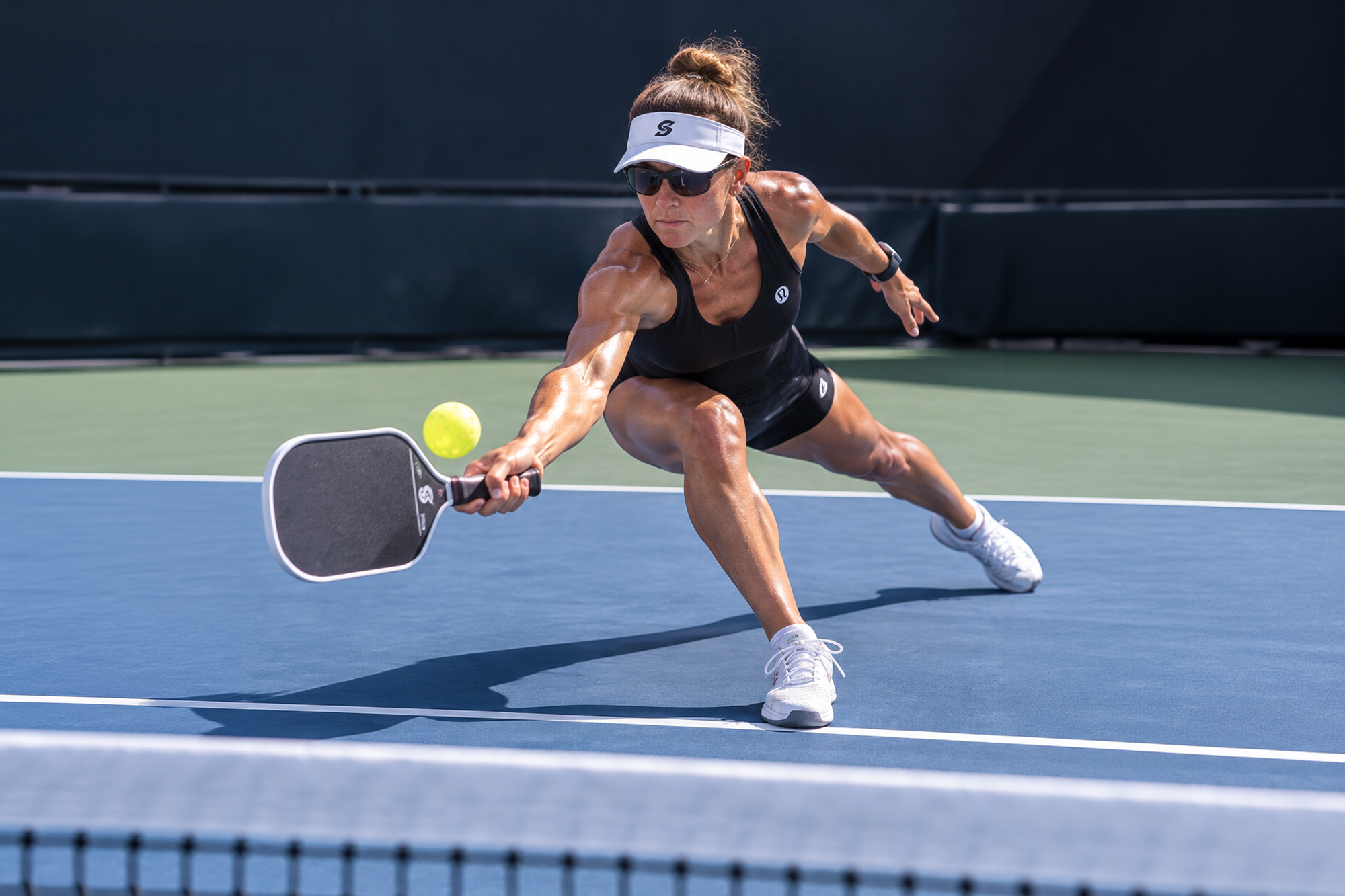
A rally can send a player laterally along the kitchen line, forward toward a short ball, backward after a lob and into rotation to reach a ball arriving at an awkward angle. The body may move through several of those patterns within seconds.
That multidirectional nature is one reason pickleball can challenge balance and coordination as well as cardiovascular fitness and strength. Cleveland Clinic notes that the sport requires players to move forward, backward and side to side while reacting quickly to the ball, movements that can contribute to balance and coordination.
For players accustomed to spending most of their day moving straight ahead, the court offers something different.
It breaks the sagittal trap.
Your Body Moves in Three Dimensions
Exercise professionals describe human movement using three primary planes.
The sagittal plane involves primarily forward and backward movement. Walking, running and cycling are familiar examples. On a pickleball court, sprinting from the baseline toward the non-volley zone or retreating for a lob relies heavily on this plane.
The frontal plane involves side-to-side movement. Think about shuffling along the kitchen line to cover an opening or pushing laterally to reach a wide dink.
The transverse plane involves rotation. Turning through a shot, pivoting to change direction or rotating the trunk to reach a ball engages this third dimension.
Pickleball constantly asks players to transition among them.
A player may move forward after a return, split-step near the kitchen, shuffle laterally, reach for a wide ball and then recover toward the middle. Unlike repetitive linear exercise, the movement pattern is dictated by an opponent and a ball whose next destination is not entirely predictable.
That unpredictability matters. The player is not simply producing movement. The body is continually responding to it.
The Muscles That Keep You Stable
The largest muscles often get most of the attention in fitness. Strong quadriceps, hamstrings and glutes certainly matter, but movement also depends on smaller stabilizing muscles that help control the pelvis, hips and trunk.
One important player is the gluteus medius, located along the outer hip. It contributes to hip abduction and helps stabilize the pelvis, particularly when the body is supported on one leg.
That becomes relevant in pickleball when a player pushes laterally, reaches wide or temporarily loads one leg before recovering.
The adductors, located along the inner thigh, also participate in controlling the leg and producing and absorbing forces during multidirectional movement. Moving sideways is only half the challenge. Players also have to slow themselves down, regain control and push in another direction.
Then there is the trunk.
The obliques and deeper abdominal musculature help stabilize the torso as forces travel between the upper and lower body. Every time a player rotates, reaches or changes direction, the trunk helps control that movement.
These muscles are not working independently. Pickleball repeatedly asks the hips, legs and core to coordinate as the body accelerates, decelerates and redirects itself.

Stopping May Matter as Much as Starting
Speed gets attention on the court. Deceleration deserves some too.
Reaching a ball is only useful if a player can arrive under enough control to hit it and recover for the next shot. A hard lateral push has to be followed by braking. A sprint toward the kitchen has to end without carrying the player into the non-volley zone after a volley. A quick change of direction requires the body to absorb force before generating force in another direction.
This ability to slow the body and regain control is part of what makes multidirectional movement demanding.
It is also an area where players can get into trouble. Pickleball’s quick starts, stops, pivots and changes of direction place demands on muscles and joints that may not be adequately prepared for them. The fact that pickleball involves multidirectional movement does not automatically mean every player develops ideal movement mechanics simply by playing.
The benefit comes with a requirement: the body has to be prepared for the movements the game demands.
Where Balance Enters the Picture
The multidirectional demands of pickleball become particularly interesting when viewed through the lens of healthy aging.
Balance is not simply the ability to stand still on one leg. In everyday life, balance is frequently reactive. Someone steps off a curb unexpectedly, turns while carrying groceries, catches a toe on a rug or has to recover after being bumped.
The body has to recognize that its position has changed and respond quickly enough to keep its center of mass under control.
Research outside pickleball has found that practicing responses to lateral balance disturbances can improve protective stepping in older adults. In one randomized controlled trial, lateral perturbation step training, particularly when combined with hip-strengthening exercises, improved aspects of lateral balance and was associated with fewer subsequent falls than the control condition.
Research specifically involving pickleball is beginning to point in an intriguing direction as well.
A randomized controlled trial involving 36 women ages 60 to 75 found that participants completing an eight-week supervised pickleball program improved measures of balance and gait compared with a control group. The researchers cautioned that additional work is needed to determine long-term effects and directly evaluate fall prevention.
A more recent study comparing pickleball players over age 55 with nonplayers also found significantly better balance and leg strength among the pickleball group, although the study was small and observational, meaning it cannot establish that pickleball caused those differences.
The distinction matters. Pickleball should not be described as a proven way to make someone “fall-proof.” But the relationship between multidirectional movement, reactive balance and healthy aging deserves attention.
Training the Brain Along With the Body
Changing direction is not purely muscular.
Every wide dink creates a rapid stream of information. Where is the ball going? How quickly is it traveling? How far must the player move? Where is the sideline? Where is the partner? Can the player reach the ball without losing balance?
The nervous system processes that information while the body is already moving.
This involves proprioception, the body’s ability to sense the position and movement of its joints and limbs without having to look directly at them. It also involves visual information, coordination and rapid motor responses.
A 2026 randomized controlled trial of pre-frail older adults found that eight weeks of supervised pickleball improved certain measures of lower-limb coordination during walking while participants simultaneously performed another task. The researchers described the findings as evidence that cognitively engaging, open-skill exercise may improve adaptability in motor coordination, while noting that other gait measures did not significantly change.
In other words, there is promising evidence, but the science is more nuanced than saying pickleball automatically prevents falls.

Before the First Ball: Prepare to Move Sideways
Because many people spend relatively little time moving laterally, walking onto the court and immediately asking the body to lunge, shuffle and change direction at full speed is not ideal.
A short dynamic warm-up can introduce those movements before competitive play begins.
Kitchen-Line Shadow Shuffle: Start near the non-volley zone line in a comfortable athletic stance. Shuffle laterally several steps in each direction without crossing the feet. Keep the movement controlled rather than trying to cover the court at maximum speed.
Controlled Lateral Lunges: Step comfortably to one side, allowing the stepping knee and hip to bend while keeping the movement within a pain-free range. Return to center and repeat on the opposite side. The goal is preparation, not maximum depth.
Easy Crossover Steps: At a slow pace, practice controlled lateral crossover movement in both directions. The exercise introduces the combination of lateral movement and rotation without immediately demanding game-speed reactions.
The emphasis should be on control. A warm-up is not the time to test how far someone can lunge or how quickly they can change direction.
Players with existing balance problems, joint pain, recent injuries or medical restrictions should get individualized guidance from a qualified healthcare professional rather than treating a generic warm-up as rehabilitation.
The Workout Hidden Inside the Game
Pickleball does something many conventional workouts struggle to replicate: it makes multidirectional movement part of the objective rather than the exercise.
Nobody standing at the kitchen line is thinking about the frontal plane when an opponent pulls them wide. They are thinking about getting the ball back.
They are not consciously training proprioception when they recover toward the middle. They are getting ready for the next shot.
And they probably are not thinking about hip stabilizers as they push off toward a sideline.
Yet underneath the strategy and competition, the body is being asked to move forward, backward, sideways and rotationally while repeatedly accelerating, braking and responding to an unpredictable environment.
Running, walking and cycling remain excellent forms of exercise. Pickleball does not need to replace them.
It simply asks the body a different question.
Instead of ‘How long can you keep moving forward?,’ the court asks: How well can you move everywhere else?
The Pickleball Weekly Health & Wellness Staff covers health, fitness, nutrition, recovery, and performance topics that help players stay active and play their best. With contributors who explore everything from injury prevention and conditioning to mental wellness, healthy aging, nutrition, and recovery, the team is committed to providing practical insights that support players both on and off the court.

Read the full magazine issue! Click below, then click on the X in the lower bar to enjoy a full screen view!