When the Ball Disappears
Why Pickleball Ball Visibility Is About More Than Wattage
By Anfi Li • September 16, 2026 • 12 min read
Pickleball lighting starts with sightlines, layout and glare
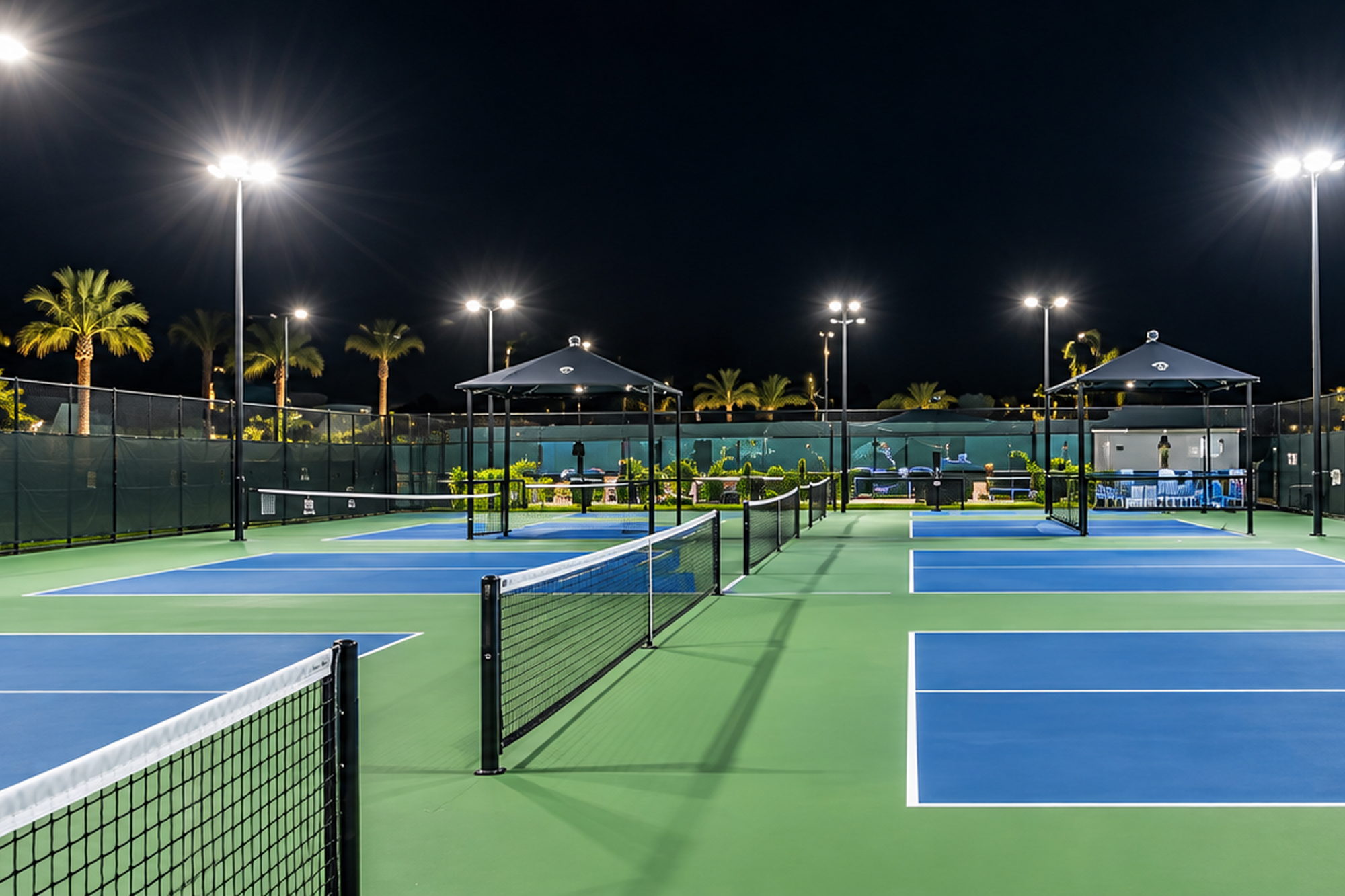
A PLAYER FOLLOWS a lob, looks up and briefly loses the ball beside a bright light. From the gate, the court looks well lit. The problem becomes obvious only from the position where the shot is being played. This imagined situation explains why a lighting discussion needs to begin on the court, looking in the directions players actually look.
For club owners, the useful question is not simply how much power the lights consume. It is whether players can follow the ball comfortably throughout a rally. Pole locations, mounting height, light distribution, aiming, and the surrounding background all deserve attention before anyone orders a higher-wattage replacement. More output may address insufficient light, but it does not automatically address how that light is directed.
USA Pickleball identifies ball tracking and consistent conditions across the court as important reasons to plan lighting carefully. Its public guidance emphasizes uniform illumination and glare control. Those objectives are a starting point for a conversation with a qualified lighting designer, not a promise that one fixture package will suit every facility.
The following review is intended for players and club operators. It is a way to describe problems and ask useful questions, not a substitute for a professional lighting design, electrical inspection, or formal compliance assessment.

Separate Power Consumption From What Players See
Watts describe electrical power. They do not tell a buyer how light is distributed across a court or where a bright source will appear during a lob. Comparing two proposals by wattage alone leaves out the geometry of the installation and the optical distribution of the fixtures.
Illuminance describes light arriving at a surface and is commonly expressed in lux or footcandles. A horizontal measurement on the playing surface answers a useful question about that surface. It does not describe every view of a ball traveling above it. Luminance concerns light traveling toward an observer from a surface or source; it is more closely connected with what appears bright in the scene. The Illuminating Engineering Society distinguishes these quantities in its lighting definitions.
Ask a designer to explain which measurements and calculations are relevant to the intended standard of play. An average should be accompanied by information about variation across the area being assessed. A plot with bright and dark regions can raise different questions from a plot with a similar average and more even distribution. Neither plot alone replaces consideration of player views.
Keep energy comparisons for the point at which the proposals meet the same agreed performance requirements. Otherwise, a lower-power option may simply be delivering a different result, while a higher-power option may be putting additional light where it is not useful.
Trace the Views That Matter During a Rally
Start with a simple plan of the courts. Mark the net, baselines, non-volley zones, surrounding clearances, and lighting positions. Then consider a returner near the baseline, a player moving toward the kitchen, and a player looking upward to track a lob. Each position gives a different relationship between the ball, the lights, and the background.
Add arrows showing normal directions of view. These are discussion points rather than precise boundaries within which players must keep their eyes. A player moves, turns, and follows unexpected shots. A light that seems comfortably off to one side from the entrance may be much closer to a useful sightline from a baseline corner.
Review both ends of each court. A layout can look balanced on paper while presenting different backgrounds in opposite directions. One end may face a dark fence, the other an illuminated building or an opening to an adjacent playing area. Walk through neighboring courts as well, because their fixtures can enter the view even when they are not lighting the court being reviewed.
For a proposed installation, ask for an explanation of these views before pole positions become fixed. For an existing installation, mark where players report difficulty. This gives the designer a location and direction to investigate rather than a general request to make the facility brighter.

Treat Mounting Height and Aiming as a Connected Decision
Pole height cannot be selected independently of the available setbacks, the fixture optics, and the court arrangement. Changing height changes the angles between a player and the light. It also changes the distances over which the fixture must deliver useful illumination. A mounting arrangement that works in one venue should not be copied into another without checking those relationships.
Ask what constraints were used in the design. Existing poles, neighboring properties, roof structure, and permitted mounting locations may limit the choices. The lighting plan should represent those actual conditions. If a drawing assumes a pole can stand where a gate or access route needs to be, the apparent solution has not yet resolved the site problem.
Optics shape where a fixture sends its light. Aiming determines how that distribution sits within the real site. A suitable fixture aimed differently from the calculation is no longer the same modeled installation. Ask for the intended orientation of each light and a way for the installer to identify it on site.
Players and club staff should not climb poles or adjust electrical equipment themselves. If a suspected aiming problem is identified, ask the responsible professional to investigate it. Any adjustment should be checked for effects elsewhere, including neighboring courts and property boundaries. A local improvement can introduce a problem in another direction.
Describe Glare Without Assuming Every Bright Light Is a Defect
The IES definition of glare includes discomfort or reduced visibility caused by luminances in the visual field that are high relative to the level to which the eyes are adapted. Its explanation includes the position and size of sources as contributing factors. This is why the same installation can feel different when viewed from different parts of a court.
A useful report says more than “the lights glare.” Record the player’s position, direction of view, and kind of shot. Note whether the difficulty occurs while tracking a high ball, facing a particular end, or moving through one part of the court. Several people can report independently before comparing notes, helping the club distinguish repeated patterns from a single impression.
Do not turn an observation into a diagnosis too early. A ball disappearing near a fixture is a reason to investigate source position and glare, but it is not proof that a particular replacement product will solve the issue. Similarly, a bright-looking photograph is not a calibrated glare assessment. Cameras change exposure, and highlights can appear very different from the scene experienced by a player.
Ask the designer how glare has been considered for the actual arrangement and intended users. A product label or a single marketing number is not an explanation of every sightline. The response should connect the proposed equipment with its mounting, aiming, and surrounding conditions.
Include the Background in the Discussion
The ball is seen against whatever lies behind it from the player’s position, and that background can change during a shot. A ball traveling across a wall, roof structure, or open sky does not present the same visual scene throughout its path. Looking only at the color and brightness of the court surface misses those changing views.
Inside a building, include windows, doors, roof surfaces, and large signs in the review. Visit at the hours when complaints occur. A daytime opening and the same opening after dark can present different conditions. Outside, note building lights, signs, and neighboring activity rather than assuming that the pickleball fixtures are the only relevant sources.
Use ordinary observations to narrow the question. Does the reported difficulty follow a particular view, a particular time, or a change in the background? Bring photographs of those conditions to the designer, clearly labeled with the viewpoint and time. Do not prescribe a new wall color, screen, or shade before considering operational needs, permissions, and effects on the wider space.
The aim is to avoid spending money on the wrong part of the system. If the concern depends on a particular background, simply changing the power of every court fixture may leave the important relationship unresolved.

Review the Lighting Proposal With the Site Plan
A useful proposal lets the club connect the calculation with what will be built. Ask for the court arrangement, mounting positions and heights, fixture identification, optical options, and aiming assumptions. The designer should be able to point from a fixture on the plan to the corresponding information used in the calculation.
Ask which areas and planes have been evaluated and why they suit the project. Discuss the playing level and any requirements for events or recording. Different uses may call for different assessments. Avoid treating one attractive color plot as evidence for every aspect of lighting quality or every future use of the venue.
Clarify whether the report describes initial output or accounts for changes over time, and ask what maintenance assumptions support it. Keep those assumptions with the operating records. A facility that changes its equipment or maintenance practices should not assume the original prediction still applies unchanged.
Finally, ask what will happen if site conditions differ during installation. A substitution in optics, an altered pole location, or a revised aiming direction should trigger a review of the affected design. A clear record of changes is more useful than discovering later that the drawings and the installed equipment describe different arrangements.
Organize a Short Observation Session
Arrange a review with the facility operator at a quiet time, with the court safely available. Use the lighting mode normally selected for play. Include players with different playing styles and movement patterns, and invite the lighting professional where practical. The purpose is to document experience, not to ask volunteers to certify performance.
Begin at the two baseline ends, then consider the non-volley zone and the normal transition between them. Use controlled, ordinary shots only when the court is safe and participants are comfortable. Do not ask anyone to stare directly into a light or continue a drill that feels unsafe. Players who use different viewing heights should be included in the discussion where relevant to the venue.
Record a few consistent details for each observation: court identifier, location, direction, time, operating mode, shot, and what was difficult to see. Note relevant conditions such as an adjacent court being switched on. A statement like “difficulty following a high ball while facing the clubhouse from the north baseline” is more actionable than a general complaint about brightness.
Use photographs as location records. If actual light measurements are required, agree on the appropriate equipment, procedure, and criteria with the responsible professional rather than treating an unverified phone reading as an acceptance test.

Agree on a Remedy That Can Be Checked
After the review, separate observations from proposed fixes. List each repeated concern and ask the designer or installer to explain the likely cause, the proposed action, and how the result will be checked. Possible actions depend on the installation; do not assume that all problems require new lights or that all existing equipment can be retained.
Repeat the relevant observations after a change, using comparable conditions as far as practical. Check nearby positions as well as the original complaint location. Retain the revised plan, settings, and any professional measurement report so that a later maintenance visit does not unintentionally undo the adjustment.
Outdoor changes also need a boundary check. DarkSky International’s sports-lighting guidance addresses targeted light, offsite glare, and controls. Its general principles, developed with the IES, encourage directing light where needed and using it when needed. These are useful considerations, but they are not a substitute for the requirements that apply to a particular site.
Ask how operating schedules and available modes affect the whole venue. Turning off an unused court may change the scene seen from an occupied one. Agree with the designer which combinations are appropriate for play and which are intended only for other activities. Staff should know the difference and have a clear route for reporting problems.
Make the Next Conversation Specific
Before seeking quotations, a club can prepare a small but useful package: a current plan, photographs from player positions, operating hours, and a short record of the difficulty it wants to solve. This information gives each prospective supplier a common problem to address and makes the responses easier to compare.
Ask each respondent to explain the reasoning, not just supply a fixture count. A proposal that answers the important questions about placement, player sightlines, site conditions, and post-installation performance gives the club something concrete to review.
Keep listening once the work is complete. Court layouts, neighboring activity, and operating practices can change. A simple route for reporting the location and circumstances of a visibility concern helps staff recognize patterns without treating every comment as a demand for more power.
Players need to see the ball through the rally, including the moments when they look above the net and beyond the court surface. Beginning with those views makes the lighting conversation more useful. Wattage remains part of the specification, but it should follow an explanation of how the proposed layout serves the people playing beneath it.
About Anfi Li
Anfi Li represents AHFL Sports Lighting, a supplier of LED lighting for sports courts and stadium projects.

Read the full magazine issue! Click below, then click on the X in the lower bar to enjoy a full screen view!