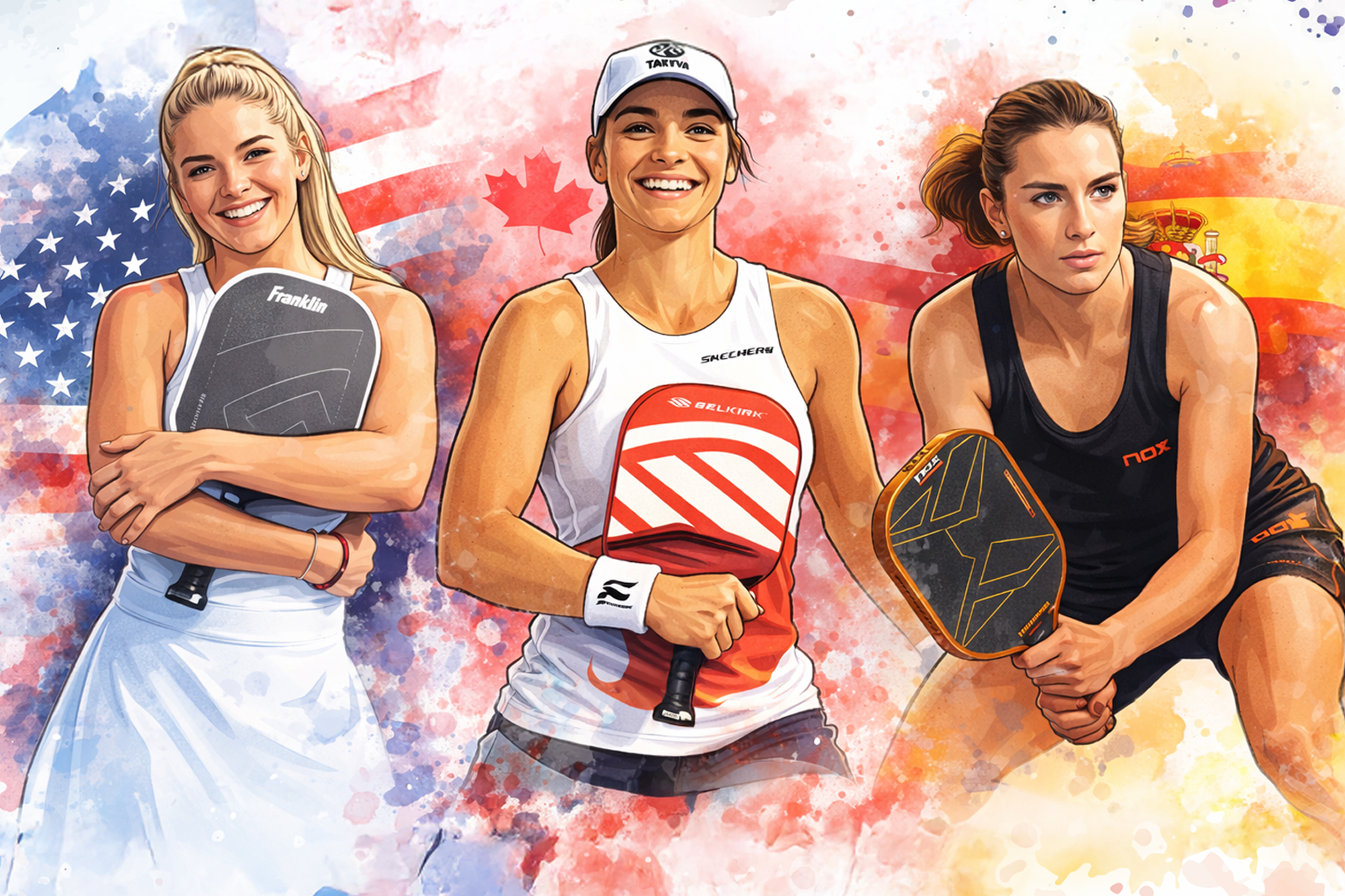
The Women Redefining the Global Game
By The Pickleball Weekly Editorial Team • Feb 25, 2026 • 8 min read
Inside the rise of the world’s top female pickleball players in 2026
PROFESSIONAL PICKLEBALL IS no longer a regional phenomenon. It is a global sport with international circuits, national leagues, ranking systems, sponsorship portfolios, and television contracts. At the center of that evolution are the women who have elevated the standard of play and accelerated the sport’s international expansion.
As of early 2026, the competitive hierarchy in women’s professional pickleball is shaped by three primary benchmarks
the PPA Tour rankings, UPA Power Rankings, and DUPR (Dynamic Universal Pickleball Rating). The United States continues to dominate the top of the leaderboard, but the global gap is narrowing. Europe, Asia, Australia, and South America are producing players capable of challenging the American stronghold.
This is the state of the women’s game in 2026.
The American Standard
The United States remains the epicenter of elite women’s pickleball, and at the top stands one name that defines the era: Anna Leigh Waters.
Waters continues to hold the No. 1 ranking in singles, doubles, and mixed doubles — an unprecedented level of dominance in the modern professional game. Still a teenager, she has combined power, anticipation, and court IQ into a style that has reshaped how women’s pickleball is played. Her speed at the kitchen line and ability to transition seamlessly between defensive resets and offensive acceleration have forced opponents to raise their physical and tactical standards.
Behind her, the depth of American talent is equally compelling. Anna Bright has established herself as one of the fiercest competitors on tour, known for her explosive left-side offense and mental toughness in long rallies. Jorja Johnson, only 18, continues to rise, particularly in mixed doubles alongside her brother JW Johnson, showcasing composure and rapid development under pressure. Tyra Black has emerged as one of the most dynamic movers on tour, blending elite defensive retrieval with heavy counterpunching power.
And then there is Catherine Parenteau, whose precision on the right side and consistency across events have kept her firmly inside the global top tier. Although often associated with the U.S. circuit, Parenteau represents Canada internationally and remains one of the sport’s most technically disciplined players.
The American model emphasizes full-time training, advanced analytics, and consistent doubles partnerships, a formula that has produced both dominance and depth.
Canada’s Dual Identity
Canada occupies a unique space in the women’s professional landscape. While many Canadian players compete heavily on U.S.-based tours, the Canadian National Pickleball League (CNPL) has created a growing domestic infrastructure.
Parenteau remains the country’s flagship athlete. Meanwhile, Hannah Blatt, Jess Kawamoto, and Anne-Sophie Courteau represent the new generation of Canadian professionals pushing into higher global rankings. Courteau’s signing as the first free agent in CNPL history signaled that professional pickleball is now operating with contract-level seriousness even outside the United States.
Former tennis star Genie Bouchard’s transition into professional pickleball has also amplified global attention, reinforcing Canada’s crossover potential between established racket sports and pickleball’s growth curve.
Europe’s Strategic Rise
Europe’s top female players are closing the competitive gap by combining traditional tennis fundamentals with modern pickleball-specific tactics.
Spain’s Judit Castillo Gargallo has become one of the continent’s most consistent performers, regularly appearing in quarterfinals on international stages. Germany’s Caroline Nothnagel has led European singles rankings, while Sweden’s Alma and Klara Thell-Lenntorp have emerged as a dominant doubles duo on the RTA European circuit.
In the United Kingdom, Thaddea Lock and Mollie Knaggs have captured multiple European titles, proving that the women’s game in Europe is no longer developmental. It is competitive.
The European style tends to emphasize precision, placement, and patience at the kitchen line, contrasting with the increasingly aggressive American approach. As intercontinental tournaments expand, these stylistic differences are shaping a more layered global game.
Asia and Oceania Enter the Conversation
The Asia-Pacific region is accelerating rapidly.
China’s Zoey Wang has become a rising presence on the PPA Tour, making consistent runs into later rounds and signaling China’s serious entry into professional pickleball. In Asia, Aibika Kalsarieva has ranked among the top women’s doubles players in regional DUPR standings, part of a cohort bridging American and international competition.
Australia’s Somer Dalla-Bona has established herself as one of the highest-ranked players globally from Oceania, while emerging talents such as Danni-Elle Townsend and Lara Giltinan reflect Australia’s growing domestic circuit strength.
The World Pickleball League and PPA Tour Asia are creating new competitive platforms, reducing the geographic dependency on North America and accelerating global skill parity.
India’s rise in professional pickleball is also being driven by players such as Mihika Yadav, who has emerged as one of the country’s most recognizable female competitors on the international stage. Competing across Asian tour events and increasingly appearing in global competitions, Yadav represents the new generation of Indian athletes embracing pickleball as a primary sport rather than a crossover pursuit. Her aggressive baseline play and growing confidence in fast kitchen exchanges reflect the rapid development of India’s competitive infrastructure. As domestic leagues and the World Pickleball League expand, players like Yadav are positioning India as a serious contributor to the sport’s international future.
Brazil’s Enduring Legacy
No discussion of elite women’s pickleball is complete without acknowledging Simone Jardim. Although Brazilian-American and long associated with U.S. competition, Jardim’s legacy transcends borders. As one of the sport’s early dominant champions, she set a professional standard that today’s generation continues to build upon.
Her influence remains visible in the emphasis on footwork, consistency, and transition play that defines the highest level of competition.
Key Trends Defining 2026
Three forces are shaping the women’s game:
Youth Dominance: Teenagers now headline the sport. Waters and Johnson represent a generation that grew up with pickleball as a primary sport rather than a crossover discipline. Their training intensity and athletic ceilings are redefining expectations.
Doubles Specialization: UPA rankings increasingly reward consistent partnerships. Stable doubles pairings are producing chemistry-driven success, elevating the importance of synchronized movement and tactical coordination.
International Convergence: The “Global Four” and other international standouts are narrowing the performance gap. The technical and athletic difference between American and non-American players is shrinking, setting the stage for more diverse podium finishes.
A New Competitive Standard
What separates the top female players in 2026 is not simply power or ranking position. It is professionalism. Training regimens are year-round. Recovery protocols mirror those of established professional sports. Sponsorship portfolios are global. Athlete branding now extends beyond tournament wins into business ventures, speaking engagements, and cross-platform media exposure.
The women’s game has become a proving ground for pickleball’s global credibility. As circuits expand, television contracts deepen, and international talent continues to emerge, one reality is clear: the future of professional pickleball will not be defined by geography. It will be defined by performance.
And the women leading the sport today are not just winning matches. They are setting the global standard for what elite pickleball looks like in the modern era.
The Pickleball Editorial Team produces in-depth reporting and cover features that examine the sport’s growth, innovation, competition, and culture. With contributors who understand both the strategy of the game and the forces shaping its future, the team is committed to telling the full story of modern pickleball.

Read the full magazine issue! Click below, then click on the X in the lower bar to enjoy a full screen view!