
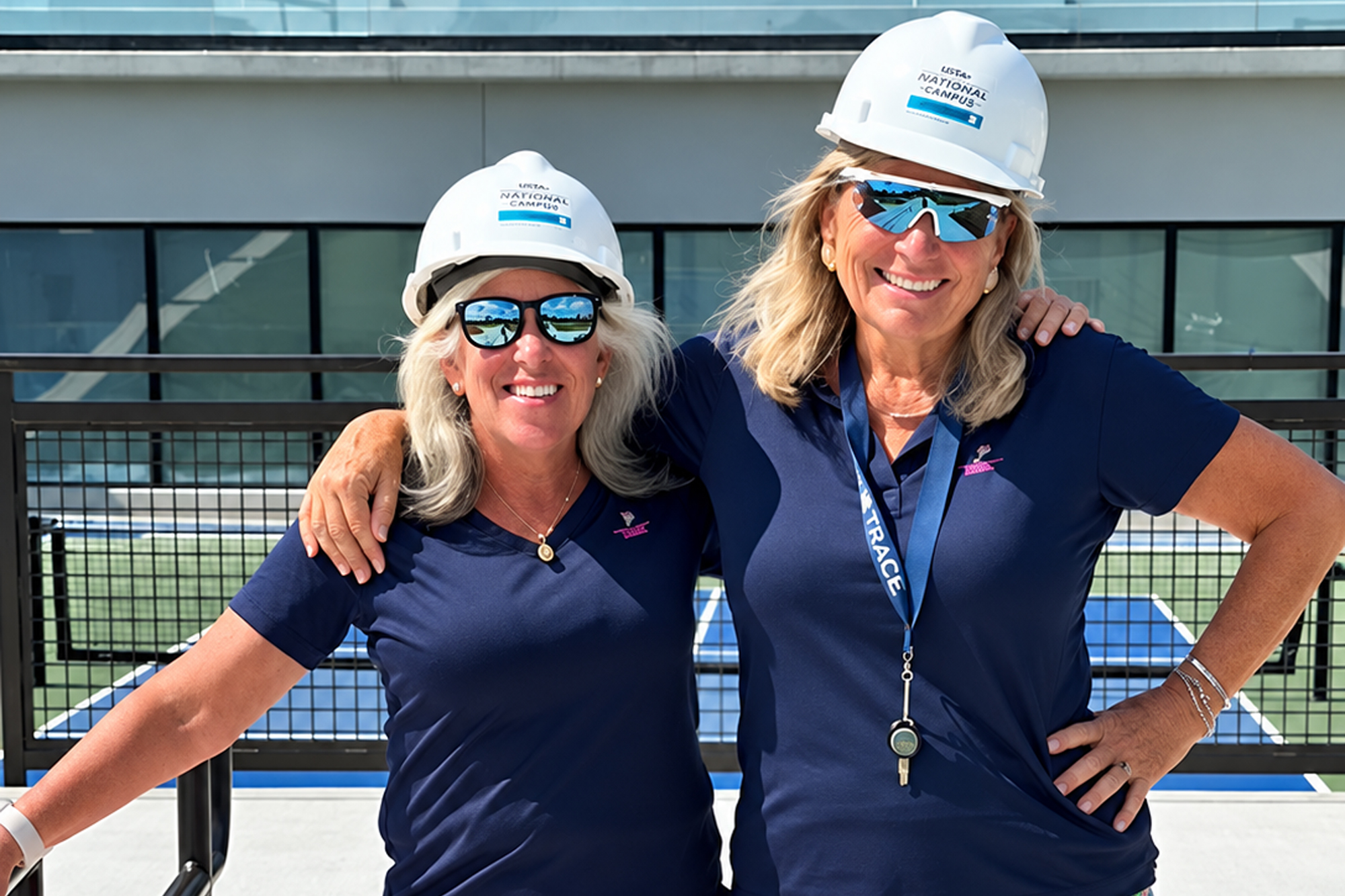
The Power of Two
Alita Friedman and Catherine Barton are transforming women’s pickleball into a national movement for opportunity, inclusion and community.
By Adriana Falco
October 14, 2026 • 13 min read
Two Women. One Powerful Vision.
When Catherine Barton first met Alita Friedman, she had no idea that the woman standing before her would eventually become her business partner, close friend and co-founder of a national organization. But something about that first encounter made an immediate impression.
In late 2018, Barton was exploring the viability of a competitive pickleball league exclusively for senior women. She had been conducting focus groups, speaking with accomplished athletes and businesswomen, and trying to determine whether her concept could become something sustainable. The league launched in 2019, and by 2020, country clubs and private communities were participating in the league. In 2021, Friedman and her fellow captains had organized a gathering of 60 women from Boca West Country Club in South Florida to celebrate their first season in the league.
For Barton, the experience was a revelation. Friedman had built upon precisely what she was trying to build: a community of engaged, accomplished women who shared a passion for pickleball and wanted something more from the sport.
“I realized that what Alita had assembled was my vision,” Barton recalled. “I knew from that moment that you were going to play a consequential role.”
She was right. Friedman became part of Barton’s informal advisory circle, offering guidance, questioning decisions and repeatedly encouraging her to think bigger. Barton had envisioned a competitive league for women. Friedman saw the possibility of an organization that could support women in ways that extended well outside organized sports.
“This could be more, this could be bigger,” Barton remembered Friedman telling her.
It would take several years for the two women to formally join forces, but the foundation of their partnership had already been established. Barton brought decades of athletic experience and an understanding of what women wanted from competitive sports. Friedman contributed an extraordinary background in business, branding, licensing and organizational development.
Today, they are co-founders of the National Women’s Pickleball Foundation (NWPF), a nonprofit dedicated to expanding access to pickleball, empowering women and creating opportunities for underserved communities, children and adaptive athletes. Their ambitions also encompass a growing national women’s league and a membership association designed to connect women through health, education, professional development and community.
What began as a conversation about a pickleball league has become a shared mission to improve lives through the sport.
Two Different Paths
Catherine Barton has always understood the competitive side of athletics. A longtime tennis player, she spent decades immersed in a sport that demands discipline, determination and an appreciation for the relationships developed through competition. Her professional career included architecture and strategic marketing, experiences that would later help her turn a recreational concept into an organized league.
When she founded the Women’s POWER Pickleball League, her goal was to create a structured competitive environment for senior women in Palm Beach County. She recognized that many accomplished female athletes wanted more than occasional recreational games. They wanted organized matches, meaningful competition and an opportunity to develop relationships with women who shared their enthusiasm for the sport.
The response confirmed her instincts. The league attracted former professional athletes, competitive tennis players, executives, entrepreneurs and women from a variety of backgrounds. While the matches provided the initial attraction, the community developing around them became equally important.
Friedman’s path to pickleball was considerably different. A certified public accountant by training, she built an impressive career in brand development, manufacturing, international distribution and licensing. Among her most notable accomplishments was helping transform Uglydoll, a collection of quirky plush characters, into a globally recognized consumer-products brand.
Friedman helped expand the business through licensing agreements, international distribution and a broad range of consumer products. The brand eventually inspired the 2019 animated film UglyDolls, featuring an ensemble of well-known musical performers and actors.
Her experience extended far beyond the creative side of branding. She understood the financial, operational and logistical challenges of growing a business, from manufacturing and warehousing to sales networks and international distribution. Those skills would later prove invaluable in developing the infrastructure behind the National Women’s Pickleball Foundation and its affiliated organizations.
Friedman also spent six years on the board of Women in Toys, Licensing & Entertainment, an organization dedicated to advancing women in the toy, licensing and entertainment industries. Through that involvement, she experienced firsthand the importance of professional networks that provide mentorship, educational resources and opportunities for women to support one another.
When she began discussing the future of women’s pickleball with Barton, Friedman recognized a similar opportunity.
“There’s got to be something for women in pickleball, there’s nothing just for women in pickleball,” she recalled saying.
The idea was not simply to create another league. Friedman envisioned a national organization that could connect women through their shared interest in pickleball while providing access to resources that addressed other aspects of their lives.
Barton had already demonstrated that women were eager to participate in organized competition. Friedman understood how to build a recognizable brand and create an organization capable of serving a much larger audience. Together, they had the experience and ambition to turn an idea into a national initiative.

In 2024, they formally committed to building it.
A Foundation Built on Giving Back
The National Women’s Pickleball Foundation grew from a tradition of charitable giving that had been part of Barton’s original league for years.
League participants had organized fundraisers benefiting organizations including the Alzheimer’s Association and Make-A-Wish. The women enjoyed competing, but they also recognized that their shared enthusiasm for pickleball could provide an opportunity to help others.
Barton believed that those fortunate enough to enjoy the sport had a responsibility to contribute to their communities.
“We believe that we wake up in paradise every morning, we get to play pickleball, shame on us if we don’t build in time to give back,” she explained.
As the fundraising efforts expanded, Barton and Friedman recognized the need for a formal nonprofit organization with its own governance and accountability. They established the foundation as a 501(c)(3) public charity, creating a structure that could support larger charitable initiatives, build relationships with national organizations and attract corporate partners.
The foundation’s mission centers on expanding access to pickleball through education, equipment, volunteerism and community partnerships. Although founded and led by women, its charitable programs are intended to benefit people of all ages and genders, particularly those who face barriers to recreational participation.
“We’re not here just for women,” Friedman explained. “We’re here for underserved children and their families, adaptive athletes, and those with special needs.”
The foundation has developed relationships with organizations including Special Olympics, the Police Athletic League and Boys & Girls Clubs. Its programs provide equipment such as paddles, balls and nets, along with instructional opportunities and volunteers who help introduce the sport to new participants.
For the founders, those efforts represent something far more meaningful than participation statistics. Each program offers individuals an opportunity to experience the physical activity, social interaction and sense of accomplishment that pickleball can provide.
One of the foundation’s earlier initiatives involves its relationship with Special Olympics Florida. Barton, who previously participated in the United States Tennis Association’s QuickStart approach to introducing tennis to children, recognized that adaptive athletes could benefit from pickleball instruction designed around their specific needs.
Drawing on her experience with instructional development, Barton assembled a group of certified teaching professionals, enabling NWPF to create a modified pickleball curriculum intended to make the sport more accessible to athletes with different abilities. The initiative has expanded from regional involvement to broader state and national efforts. NWPF now has a seat on the National Special Olympics Pickleball Committee.
The foundation is also exploring opportunities to collaborate with organizations focused on cognitive health and wellness. Barton has participated in discussions with Alzheimer’s organization leaders about the potential role of pickleball in programs emphasizing movement, social engagement and physical activity.
The founders believe that introducing the sport to new populations requires more than simply providing access to courts. Participants need appropriate instruction, encouragement and opportunities to develop confidence at their own pace.
Their charitable programs are designed to make those experiences possible.
Bringing Pickleball to Times Square
One of the foundation’s most memorable initiatives unfolded in the heart of New York City, where thousands of people pass through Times Square every day.
Working with CityPickle, the organization helped arrange a special pickleball experience for adaptive athletes from AHRCNYC an adult day program in the Bronx. Volunteers and local pickleball professionals joined participants on court, transforming a high-profile sporting venue into an opportunity for inclusion and community engagement.
For Barton and Friedman, the event demonstrated what can happen when organizations use the visibility of professional sports to introduce recreational opportunities to people who might otherwise remain on the sidelines.
The experience also attracted media attention. Barton recalled an NBC television personality who initially arrived to cover the event with a microphone in hand. Rather than simply conducting interviews, she was encouraged to step onto the court and try pickleball herself.
After participating, the reporter developed a different appreciation for the sport, an experience Barton said influenced her subsequent coverage.

The founders see these events as opportunities to change perceptions while creating meaningful experiences for participants. They hope to develop similar programs at major pickleball tournaments and industry gatherings, bringing together professional players, manufacturers, facilities and community organizations.
Their emphasis remains on participation rather than spectacle. A prominent venue may attract attention, but the real accomplishment is introducing someone to a sport that could become part of their everyday life.
When the Mission Becomes Personal
For Friedman, the foundation’s work is connected to an intensely personal journey that few people would recognize simply by watching her play pickleball.
Unlike Barton, whose life had long revolved around competitive athletics, Friedman did not grow up participating in sports. Alita never considered herself athletic, as a child. Discovering pickleball later in life introduced her to a new form of physical activity and a community she had not experienced through traditional sports.
Then came a series of devastating medical diagnoses.
Friedman learned she had multiple sclerosis. Six months later, she was diagnosed with breast cancer. Less than 18 months after that, she faced breast cancer again.
The diagnoses came during the period when she and Barton were developing their plans for the foundation and affiliated organizations. Friedman continued working on their initiatives while navigating treatment and the uncertainty associated with serious illness.
“I have gone through hell while we’re doing all this,” she acknowledged.
Her determination to continue was rooted in something larger than building a successful organization. The experience gave her a personal understanding of how important community, physical activity and meaningful connections can become when life takes an unexpected turn.
“It just made the impetus, to want to do this, even stronger,” Friedman explained.
She began to view the foundation as an opportunity to create something lasting. The Foundation is working to align with organizations such as Multiple Sclerosis and Breast Cancer foundations to support women, girls and families who may be dealing with invisible and long-term illnesses.
A woman arriving at a pickleball court may be recovering from illness, navigating a divorce, coping with loneliness or adjusting to a major career change. Another may simply be looking for an enjoyable way to remain active. Their personal stories may be entirely different, yet the sport gives them an immediate connection.
Friedman understands that experience from a perspective she never anticipated having when she began her business career. Her accomplishments in brand development and licensing taught her how to build successful organizations. Her health challenges deepened her understanding of why creating one with a meaningful purpose matters.
Barton has watched her partner navigate those challenges while continuing to contribute to the foundation’s development. Their relationship has grown into a friendship built on mutual respect, shared determination and the ability to support one another through the demands of their work.
The two also make time to enjoy their shared interests outside the foundation. They attend US Open tennis tournaments together, taking an opportunity to celebrate their partnership while enjoying a sport that plays an important role in both of their lives.
Their friendship reflects the very connections they hope to foster among women through pickleball. They came together because of a shared interest in the sport, but their relationship has developed into something considerably more meaningful.
A Community for Every Generation
While the foundation expands its charitable initiatives, Barton and Friedman are also developing the National Women’s Pickleball League and preparing to launch the National Women’s Pickleball Association.
The league has evolved from its original senior-focused model into an organization capable of serving different age groups and communities. They also intend to expand the National Women’s Pickleball League through affiliations with existing facilities and organizations.
Barton emphasizes that their broader mission is not limited to seniors. Instead, they want to create organized opportunities for women to participate in competitive and recreational pickleball at different stages of life.

The planned membership association, anticipated for 2027, represents another significant step. Friedman and Barton envision a national network that provides women with access to health and wellness information, professional development resources, educational programming and opportunities to connect with experts in different fields.
“We see the National Women’s Pickleball Association not just as a key to social, recreational, and competitive pickleball for women, we also see it as a lifestyle connection,” Barton explained.
Their vision includes webinars, podcasts, conversations with medical professionals and programs addressing issues such as career advancement, family responsibilities and personal well-being.
The founders believe that the friendships developed through pickleball can provide a foundation for a broader support network. A woman might initially join to participate in a league, but the relationships she develops could eventually connect her with professional advice, health resources or opportunities to volunteer in her community.
Barton sees similar possibilities in the sport’s ability to connect people across generations.
One of her favorite memories occurred at the Delray Beach Tennis Center during an event called the Court of Dreams. Four generations of a family participated together, with a grandchild, child, parent and grandparent sharing the court.
“Four generations! One sport!” Barton exclaimed while recalling the experience.
For a woman who spent decades playing competitive tennis, the moment illustrated something special about pickleball. Few sports allow people separated by generations to participate together in such an accessible and enjoyable way.
Friedman brings a complementary perspective. Having discovered athletics later in life and continued playing through serious health challenges, she understands the significance of making people feel welcome regardless of their experience or circumstances.
Together, they see pickleball as a sport capable of connecting families, supporting women and introducing physical activity to people who might never have considered themselves athletes.
A Partnership with Purpose
The next stage of the organization’s development will require the same combination of vision, business expertise and community relationships that brought Barton and Friedman together.
The founders are pursuing sponsorships, donations, grants and strategic partnerships to support the foundation’s charitable initiatives. They also intend to expand the National Women’s Pickleball League through affiliations with existing facilities and organizations, allowing more facilities and communities to introduce women’s programming.
While the foundation expands its charitable initiatives, Barton and Friedman continue to grow the National Women’s Pickleball League and are preparing to launch the National Women’s Pickleball Association. The Association is a business enterprise.
“We’ve built a strong foundation and proven the demand. Now, our focus is on finding the right strategic partners to help us scale that success and meet growing market demand,” explained Barton. “As we expand our impact, we’re actively exploring strategic investment opportunities to accelerate our growth trajectory.”
The planned membership association remains a major priority. Before launching, the founders want to establish meaningful benefits that will make membership valuable to women with different interests, backgrounds and needs.
Their ambitions are substantial, but both women understand the work required to build an organization. Barton has spent years developing competitive programs and cultivating relationships within the sports community. Friedman has built international brands, managed complex business operations and helped advance women through professional organizations.
Their partnership has also demonstrated the importance of recognizing opportunities that may not be immediately apparent.
Barton originally envisioned a competitive pickleball league. Friedman recognized that the relationships forming among its participants could support something larger. Over time, their combined experiences helped transform those early conversations into a foundation, a growing league and plans for a national membership community.
For Barton and Friedman, the greatest victories may never appear on a scoreboard. They will be found in the friendships formed, the barriers removed and the lives enriched because someone made room for one more person on the court. ●
About Adriana Falco
Adriana Falco is the Founder and Editor-in-Chief of The Pickleball Weekly, a global digital magazine reaching readers in over 100 countries across six continents. A pickleball player since 2012, she combines more than 30 years of executive leadership with a passion for storytelling that captures every facet of the sport. With a career from international technology companies to major news organizations, Falco covers the people, businesses, innovations, and global trends shaping pickleball’s future, with a mission to connect and inspire the worldwide pickleball community through credible journalism and compelling stories.

Read the full magazine issue! Click below, then tap Full Screen for the best reading experience.
