
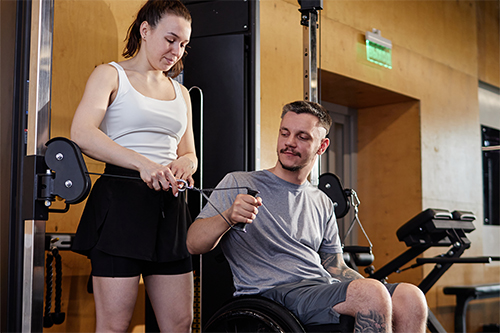
Stronger Upper Body, Better Control on the Court
By Michael Falco • Mar 25, 2026 • 3 min read
PICKLEBALL for wheelchair athletes is built on repetition, control, and positioning. Unlike standing players, movement and shot execution are driven almost entirely by the upper body and core. That means strength is not just helpful, it is essential.
The players who improve the fastest are not always the ones hitting harder. They are the ones who move more efficiently, stay balanced, and maintain control deep into matches. That starts with targeted training.
Core Strength for Stability & Rotation
The core is responsible for balance, posture, and rotational power. Without it, players struggle to reach wide balls, recover quickly, or control their shots. Focus on exercises that mimic on-court movement. The goal is controlled rotation, not speed.
Recommended exercises:
- Seated medicine ball twists: Sit upright and rotate side to side, simulating forehand and backhand motion. Start light and increase weight gradually.
- Resistance band rotations: Anchor a band to the side and rotate your torso across your body. This builds controlled rotational strength used in every shot.
- Seated knee lifts or marches: If mobility allows, lift one knee at a time to engage lower core stability.
- Isometric holds (seated balance): Sit without back support and hold posture for 20–30 seconds. This builds stability for reaching and leaning shots.
Shoulder Strength for Endurance & Protection
Shoulders take on a heavy workload in wheelchair pickleball. Strengthening them helps prevent fatigue and reduces injury risk. Focus on lighter resistance with higher control. Poor form leads to overuse injuries quickly.
Recommended exercises:
- Resistance band shoulder presses: Strengthens overhead stability for serves and resets.
- External rotations with bands: Critical for shoulder health and injury prevention.
- Front and lateral raises (light weights): Builds endurance for extended play.
- Seated rows (bands or cables): Strengthens the upper back, improving posture and control.
Arm and Grip Strength for Paddle Control
Control at the net and during fast exchanges depends heavily on forearm and grip strength. Small improvements here translate directly to better touch and reaction time.
Recommended exercises:
- Wrist curls and reverse wrist curls: Improves paddle stability and shot control.
- Grip trainers or stress balls: Enhances hand strength for quicker reactions.
- Light dumbbell punches: Builds speed and endurance for hand battles at the kitchen.
Movement Strength for Court Positioning
Wheelchair movement requires strength, coordination, and efficiency. The goal is not just speed, but control when stopping and changing direction.
Recommended exercises:
- Short push sprints: Push hard for short distances, then stop and reset. Mimics real points.
- Start-stop drills: Push forward, stop quickly, then reverse or change direction.
- Resistance band pushes: Attach a band behind the chair and push forward against resistance.
- Cone drills: Move between set points to improve positioning and court awareness.
Endurance Training for Match Play
Fatigue shows up quickly in the upper body. When it does, everything suffers. Players who maintain energy late in matches gain a clear advantage.
Recommended exercises:
- Interval pushing (30 seconds on, 30 seconds off): Builds stamina for rallies.
- Extended rally simulations: Practice keeping the ball in play for longer periods.
- Circuit training: Combine strength and movement exercises for sustained effort.
Train for the Game You Play
Strength training for wheelchair pickleball should always connect back to the court. Every exercise should answer one question, “Does this help me move better, stay balanced, or control the ball more effectively?” When the answer is yes, the results will show up quickly.
Stronger athletes do not just hit better shots. They stay in points longer, recover faster, and compete with more confidence every time they take the court.
Note: Before starting any new exercise program, athletes should consult with their primary care physician or a qualified medical professional to ensure the exercises are appropriate for their individual condition.
Michael Falco is a Certified Master Trainer and ISSA Personal Trainer, an ISSA Nutritionist, and an FWI Certified Life Coach. He trains clients at LA Fitness in North Wales, PA, and writes the Health & Wellness column for The Pickleball Weekly.

Read the full magazine issue! This story appeared in the March 25, 2026 issue of The Pickleball Weekly.
