
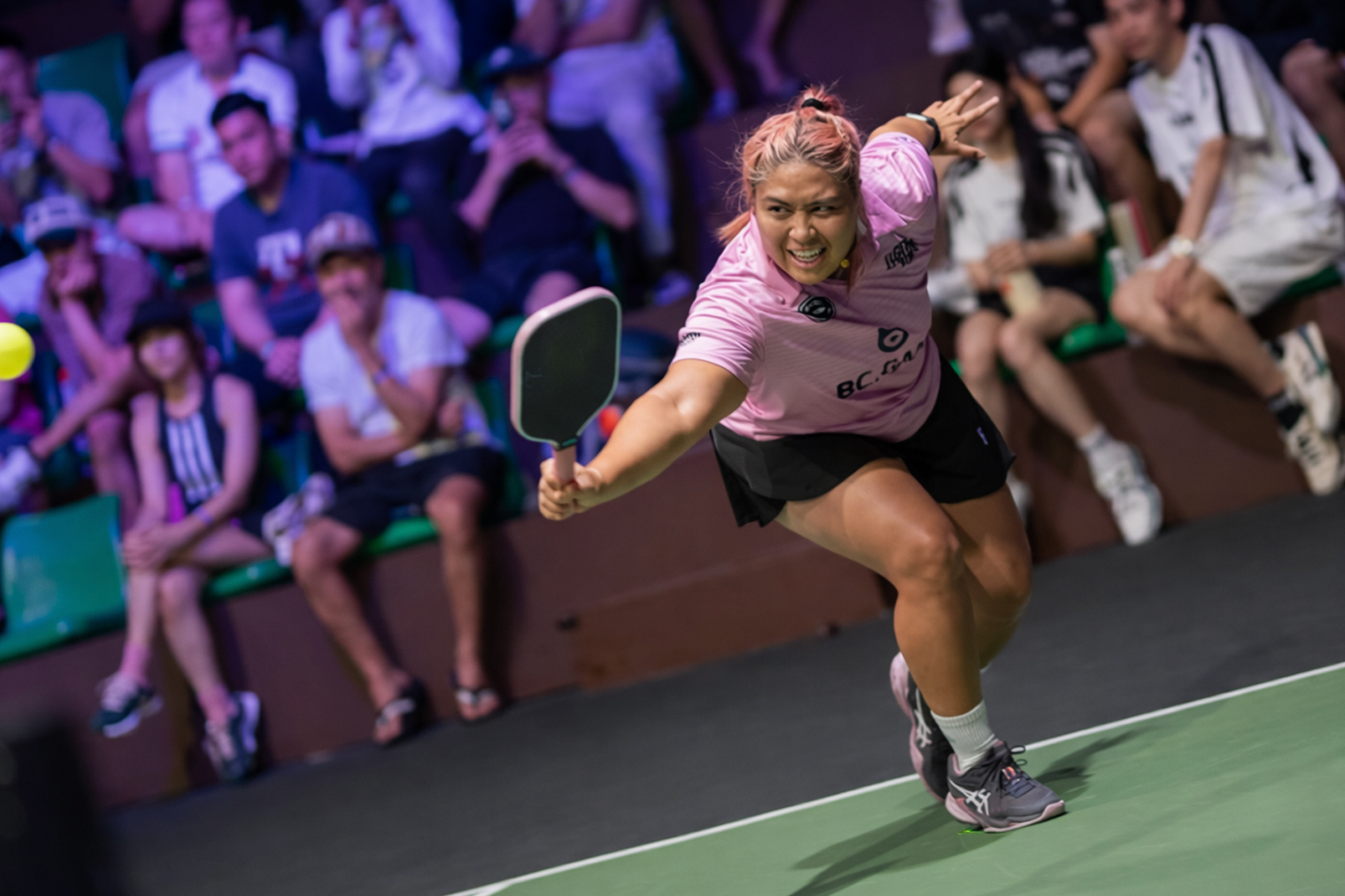
Trailblazer Sharneem “Neem” Shamsuddin
By The Pickleball Weekly Editorial Team
April 8, 2026 • 7 min read
SHARNEEM SHAMSUDDIN did not arrive at the top of Malaysian pickleball through a system that carried her. She built her path in pieces—across cities, across countries, and, at one point, through a public ask for help.
By early 2026, she is one of Malaysia’s leading female players, holding a DUPR rating above 5.0—the first Malaysian to reach that level—and competing across both the United States and Asia. The number signals entry into the highest tier of amateur and semi-professional play. It also marks a ceiling that, until recently, did not exist for Malaysian women in the sport.
She did not get there by accident.
Where It Started
Her entry point was not a national program or a formal pipeline. It was a country club in Hilton Head Island, South Carolina, where she was working and looking for a way to stay connected to the court.
“I discovered pickleball in 2022 while I was working at a country club in Hilton Head Island, SC,” she said in an interview with Pickleball News Asia. “At first, I played it casually, just as a fun way to interact with members of the club.”
The shift from casual to committed happened quickly, but not impulsively. The appeal of the game; its pace, its strategy, and its community pulled her in.
“But it didn’t take long for me to realize how much I loved the sport,” she said.
By mid-2023, she had made the decision that defines most professional athletes at some point: to stop treating the sport as something you play, and start treating it as something you pursue.

Photo Credit: Neem Shamsuddin / Instagram
Paying for the Dream
The decision came with a cost. Not metaphorically, literally.
Professional pickleball is not free to enter. It requires travel, tournament fees, coaching, and equipment, all before results begin to offset those expenses.
“The transition into professional sports requires a lot of investment—for travel, tournament fees, coaching, and equipment,” she said in Pickleball News Asia.
Without a sponsorship structure or federation backing, Neem made a different move. She asked.
She launched a GoFundMe campaign to support her early career, turning to community to fund a path that had no guaranteed return.
“I was grateful for everyone who contributed and supported my dream,” she said. “Every bit of support helps me get one step closer.”
That moment matters. It reframes the story. This was not a player stepping into opportunity. It was a player creating it.
“As someone who was born and raised in Malaysia, I feel a strong connection to the development of pickleball there.” — Neem Shamsuddin, Top-Ranked Malaysian Women’s Doubles Champ
Learning the Hard Way
Her development has largely taken place in the United States, where the level of competition is deeper and the pathway more established. It is also where results are harder to come by.
“One of my proudest moments was competing in a PPA event in North Carolina,” she said in Pickleball News Asia. “I played in qualifiers and won my first match… and then I had the chance to play against former professional tennis player Genie Bouchard.”
She did not win that match. That’s not the point.
“It was an incredible experience and a sign of the progress I’ve made in a short time,” she said.
That is how the level changes. Not through one win, but through exposure, repetition, and adjustment.

Breaking Through
Results followed. A USA Pickleball Golden Ticket. A PPA World Championship title at the 4.0 level in Dallas. Multiple 5.0-level tournament wins. And then the number. A DUPR rating above 5.0.
It is easy to list. It is harder to contextualize. In a system where most players plateau below that level, crossing it places her in a different category entirely and makes her the first Malaysian to do so.
That milestone marked a shift in what was possible, but it did not mark an end point. The landscape around her was already beginning to change.
A Changing Landscape at the Top
Neem’s rise did not happen in isolation. It unfolded at the same time Malaysia’s women’s pickleball scene began to deepen, accelerate, and shift.
As recently as 2025, she was widely recognized as the country’s top women’s doubles player, holding the No. 1 position in DUPR rankings. By early 2026, however, the landscape had evolved. The arrival of new high-rated players, combined with her own increasing focus on international competition and coaching, contributed to a visible shift in national rankings.
As of late January 2026, Choo Lyn Yuen moved into the No. 1 position in women’s doubles with a DUPR rating of 5.318, placing her inside the top 20 in Asia. She was followed by Athilla Miasara at No. 2, with Neem at No. 3.
In singles, the rankings have been equally competitive. As of April 2026, Ariana Murali holds the No. 1 position, followed by Eugenia David at No. 2, with Neem again ranked No. 3 nationally.
Other players, including Ooi Kah Yan, Xin Yu Lim, and former professional squash player Delia Arnold, continue to appear consistently at the top of the leaderboard, reflecting the growing depth of the field.
It is also important to recognize that DUPR rankings are inherently fluid. Ratings adjust dynamically based on match results and strength of competition, meaning standings can shift rapidly from one tournament cycle to the next.
Within that movement, Neem’s position tells a different story than a simple ranking drop.
She remains a top-tier figure in Malaysian pickleball, but her recent shift in rankings reflects two parallel forces: the rapid emergence of new elite players and her own expanding focus beyond domestic competition. While others have climbed through concentrated local play, Neem has continued to compete internationally, most recently at events such as the MB Hanoi Cup in April 2026, while also investing significant time into coaching and developing the next generation of players.
Her influence, in other words, has not diminished. It has expanded.

Carrying It Back
Despite building much of her career abroad, her connection to Malaysia has remained constant.
“As someone who was born and raised in Malaysia, I feel a strong connection to the development of pickleball there,” she said in Pickleball News Asia. “I’m eager to be part of it.”
That connection shows up in how she returns. Competing in local events. Running clinics. Working with players who are now where she was just a few years ago. Her role is not just to compete. It is to translate what she has learned into a system that is still forming.
“Expanding into both singles and doubles will help me grow as a complete player.” — Neem Shamsuddin, Top-Ranked Malaysian Women’s Doubles Champ
More Than a Ranking
Neem is not just a doubles specialist, even if that is where she has held the No. 1 ranking in Malaysia. She continues to expand across singles and mixed, building a more complete game.
“I really enjoy the team aspect and the strategic differences of doubles,” she said in Pickleball News Asia. “Expanding into both singles and doubles will help me grow as a complete player.”
That approach reflects something larger. In emerging markets, the best players cannot afford to specialize too early. They have to build everything.

Trailblazer in Motion
Neem’s career is still unfolding, shaped by competition across continents, evolving rankings, and a growing role within the sport itself. Her path has not followed a traditional structure, and that is precisely what defines it.
“I feel like I’m improving with every event I enter,” she said in Pickleball News Asia.
Her story is no longer just about reaching the top. It is about navigating what comes next, as the sport and the competition around her continue to evolve.
In a game expanding as quickly as pickleball is in Malaysia, players like Neem are not just competing within it. They are adapting alongside it, shaping its direction in real time, and redefining what success looks like at every stage of the journey. ●
About The Pickleball Weekly Editorial Team
The Pickleball Weekly Editorial Team produces in-depth reporting and cover features that examine the sport’s growth, innovation, competition, and culture. With contributors who understand both the strategy of the game and the forces shaping its future, the team is committed to telling the full story of modern pickleball.

Read the full magazine issue! Click below, then tap Full Screen for the best reading experience.
