
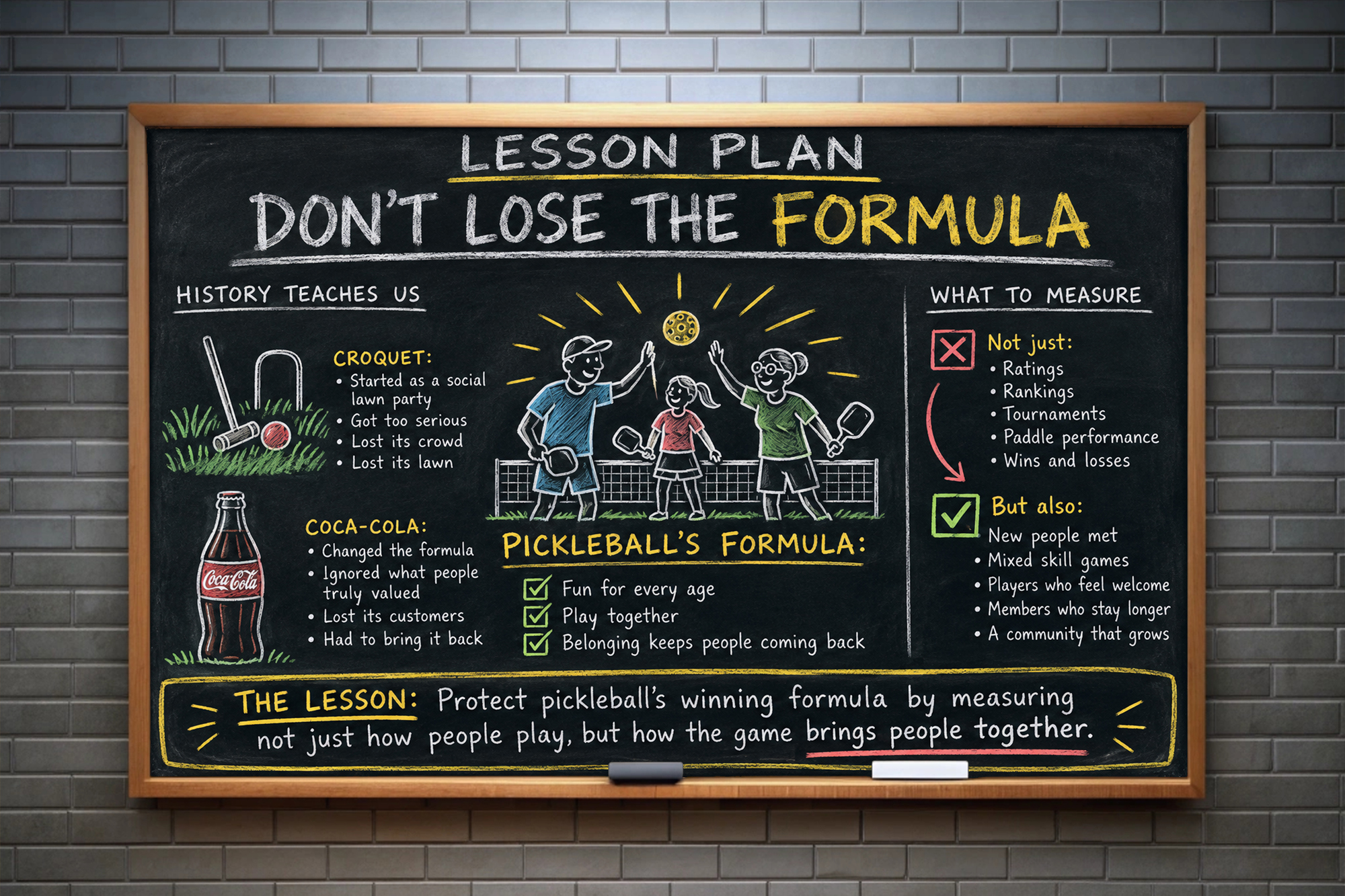
Don’t Lose the Formula
How croquet lost its lawn, Coca-Cola lost its formula, and what both can teach pickleball facility owners about the players who keep coming back for more
By Mark Cerezin
October 7, 2026 • 8 min read
Lessons in Life
Two true stories from the history books. One comes from the manicured lawns of Victorian high society, where an empire’s favorite pastime was slowly pushed to the margins. The other comes from the high-stakes boardrooms of corporate America, where a century-old empire risked everything on a taste test.
They happened more than a century apart and in entirely different worlds, but the mistake at the center of each was remarkably similar. Both focused on improving what people were doing while losing sight of why people loved doing it in the first place.
Together, they form a cautionary blueprint for the modern sports entrepreneur, proving that the spaces we build are only as durable as the culture of the people who inhabit them.
A Ghost Story
If you are playing croquet properly, you are slightly overdressed. You are holding a mallet in one hand, a cocktail in the other and, at some point, you simply forget whose turn it is to hit the ball because the conversation became too interesting.
This is not failing at croquet. This is croquet working exactly as designed.
We think of croquet as a punchline now, a lawn ornament of a game. But back in the 1860s, it was the fastest-growing social phenomenon in the English-speaking world for one revolutionary reason: it was the first outdoor game that men and women could respectably play together.
Mixed company together on a lawn, with just enough activity that nobody had to invent conversation from a standing start. The long-handled mallet was a pretext. The ball and hoops were punctuation. The game was a machine for turning strangers into company.
The sport grew so quickly that in 1868, at the height of the craze, a club formed as The All England Croquet Club in an affluent London suburban town known as Wimbledon. You already know how this ends. You just may not know how fast.
When the Game Changed
The serious players soon arrived. Rules tightened. Championships were organized. The official game became, in the words of one club history, too “scientific” for ordinary players, while the ordinary players were the whole point.
The cocktail crowd drifted off, membership sagged and, by 1875, the club was desperate enough to set aside one croquet lawn for a novelty game called lawn tennis in the hope of boosting numbers.
Records show that just two years later, the club renamed itself The All England Croquet and Lawn Tennis Club and staged its first tennis championship to raise money for a pony-drawn roller to maintain the croquet lawns. In 1882, croquet was removed from its name entirely. Wimbledon would grow to become synonymous with tennis, while its croquet origins were largely forgotten.
Here is the mechanism, because this is the part that matters: competition did not intensify croquet’s social experience; it substituted for it. When the match tightens, attention collapses onto the ball and away from the people. A game built as a pretext for connection cannot survive being taken seriously because seriousness devours the pretext. Nobody decided to kill croquet’s vibe. It died through a thousand small decisions that each looked like progress.
The Pickleball Parallel
Now let’s look at pickleball honestly. It is croquet’s social architecture with the fatal flaw fixed. At first, croquet was only a party. The moment anyone wanted real exercise, the socializers had to exit the field, and tennis began right there on the very same blades of grass.
Pickleball closed that exit. The small court, the underhand serve, the kitchen. This game is deliberately engineered to compress the advantages of size, strength, speed and skill, allowing a 70-year-old and her granddaughter to share a court and both mean it.
You sweat. You scramble. And you are still structurally at the new lawn party.
No game in a century has held both. This dual capacity, not celebrity videos and not pandemic boredom, is why it exploded. Which means the serious players have arrived once again, and this time it is our lawn. Rating systems, sometimes worn on wristbands at check-in when mandatory. Courts gated by a number and often by playing ability level. Facilities investing as if a broadcast frame is zooming in.
None of this is malicious or ill-intentioned. All of it looks like progress, and every bit of it moves the attention from the people to the ball. Croquet’s rules got too scientific for the crowd that made it a phenomenon. We are writing our rules right now.
I spend my working life in pickleball facilities and at live events, and I will tell you what I see in the struggling ones: they are never failing at pickleball.
Courts are fine. Instruction is fine. Where they are failing is belonging, the very thing the game was engineered to produce. The lawn party is not the soft side of this business. It is the moat. The facilities that thrive tend it on purpose, the way Wimbledon’s founders, just once, forgot to do.

The Taste Test
There is another way to lose sight of what people value. This one is a different business story, and it started in a boardroom.
In 1985, The Coca-Cola Company had a problem. Its share lead over its chief rival in the U.S. had been slipping for 15 straight years. The company did what any serious company would do: it researched. It put a sweeter formula in front of nearly 200,000 consumers in taste tests, and they preferred it. Picture standing up in that room and arguing that people do not drink Coke for the way it tastes. They would have walked you out.
On April 23, 1985, the company announced it was changing a formula it had not changed in 99 years. The public revolted. People filled their basements with cases of the old Coke. Protest groups formed. By June, the consumer hotline was taking 1,500 calls a day, up from 400 before the change. One protester’s sign read, “Our children will never know refreshment.” On July 11, the original came back as Coca-Cola Classic. The whole episode lasted 79 days.
The research was not wrong. In the tests, people really did prefer the new taste. The research was answering the wrong question. By the company’s own account, the taste tests did not show the bond people felt with their Coke. Nobody was drinking a flavor. They were drinking the thing that had always been there, the Coke their grandmother drank, the one they expected to hand down. Measure the liquid, and your data will tell you to throw away the very thing people love.
Pickleball Has a Formula, Too
Pickleball has a formula too, and we know who wrote it. One summer afternoon in 1965 on Bainbridge Island, Washington, Joel Pritchard and Bill Bell came home from golf and found their families bored. They set up a badminton net but could not find a shuttlecock, so they improvised. They grabbed paddles, a plastic whiffle ball and lowered the net.
The next weekend, they brought in Barney McCallum, and the three of them wrote rules built around one idea: a fun game for every member of the family, at every age.
A missing shuttlecock explains one afternoon. It does not explain the rules. The rules were a choice. The games those families already knew rewarded the tallest, the fastest and the strongest. They built one that did not.
Pickleball is not smaller tennis. It is an anti-sport, engineered so a grandparent, a 10-year-old and the guy who played a sport in college can share a court and all have a good time. That is what people bought. Not a sport. Something to do together that does not leave anybody out.
What Are We Measuring?
Now look at our dashboards. We have classified pickleball under sports, so we measure it like one: ratings, rankings, tournament draws, paddle performance and audience numbers. Every one of those can go up while the formula quietly changes underneath.
You have probably already seen it. A player turns down a game because a partner might drag his rating down. A suspiciously hot paddle shows up at open play, and nobody wants to be the one who says something about it. No scoreboard records a loss. People just stop coming back, and nothing on the dashboard tells you why.
Here is where the Coca-Cola story stops being comforting. Coke could undo its mistake because the original formula still existed. A court culture has no backup copy. Once open play sorts itself into tiers and the casual players drift away, no announcement can bring them back, just as croquet never got its lawn back.
Measure what the taste tests missed. At our events, we do not count who won. We count who met. Every facility can ask its own version of that question: Do the members who play with the widest mix of people stay longer than the ones who only play inside their rating band?
If the answer is yes, the lawn party is not a nice-to-have. It is the formula. Do not let a taste test talk you out of it.

Protect What People Came For
The lesson from croquet is not to resist competition. The lesson from Coca-Cola is not to resist change. Both stories are warnings about confusing the measurable part of an experience with the reason people care about it.
Pickleball facilities need ratings, organized play, instruction, leagues and competition. Growth will bring more sophistication, more technology and more ways to measure performance. None of those things has to threaten the game’s culture unless they begin replacing the connections that made people walk through the door in the first place.
The formula is not hidden. It is the new player who gets invited into a game. It is the foursome that stays another hour because nobody wants to leave. It is the 70-year-old playing with the 20-year-old, the beginner sharing a court with someone better and the person who arrives alone but does not stay that way for long.
History does not usually repeat itself. But on this exact kind of lawn, with this exact kind of game, it already did, and it only took 15 years.
Hold your cocktail a little tighter. ●
About Mark Cerezin
Mark Cerezin is an American healthcare strategist, entrepreneur, podcast host, and prominent pickleball advocate based in Fort Lauderdale, Florida. He is best known within the sports community as the founder and host of the podcast The Pickleball Talks and is co-founder of interACT (interactforreal.com), which builds human connection at live events.

Read the full magazine issue! Click below, then tap Full Screen for the best reading experience.
