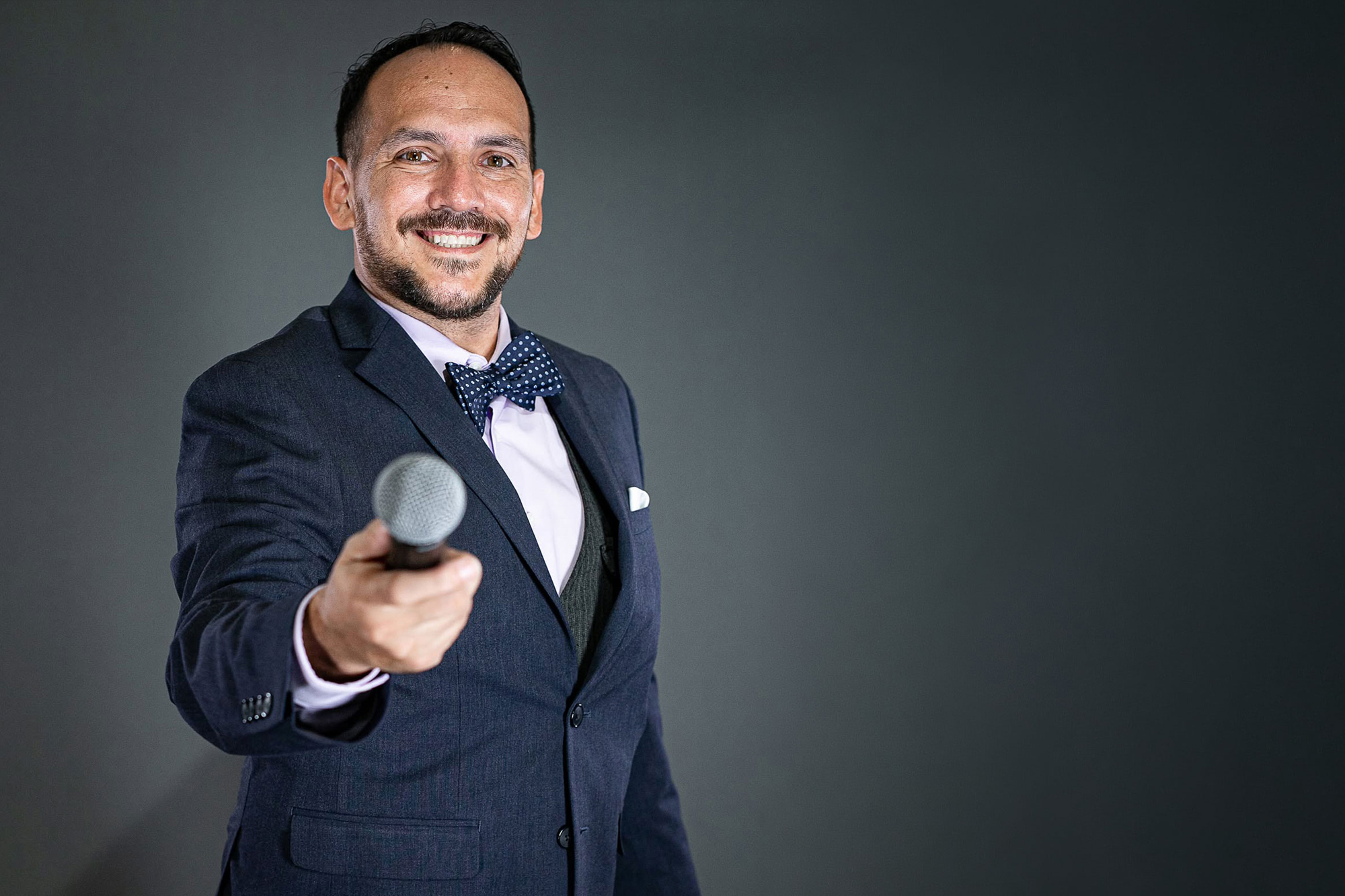
Finding His Voice
How a small-town theater kid from Ohio survived two major surgeries to become an emcee for professional pickleball
By Adriana Falco • September 23, 2026 • 17 min read
Center stage
IF YOU HAVE attended PPA Tour or Major League Pickleball event, chances are you’ve seen the man in the colorful suit commanding the court between matches.
Mic in hand, Joshua Flores is often the live host for the PPA and MLP and a fan favorite. He is a natural for the role of emcee, energizing the crowd and running interactive activities to keep the audience entertained.
Ironically, before ever becoming the voice for professional pickleball, Flores lost his own voice twice. Literally. Once after open-heart surgery left him unable to perform for over a year, and again eight years later, when a mass growing near his carotid artery triggered a mini-stroke and left him relearning how to swallow, speak, and eventually sing.
Each time, he built himself back from nothing and returned to the microphone.
Today, that same voice fills MLP and PPA Tour arenas across the country, introducing teams, working the crowd between points, and doing whatever it takes to make the fans on-site feel like they are part of the show.
But none of it started anywhere near a pickleball court.
Small Town, Big Dreams
Flores grew up in Lima, Ohio, a football town that poured just as much into its choir and theater programs, dreaming of Broadway before he ever picked up a microphone for sports. He built an entire career out of other people’s stages first, community theater, rock bands, professional wrestling, boxing, MMA and Major League Baseball, before a couple of well-placed referrals introduced him to a sport he had never heard of.
What follows is a conversation with Joshua Flores about growing up the only performer in his family, surviving two surgeries that each threatened to take away the very thing he built his life around, and how he became one of the most recognizable voices in professional pickleball almost by accident.
From the Stage to the Sidelines
Q: You grew up in one of the biggest football states in America. What was Lima, Ohio like when you were growing up, and how did the arts become a passion?
FLORES: Growing up in Ohio, my hometown of Lima put as much into our arts programs as we did into our state champion football team, which was a big deal for a city school. Our marching band sent a lot of people up to Ohio State’s band, the greatest band in the land, so the music program at my high school was huge.
I was big into the arts. I did music classes in school, chorus, musical theater, show choir, glee, all of it. I grew up wanting to be a musician, or a vocalist, or an actor.
My mother was the biggest influence on that journey. She did not have that artistic love herself, but she made sure I got to every audition, every play, every concert. In my immediate family, I was the only one who was really into it.
Q: What sparked the move from Ohio to Florida, and what was that first chapter in the South like?
FLORES: I moved to Florida right after high school to pursue acting, since my father, stepmother, and siblings already lived there. Broadway was on my bucket list at one point, but I was young and scared of moving to New York City without anyone there.
I officially settled in Florida around age 24. By then, I already had a daughter, born just as I was turning 21. So, being somewhere with family nearby while raising a child mattered a lot.
I actually auditioned for Disney World and got hired as a character actor, but the starting pay back then was low. I would not have been able to support myself and my daughter. Instead, I stayed local, picked up some small modeling gigs and independent film auditions, and did a lot of community and musical theater .
Q: How did that lead into singing gigs with bands?
FLORES: That local theater work turned into singing with a couple of rock bands around the Treasure Coast area of Florida, playing bars, smaller clubs, and a few bigger venues with a couple thousand people.
I loved it, having fans right in front of you singing along.
I did that for about seven or eight years, working a serving job in the mornings, then getting off in the afternoon, playing a show until two o’clock in the morning, and doing it all again the next day.

Q: At some point a wrestling promoter noticed you. How did you end up as a ring announcer?
FLORES: After one of my shows, a friend who happened to be a local promoter for a professional wrestling company approached me. He said the way that I worked a crowd and my speaking voice would make me a great ring announcer.
I did not believe him at first. People make those types of promises all the time in this business, but he followed through. He had me announce the first two matches of an event just to see how I did, and for the next five years, from 2010 to 2015, I worked as that company’s ring announcer while still doing music on the side.
Q: In December of 2015, everything stopped. What happened?
FLORES: I had to undergo open-heart surgery. A couple of years earlier, my father had a major heart attack. It turned out to be a genetic issue, a bicuspid aortic valve that led to an aortic aneurysm. None of my siblings had it, but I did. Thankfully, my father survived.
They had to open me up, remove the aneurysm and the valve, and replace it with artificial parts.
I have a mechanical heart valve now. I was out of announcing and singing entirely for a little over a year because I could not put any pressure on my sternum after that kind of surgery.

Q: How did you rebuild your career after that?
FLORES: I made my return to wrestling about a year later, and from there I started picking up bookings with other promotions, as well as boxing and mixed martial arts. I also spent about a year and a half doing monthly stints in Puerto Rico working with Latin American Wrestling Entertainment.
Around 2019, former WWF ring announcer Evan Nine helped open another door for me. He was the PA announcer for New York Mets spring training and the St. Lucie Mets, their minor league team in Port St. Lucie. They happened to be looking for a backup announcer, so I auditioned and interviewed with the Mets and ended up spending about seven seasons with the organization as a PA announcer.
I did more than PA announcing. On days when I wasn’t behind the microphone, I might be doing on-field hosting, kind of like what I do with MLP now, or running sound for the stadium. Over time, I worked fewer games as I started getting more announcing bookings elsewhere.
I moved from a desk job into bartending in order to rebuild my physical stamina and to get more flexibility in my schedule, so I could keep chasing the bookings. Then in 2023, I had a minor stroke and had to have surgery on my neck to remove a mass from next to my carotid artery.
Q: That sounds terrifying. Can you share what happened?
FLORES: I was getting ready for work when the room started spinning and I lost feeling on the right side of my body. My instinct was to call my fiancée, Christina. Thankfully, she was only a few minutes away and rushed home to get me to the hospital.
It turned out to be a paraganglioma that had grown from the base of my skull into my jaw, temporarily cutting off blood flow near my carotid, which caused the stroke-like symptoms.
After the surgery, my throat was so swollen I couldn’t swallow or eat at first. I went through about a month to six weeks of physical, occupational, and speech therapy just to get my voice back, and I was out of work for about six weeks altogether.
A couple of months later, I made my return to the microphone with Rise FC in mixed martial arts. From there, I just kept building myself back and growing my career.
Q: Around that same period, you also stepped away to run your father’s business for a while. How did that experience shape you?
FLORES: My father had to undergo brain surgery of his own and could not keep running his lawn maintenance company. I took it over for a little over a year. I wanted to keep his business in the family, to keep his legacy alive.
I was not fulfilled by it at all, if I am honest. It was a decision made out of emotion, not passion. And honestly, my body could not handle the grueling physical labor in the Florida heat every day. My nephew runs the business now.

Q: How did pickleball enter the picture?
FLORES: While I was running my dad’s business, Ashlyn Andrews, an executive with the PPA Tour, reached out to me. Matt Graifer, the Young Professor and creative director for the Savannah Bananas, had given her my information since we had worked together before. I did a handful of PPA events last year, whatever I could fit around everything else going on.
Then, Danielle Ieraci from Major League Pickleball happened to be at one of those first PPA events, came up to me, and asked if I would want to work with MLP as well. I genuinely didn’t know professional pickleball even existed.
Going in, I only did a little bit of research on purpose, because I wanted my first reactions on the microphone to be real, not rehearsed, so people could actually feel my excitement.
There are a couple of other guys who emcee for the tour, too, but usually only one of us works at a given event. So, I have never even met any of them in person. This year, I am doing every MLP event and the vast majority of PPA events.
Q: Walk us through what a typical day looks like when you are emceeing a professional pickleball event.
FLORES: The night before, I write out all of my matches in order, learn the teams, and get all the details on the event, the title sponsor, the presenting sponsors, the format. I build my own script for the opening from there.
I show up an hour to an hour and a half before play starts to go over my sponsor reads and giveaways with the AV team, so the music, the video boards, and my volunteers all know what is happening and when. I have full creative control over exactly where those moments land inside the matches, even though the day’s basic schedule comes from the tour.
A lot of the trivia and video content actually comes from the tour itself. They run a media day at the start of the season where they film the players. I might get handed something like a clip of Hayden Patriquin naming as many superheroes as he can in 20 seconds, and then I will pull a fan out of the crowd to try to beat his time before we play the video.
Sometimes, a break happens that nobody planned for. In that case, I just go with it on the fly.
Once we are ready to open, I go on a few moments before the broadcast starts to introduce the event and the players to the fans in the building, because my focus is always on making the experience great for the people who are actually there, onsite.
Q: Do you play pickleball yourself?
FLORES: I have played once, literally just once. It is one of those funny things, because I had zero interest in sports growing up. My friends and I would go to football games in high school, watch maybe a quarter, and spend the rest of the time talking to girls instead of paying attention to the guys on the field.
I was not in marching band either. I did chorus and drama the whole way through.
So, if you had told teenage me that I would end up making a living as a sports announcer, I would have laughed at you. There must have been some comfort level built in just from being around it, though, because here I am.
Perhaps the greatest irony is that the kid who barely watched the football games he attended ultimately built a career behind the microphone in professional wrestling, boxing, MMA, baseball and pickleball.

Q: What has surprised you most about pickleball fans?
FLORES: I had no idea how passionate they are.
I have worked pro wrestling events in Puerto Rico, lucha libre crowds, that is real passion. The World Cup soccer is real passion. Pickleball fans are right there with them.
At the same time, when I tell everyday people I am an emcee for professional pickleball, I still get a mixed reaction, because some people still think of it as a joke. But you get that with any sport people who do not fully understand yet. Even wrestling still gets written off by people who call it fake, when the work these athletes put in is completely real.
Q: You also own and operate your own entertainment business. Tell us about that venture.
FLORES: My fiancée, Christina, and I started 4 Your Entertainment in early 2023. It includes mobile bartending, DJing, and a 360 photo booth for weddings, birthdays, and quinceañeras party experiences. We still own it, although between the travel schedule with the tour it is harder to put time into it these days. December works out well for the business, since the MLP is over for the year and PPA does not run events that month, so the business helps carry us through the holidays between tour stops.
Q: Who have been the biggest influences on your career?
FLORES: My mother, without question, for always showing up. My father too, once I moved to Florida. He bought his own ticket to every single play I was in, never took a free one, and always brought along one or two of my sisters. My fiancé Christina also has helped me back to health twice after each of my surgeries and encouraged me to keep pursuing my announcing.
No one in my family ever looked down on me for being the only performer in the bunch. It was just known as ‘Josh’s thing.’
Professionally, Matt Graifer, the Young Professor with the Savannah Bananas, is one of my favorite people I have ever worked with. And Evan Nine, a former WWF ring announcer, is the one who got me into the Mets organization and originally introduced me to USA Boxing.
I have learned just as much from watching how other people do things I did not want to copy as I have from the people I looked up to directly.
Q: You also hosted a talk show for a season. What was that experience like?
FLORES: I hosted Don’t Come Here, a tourism podcast and talk show for the Treasure Coast in Florida, 12 episodes over a year, one a month. It was about pushing people past just Orlando and Miami to see what small-town Florida had to offer. I got to learn things about the area I had lived in for years that I never even knew, and it was a lot of fun being the one asking the questions for once.
Q: What is next for you?
FLORES: The PPA Tour is branching out internationally, Asia, Australia, and beyond, and I have already told them I would be on board for that whenever it becomes a real possibility. I have my passport ready and I love to travel. It is not on anyone’s radar just yet, but if the call ever comes, I am going.
Closer to home, I want to ultimately be able to make a full living off my name doing exactly what I do now, and I am close to that.
A lot of fans call me “the Bruce Buffer” or “the Michael Buffer of professional pickleball” because of the energy I bring over from combat sports. While that is an incredible compliment, I always joke that they will retire eventually and somebody will have to step into that role.
I do not want to be the next Bruce Buffer or Michael Buffer, though. I want to be Joshua Flores. I want that name to be known and recognized on its own, whether pickleball gets there first or somewhere else does. And if I can help build this sport up along the way, I absolutely will.
Becoming Joshua Flores
Joshua Flores has spent much of his life finding new stages. A theater kid who barely watched the football games he attended became a singer, then a ring announcer, before building a career behind the microphone in wrestling, boxing, MMA, baseball and, ultimately, professional pickleball.
Each time one path closed, another unexpectedly appeared.
His journey carried him from theater productions and concert stages to wrestling rings, baseball stadiums, and eventually a sport he had never even heard of until a pair of well-timed phone calls changed the course of his career.
Twice, his own body threatened to take away the very gift that defined him. Twice, he endured months of therapy, relearned how to speak, and returned to the microphone with an even greater appreciation for every word.
Today, Flores is not trying to become the next anyone.
He is not interested in filling someone else’s shoes or inheriting someone else’s nickname. He wants the name Joshua Flores to stand on its own.
Judging by the thousands of fans filling the pro pickleball arenas and responding to the unmistakable voice echoing through them, it already does.
About Adriana Falco
Adriana Falco is the Founder and Editor-in-Chief of The Pickleball Weekly, a global digital magazine reaching readers in over 100 countries across six continents. A pickleball player since 2012, she combines more than 30 years of executive leadership with a passion for storytelling that captures every facet of the sport. With a career from international technology companies to major news organizations, Falco covers the people, businesses, innovations, and global trends shaping pickleball’s future, with a mission to connect and inspire the worldwide pickleball community through credible journalism and compelling stories.

Read the full magazine issue! Click below, then click on the X in the lower bar to enjoy a full screen view!