
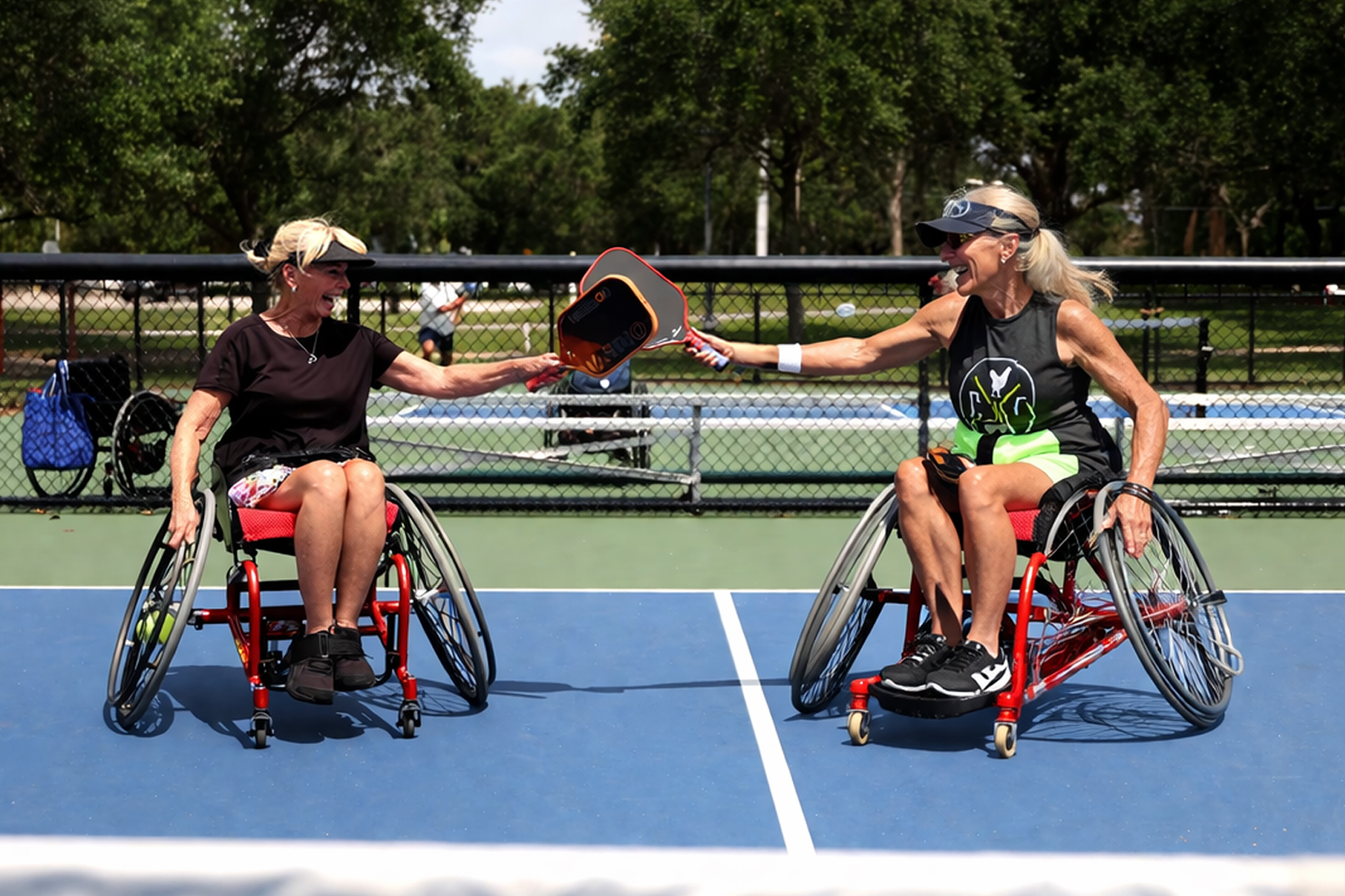
Two Women, One Mission: Redefining What It Means to Compete
By The Pickleball Weekly Editorial Team
March 25, 2026 • 13 min read
IN PICKLEBALL, PEOPLE are drawn in by the rally. The rhythm of the ball, the quick exchanges at the net, and the accessibility of the game make it easy to start and hard to leave. In wheelchair pickleball, that connection deepens. The game is still competitive, still strategic, still fast, but the meaning behind each point carries something more substantial.
Adaptive pickleball is expanding across the United States, creating space for athletes whose relationship with sport has been interrupted and, in many cases, completely redefined. Within that growth are players who are not only competing but building the foundation for what the sport will become. Jody Davis and Jamie Bunch Elliott represent two of those players. Their paths into wheelchair pickleball are different in every practical sense, yet they converge in mindset, purpose, and impact.
JODY DAVIS
The Moment That Changed Everything
Jody Davis was not easing into retirement or slowing down when her life changed. She had spent 38 years as an educator in Washington Township schools in Indianapolis, and even after retiring, she remained active and engaged. She was a runner, a tennis player, and a regular on the pickleball court.
The moment itself was ordinary. She bent down to pick up a ball during a game at the Monon Community Center. What followed was anything but. Within an hour, she lost the use of both legs due to a spinal infarct, a rare and sudden disruption of blood flow to the spine.
There was no gradual warning. No time to prepare. One moment she was playing, and the next she was facing a completely different reality.
“Anyone of any age can learn to play pickleball. It’s easy to pick up the game.” —Jody Davis, “Rollin’ Pickle Belle”, Wheelchair athlete & advocate for adaptive sports

Rebuilding From the Ground Up
Recovery was not passive, and it was not solitary. It became a coordinated effort built around discipline, family, and an unrelenting commitment to progress.
Her daughter, a registered nurse, attended rehabilitation sessions and ensured that every exercise carried over into daily life. A trainer worked with her multiple times each week, focusing on strengthening any muscle that showed even the smallest response. Her brother, a triathlete, took her to the pool several times a week, where she began with assisted movement using a chair lift and life jacket, eventually progressing to swimming independently.
Her husband modified their home to make it fully accessible, removing barriers that could slow her recovery or limit her independence. Every element of her environment became part of the process.
The results were measurable but hard-earned. Davis regained partial mobility. Her left leg recovered significant strength, allowing her to stand, while her right leg regained limited function. With a walker, she can move short distances, but she cannot take independent steps. What she could do was return to sport.

Returning to the Court
For Davis, returning to pickleball was not symbolic. It was essential. The game had been part of her life before her injury, and it became part of her identity again during recovery.
She began competing in wheelchair pickleball within a year, using the sport not only as physical activity but as a way to reestablish rhythm, focus, and purpose. What started as participation quickly became competition.
At the Minto U.S. Open Pickleball Championships in Naples, Florida, Davis made an immediate impact. She earned a silver medal in wheelchair doubles with Lisa Ruggieri and a bronze medal in the hybrid division alongside Micki Petersen. Notably, she had never played with either partner before the tournament, yet adapted quickly and performed at a high level.
Her success continued in subsequent years. In 2024, she secured a bronze medal in the wheelchair division, and in 2025, she returned to the podium again, reinforcing her consistency and competitiveness within the field.

The “Rollin’ Pickle Belle”
In her local community, Davis is known as the “Rollin’ Pickle Belle,” a nickname that reflects both her personality and her presence. She is not defined by her wheelchair. She is defined by how she plays.
She regularly competes with standing players and is often the only wheelchair athlete on the court. That dynamic has not led to hesitation or accommodation. If anything, it has sharpened her competitive edge.
Her style of play is deliberate and intelligent. She positions herself with precision, anticipates shots, and forces opponents to rethink how they construct points. Players who expect a slower or less aggressive game quickly adjust their expectations.
There is also a sense of humor and confidence in how she approaches competition. Teammates often joke that opponents should not take it easy on her because she will win anyway. That reputation is earned.

Expanding the Game Locally
Davis has extended her impact beyond her own play. She teaches pickleball to special needs adults and actively introduces adaptive play to those who may not have considered it. In a region where wheelchair pickleball participation remains limited, she has taken on the role of educator and advocate.
She also continues to work part-time at the Monon Community Center, the same facility where her injury occurred. That decision reflects both resilience and perspective. Rather than distance herself from that moment, she has chosen to remain connected to the place where her life changed and where her new path began.
Those closest to her describe a consistent mindset. She does not allow setbacks to define her trajectory. She continues forward, focused on what is possible rather than what has been lost.
JAMIE BUNCH ELLIOTT
A Life Built on Movement
Jamie Bunch Elliott’s story begins long before wheelchair pickleball. Her life was built around movement, performance, and risk.
She worked as a stuntwoman in the film industry, performing in major productions and doubling for actors in physically demanding roles. Her credits include RoboCop, Free Willy, Dante’s Peak, and The Hand That Rocks the Cradle. The work required precision, timing, and a willingness to take on physical challenges that most people would avoid.
Her connection to pickleball dates back to 1990, when she first played on Vashon Island in Washington. Over time, she became deeply involved in the sport, co-founding clubs, organizing clinics, and helping to grow pickleball in multiple states. By 2015, she had become a USA Pickleball Ambassador, playing a key role in expanding the game at the grassroots level.
“Pickleball has saved my life. Where there’s a wheel, there’s a way.” —Jamie Bunch Elliott, Cancer survivor & sponsored Para-pickleball athlete

Diagnosis and Disruption
In 2017, a fall on ice led to back pain that did not resolve. Imaging revealed a tumor on her rib. The diagnosis was chondrosarcoma, a rare form of bone cancer that does not respond effectively to chemotherapy or radiation.
What followed was a series of major medical interventions. In 2018, she underwent surgery to remove four ribs. Later that year, another tumor was discovered in her spine. In 2019, surgery to remove that tumor left her paralyzed.
The transition was both physical and emotional. Elliott has spoken openly about the depression that followed and the uncertainty of what her life would look like moving forward.
Learning to Compete Again
Elliott’s return to pickleball required relearning the game from an entirely new perspective. Playing from a seated position introduced challenges that extended beyond basic movement.
She had to learn how to maneuver a sports wheelchair while holding a paddle, transitioning between pushing the chair and executing shots, and adjusting to a lower point of contact with the ball. Even simple tasks, such as getting the chair in and out of a car, required new techniques.
In 2021, she purchased a sports wheelchair and named it “Barney,” after pickleball founder Barney McCallum. The name reflects her ability to bring humor into situations that are otherwise physically and emotionally demanding.
Her competitive instincts returned quickly. She is a Senior Olympics silver medalist and has competed in major events including the U.S. Open and USA Pickleball National Champion- ships. Her background as a high-level standing player provided a foundation, but success in the wheelchair game required a complete adaptation of technique and strategy.

Competing Through Ongoing Battles
Elliott’s story is not defined by a single recovery. It is defined by continuity in the face of ongoing challenges.
She has undergone multiple additional procedures involving her lungs and liver as part of her continued battle with cancer. Despite this, she continues to compete, often returning to the court shortly after treatment. Her mindset is direct. She does not wait for ideal circumstances. She plays through what is in front of her.
She also understands the social challenges that come with adaptive play. Many standing players are initially hesitant to compete against wheelchair athletes, often out of concern or lack of familiarity. Elliott addresses this directly by encouraging participation, demonstrating capability, and educating players on how the game is played.

Building Something Bigger
Elliott’s influence extends far beyond her own matches. She is a central figure in the growth of wheelchair pickleball, particularly in Texas and across the broader adaptive community.
She co-founded the Para Pickleball Program, a nonprofit initiative focused on creating access to the sport. Through partnerships with organizations and sponsors, the program has secured sports wheelchairs, organized exhibitions at major events, and introduced new players to the game.
She runs weekly play sessions in the Dallas-Fort Worth area, helping players transition into wheelchair pickleball in a supportive environment. She also manages an online community that connects players across the country, providing guidance, resources, and encouragement.
Her work removes barriers that would otherwise prevent many individuals from ever stepping onto the court.

A Philosophy That Drives Everything
Elliott’s approach to life and sport is captured in a single phrase. Where there is a wheel, there is a way.
It is not a slogan. It is a principle that informs how she competes, teaches, and lives. She believes that movement is essential, that purpose can be rebuilt, and that sport can play a central role in that process.
For many of the players she reaches, she represents a turning point. She is often the person who shows them that returning to competition is not only possible, but achievable.
A Game That Continues to Evolve
Wheelchair pickleball is expanding in both visibility and participation. The structure of the game introduces new strategies, including the two-bounce rule, which changes how points are constructed and defended. Movement requires coordination, anticipation, and efficiency.
For standing players, sharing the court with wheelchair athletes shifts the dynamics of play. Power becomes less dominant, while placement and awareness become more critical. The result is a game that is more strategic, more inclusive, and more connected.
The Future Already in Motion
Jody Davis and Jamie Bunch Elliott are not outliers within pickleball. They are part of its evolution.
Their stories reflect different journeys, but they arrive at the same place. A court where competition is still central, but where resilience, adaptability, and purpose carry equal weight.
As wheelchair pickleball continues to grow, the influence of players like Davis and Elliott will only expand. They are not just participating in the sport. They are helping define what it becomes.
Expanding Access and Visibility
The growth of wheelchair pickleball is being driven by both grassroots efforts and increased visibility at major events. Tournaments are expanding divisions to include wheelchair and hybrid play, while exhibitions are introducing new audiences to the adaptive game. At the same time, local communities are beginning to invest in equipment, programming, and court access that support long-term participation.
Players like Jody Davis and Jamie Bunch Elliott are central to that growth. Their contributions extend far beyond medals and match results. They are actively building the pathways that future players will follow, often in environments where those pathways did not previously exist.
Davis is introducing new players at the local level, creating opportunities in communities where adaptive sports still have limited representation. Elliott is scaling that impact through structured programs, partnerships, and national advocacy, ensuring that access is not dependent on geography or circumstance.
Together, they represent two sides of the same movement. One is rooted in consistent presence, competition, and local engagement. The other is driving expansion, awareness, and infrastructure. Both are essential to the future of the sport.
The Future Is Already Taking Shape
Wheelchair pickleball is not a niche within the sport. It is an integral part of its evolution.
As more players enter the game, as more tournaments create space, and as more communities invest in accessibility, the adaptive division will continue to grow in both size and significance. The level of competition will rise, the visibility will increase, and the stories will continue to evolve. Jody Davis and Jamie Bunch Elliott are not exceptions within that future. They are early examples of what it already looks like.
Their journeys are different, but they lead to the same place. A court where competition, resilience, and purpose exist together. A game that continues to expand, not only in participation, but in meaning.
For everyone watching, playing, or just discovering pickleball, they offer a clear reminder. The game is changing. The definition of athlete is expanding. The strongest competitors are often the ones who had to fight the hardest just to get back on the court. ●
Editor’s Note: Jamie Bunch Elliott passed away on April 15, 2026 , at the age of 75, from complications arising from chondrosarcoma, a form of cancer she had been battling for over nine years. We are grateful to have shared a small part of her story.
About The Pickleball Weekly Editorial Team
The Pickleball Weekly Editorial Team produces in-depth reporting and cover features that examine the sport’s growth, innovation, competition, and culture. With contributors who understand both the strategy of the game and the forces shaping its future, the team is committed to telling the full story of modern pickleball.

Read the full magazine issue! Click below, then tap Full Screen for the best reading experience.
