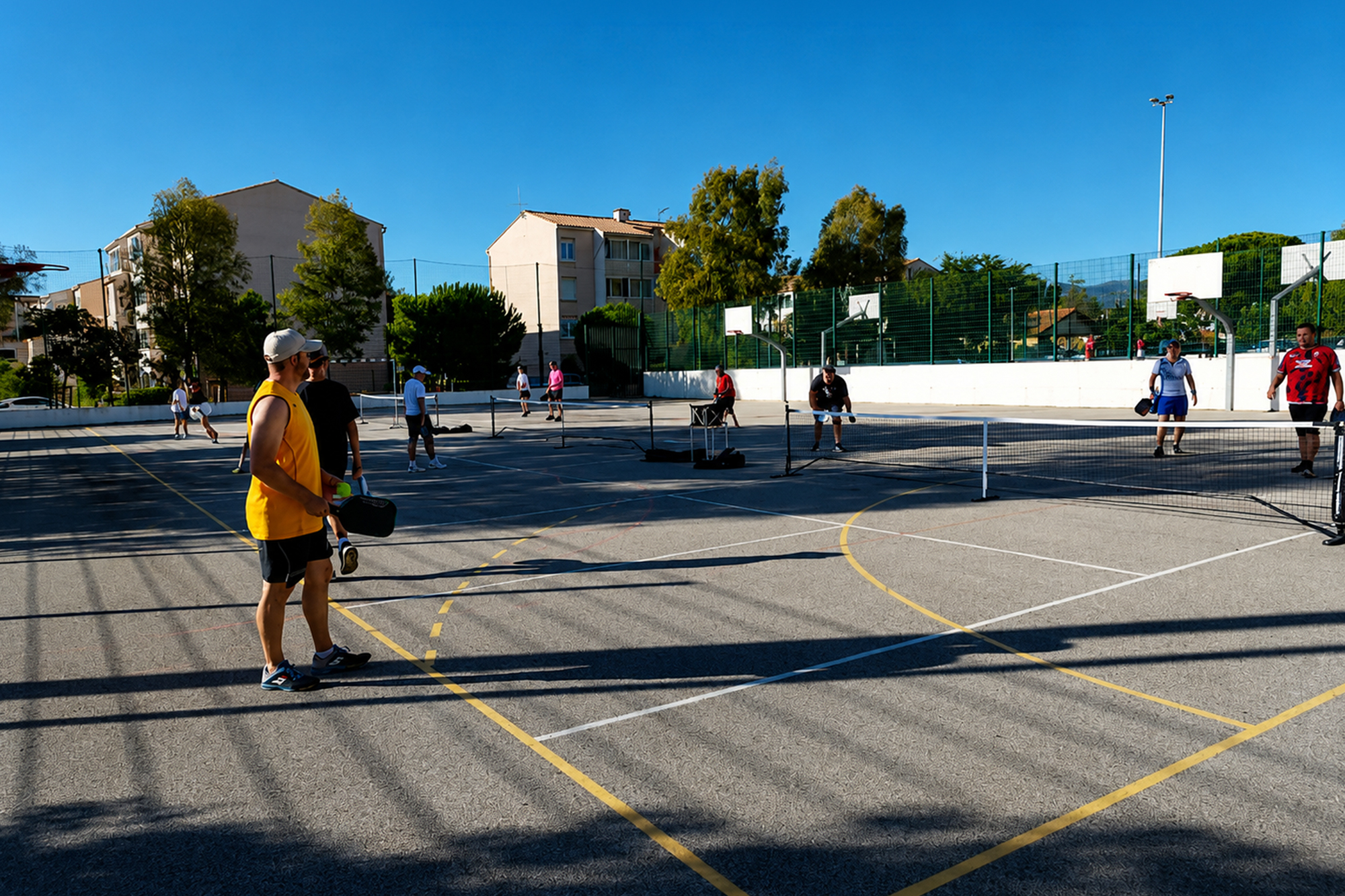
France Is Building Pickleball Before It Becomes an Industry
By Carole Stromboni • July 1, 2026 • 5 min read
From municipal courts to national championships, France is translating pickleball into its own sports system
WHILE MUCH OF the pickleball world is watching the speed of the American boom, a quieter story is taking shape in France.
It is not centered on a celebrity investor, a professional league, or a wave of private clubs. It is being built through something slower, more institutional, and potentially more durable: sports infrastructure.
French pickleball is not an industry yet. It is a sports system in the making.
I discovered pickleball in the United States in 2023 and began documenting its growth in France in 2024 through Bonjour Pickleball, an independent French-language editorial media dedicated to the sport. What I have watched unfold since then is not simply a trend. It is a translation.
France is not trying to copy the American boom. It is translating pickleball into one of Europe’s most structured sports cultures.
The French Tennis Federation reports around 30,000 people playing pickleball and hundreds of clubs offering the sport. Bonjour Pickleball has independently documented more than 200 public places to play, with practical information for players looking for courts, schedules, surfaces, and local access.
But the most important question in France is not only how many people want to play.
It is who owns the court.
In many parts of the United States, pickleball expanded through private clubs, retirement communities, public parks, dedicated facilities, and entrepreneurial speed. In France, many sports venues are public, club-based, or connected to local authorities. A court may belong to a city. A gym may be managed by a municipality. A tennis club may operate on land owned by the local government.

That changes everything.
Pickleball grows when players ask for it. But it also grows when a city agrees to paint lines, when a municipal sports hall allocates time slots, when a club board accepts a new discipline, when a local official understands the demand, and when neighbors accept the sound of play.
A major turning point came at the end of 2025. The Federation Française de Tennis, known as the FFT, received official delegation from the French Ministry of Sports to govern pickleball nationally. For a sport that had grown through passionate volunteers, local groups, and early adopters, this gave pickleball a formal institutional home.
The FFT matters because it already manages a broad racket-sport ecosystem. Its name is tennis, but its scope now includes tennis, padel, beach tennis, paratennis, and pickleball. For pickleball, that means access to a national framework for competitions, rules, clubs, coaching pathways, equipment guidance, and high-performance development.
But the French story is wider than tennis.
Pickleball also speaks to badminton clubs, padel venues, multi-sport associations, schools, leisure centers, private facilities, and municipalities looking for accessible activities that can serve different ages and levels. That is one of the reasons France is worth watching. The market will not be built by one actor only. It will be built through coordination.
The next symbolic step will come this summer. From July 10 to 12, 2026, Aix-en-Provence in the South of France will host the first official FFT French Pickleball Championships. Under this new national framework, France will award official French championship titles in pickleball.
That matters beyond competition.
A national championship creates visibility. It gives players a goal. It gives clubs a reason to train. It gives federations, brands, coaches, and local officials a shared milestone. It turns scattered enthusiasm into a calendar.
Still, France is unlikely to copy the American model exactly.
The United States gave pickleball scale, speed, media attention, professional tours, dedicated facilities, and a powerful culture of open play. France will probably move more slowly. It will ask more questions about shared facilities, municipal ownership, noise, public space, coaching, club management, and long-term access.
That may frustrate people looking for instant growth. It may also make the French market more durable.
In France, pickleball does not need to replace tennis or padel to succeed. Its strength may be different: offering a more accessible, social, intergenerational entry point into racket sports. A sport that can live beside tennis, beside padel, beside badminton, and inside clubs that want to reach new players.
For years, most pickleball knowledge came to France in English. The United States produced the coaching content, business analysis, tournament culture, equipment reviews, facility models, and open play habits. But very little of that reached French players, club leaders, or local project owners in their own language.
That bridge is now being built.
France is not simply catching up. It is translating pickleball into its own sports culture, its own federation system, its own municipal infrastructure, and its own way of creating community.
The infrastructure is in the making. The story has already begun.
About Carole Stromboni
Carole Stromboni is the founder of Bonjour Pickleball, an independent French-language editorial media dedicated to pickleball. She was cited by Big media Bpifrance in June 2026 as an expert source on the French pickleball market.

Read the full magazine issue! Click below, then click on the X in the lower bar to enjoy a full screen view!