Building the Courts Behind the Courts
By Carl Foster • July 1, 2026 • 11 min read
One of the fastest-growing software platforms
SPEAKING AS PART of the Pickleball Minds business forum in Princeton, New Jersey, several years ago I had a chance to meet Ashley and Tim Owens, who were also presenting about their emerging pickleball software company, CourtReserve.
I knew of CourtReserve from my tennis-playing days, and as we started navigating this wild west of pickleball, we became friends as we spoke together at RacquetX. I then invited Ashley to join us for our first Las Vegas World Pickleball Conference in 2024.
Our business relationship grew and when we decided to expand our 2026 WPC series to four events, CourtReserve joined us as our title sponsor to help grow the business side of pickleball.
Our first event together as the CourtReserve World Pickleball Conference kicked off in Naples during the U.S. Open Pickleball Championships to a sold out room.
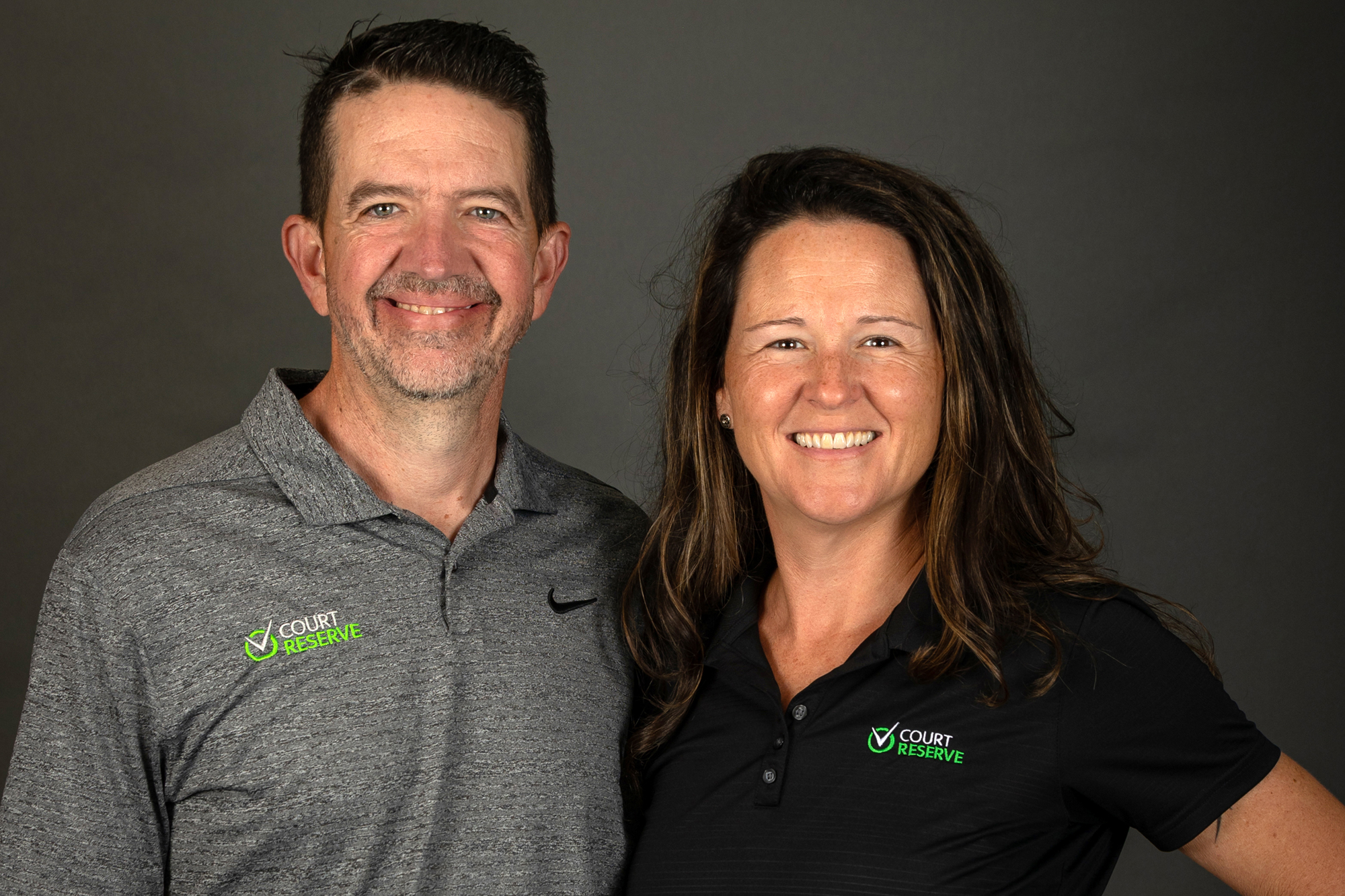
Ashley and Tim were recipients of one of our 2026 DUPR Golden Pickle Business Awards for their passion and growth of the sport of pickleball to over 2,220 clubs with their software technology. Proud of the success of CourtReserve, here’s my conversation with the dynamic husband and wife team, Ashley and Tim Owens.
A Conversation with Ashley and Tim Owens
CARL: When did you first feel pickleball would be part of the company‘s mission?
Ashley & Tim: “We started out as tennis players and instructors near Charlotte, North Carolina, and the whole reason CourtReserve exists is that we could never tell when the courts at our own club were free. So for the first few years, tennis was the entire focus.
Pickleball showed up the way it did everywhere else.
Members at the clubs we worked with started asking to tape lines on a court, then a few more, and before long those were the busiest hours on the schedule. Players wanted court time they could not find. Operators had courts sitting empty.
Nobody had an easy way to connect the two. Pretty quickly pickleball became a real part of where we were taking the product, without ever pushing tennis aside. It just made clear that the same gap shows up in every racquet sport, and we want to be the ones who close it.”
CARL: As a husband and wife team, how has the partnership carried from tennis into pickleball?
Ashley: “I live on the sales and marketing side, so most of my time goes into talking with operators and players. I want to hear what is actually working at a club and what is keeping an owner up at night, then carry that back to the team.”
Tim: “Before CourtReserve, I was a software developer, and Ashley and I were also teaching tennis at our local club outside Charlotte. So, I was in both worlds at once. We were getting more involved with the USTA and the wider tennis world around then, and it was striking how much of club life still ran on paper. That mix is really where CourtReserve came from.
The way Ashley and I split it has not changed since. She is out in the field hearing what clubs need, and I am usually the one figuring out how to build it.
Going from tennis to pickleball did not change that either. Tennis is still a huge part of the business, and more clubs are expanding to serve multiple racquet sports. Padel is the newest piece, and we build for all of it the same way.”

“The clubs that run tight, keep their courts full, and build a real community around the place will still be here in five years, thriving.” — Ashley Owens, Co-founder, CourtReserve
CARL: When did you identify the need in 2016 and fill the gap with tennis clubs?
Ashley & Tim: “By 2016, we had lived the problem ourselves, so building the fix felt obvious. Most clubs were still tracking court time on a whiteboard at the front desk, so the bar was not high.
The first version was simple: give a tennis club one place to manage courts, programs, and members, and give players an easy way to book.
We learned fast that the software was only half the problem. A lot of owners had never run this kind of business before and needed help figuring it out.
So from early on, we paired the product with hands-on support and education, walking owners through how to fill their courts and grow their programs. It is a big reason clubs stay with us, and we still work that way.”
CARL: Innovations from tennis into pickleball and the differences between pickleball-only and multi-racquet clubs?
Ashley & Tim: “The early work was all about flexibility. Tennis clubs run on reservations, lessons, and leagues, so we built around that first.
Pickleball brought a different rhythm. It runs on open play and drop-in sessions and a lot of social programming, and the software had to handle that without forcing a club into a tennis-shaped setup.
There are real differences between the two kinds of clubs. A pickleball-only facility tends to be high volume and very community driven, so things like open play management and clear member communication carry a lot of weight. A multi-racquet club has the harder job of sharing court time across sports that all want the same space at the same time. We have put a lot of work into letting one club run tennis, pickleball, and padel on the same system without anything colliding.
CARL: Biggest challenge to managing and growing your footprint?
Ashley & Tim: “The hardest part has been staying close to clubs while we grow. With over 2,300 clubs on the platform, no two run the same way.
A small community club and a large multi-sport facility need very different things, and the easy mistake when you scale is to force everyone into one rigid product. We have worked hard not to do that.
We spend most of our energy keeping the software flexible enough for very different operators, and making sure support stays strong as the club count climbs. We have held a customer satisfaction score in the mid-90s even as the club count has grown, and we are proud of that.”
CARL: The recent capital influx and the next three to five years?
Ashley & Tim: “We are coming up on our tenth year, so the timing of the investment felt right. It lets us do more of what clubs have asked us for, and move faster on it. Most of it goes straight back into the product and the team.
Over the next three to five years, we are focused on making the player experience as smooth as the operator side already is. When a club runs well on CourtReserve, the person just trying to book a court and show up should barely have to think about it.
We also want to keep helping clubs fill the hours that sit empty, because that open court time is still where most clubs are leaving money on the table.
The software itself gets smarter about this, too. As clubs do more on CourtReserve, the system gets better at spotting empty court time and suggesting ways to fill it.
Our first ten years were mostly about helping clubs run better. The next stretch is about connection. We want players to find an open court anywhere, not just at their home club, and we want clubs to reach players they could never find on their own. The whole industry is moving in that direction, and we plan to help lead it.”
CARL: Ashley, how important is it to network, meet clients, and share what works?
Ashley: “It is one of the most valuable things I do.
When I sit down with an operator and hear what is working, or where they are quietly losing money, I pick up things you only get from talking to people. I bring what I learn back to the team.
A lot of the mistakes I see in club management are common and avoidable, and the same goes for the things that work. If I can carry those lessons from one club to the next, I am doing my job.
That is also why education is such a big part of what we do as a company. The software is only half of it. Through our Catalyst User Conference and a deep library of training and resources, we spend a lot of energy teaching clubs how to actually grow the business.”

“Our first ten years were mostly about helping clubs run better. The next stretch is about connection. We want players to find an open court anywhere, not just at their home club.” — Ashley & Tim Owens, Co-founders, CourtReserve
CARL: Ashley, opening Old Coast Pickleball, lessons learned, and whether it is still a Wild West boom?
Ashley: “Opening Old Coast Pickleball in St. Augustine in 2024 put us in our own customers’ shoes. We are operators ourselves, with real skin in the game. We feel every decision the way our clubs do, from a slow Tuesday afternoon to staffing to a program that fills or flops. It has made us better at building software because we are living the same problems we are trying to solve.
On the market, I would not call it the Wild West anymore. The pure land-grab stretch is cooling off. We are seeing some operators close and some clubs come up for sale, and I do not think that is all bad. It means fundamentals matter again. The clubs that run tight, keep their courts full, and build a real community around the place will still be here in five years, thriving.”
CARL: Is CourtReserve working outside the USA, and what is the vision for global growth?
Ashley & Tim: “Racquet sports are clearly going global, and we feel the pull from outside the U.S. in the inbound interest we get.
Today, we are most focused on the U.S. and Canada, but we do have customers around the world. We would rather grow at a pace we can keep up with. We have watched other platforms in this space stretch themselves too thin, and their clubs usually pay for it.
The vision is simple enough. Wherever the sport grows, clubs are going to need a better way to manage courts and connect with players, and we want to be ready when that demand shows up.”
CARL: Does integrating several racquet sports under one roof work?
Ashley: “We are big believers in it. Think about a player who can play pickleball, hit on a tennis court, and experiment with padel, all at one club. With more to do, they stay longer and come back more often.
For the operator, running several sports means you’re not depending on any single one. Padel, tennis, and pickleball each pull a slightly different crowd, often at different times of day, so more hours of the day stay filled.
The honest catch is that running several sports well is harder than running one. Scheduling, programming, keeping members informed, it all gets more tangled the more sports you run. Our software is built to carry that. A well-run multi-sport club is a great place to play, and we expect more facilities to head that way.”
Looking Ahead
From managing reservations and leagues to creating thriving player communities, technology has become an essential part of the modern racquet sports experience. Ashley and Tim Owens have built CourtReserve by listening closely to club operators, adapting to changing needs, and remaining committed to helping facilities succeed rather than simply selling software.
While pickleball provided tremendous momentum for the company’s growth, their vision extends beyond a single sport. By supporting tennis, pickleball, padel, and other racquet sports on one platform, they are positioning CourtReserve for the next generation of club management.
Their philosophy remains remarkably simple: help clubs operate more efficiently, help players find more opportunities to play, and strengthen the communities that continue to fuel the growth of racquet sports around the world.
About Carl Foster
Carl Foster is the Chairman of the World Pickleball Conference and the CEO of Foster Events Group, LLC, where he specializes in the production and management of high-profile sports and entertainment events. With over 50 years of experience in broadcasting, fundraising, and event leadership, he produces Inside WORLD Pickleball and serves as a lead moderator for industry summits. He is a central figure in the professionalization of pickleball, connecting technology experts, organizational leadership, and the player community to elevate the sport’s presence on a global scale.

Read the full magazine issue! Click below, then click on the X in the lower bar to enjoy a full screen view!